

Tuesday, October 20, 2026
Science
No Result
View All Result
  • Login
  • HOME
  • SCIENCE NEWS
  • CONTACT US
  • HOME
  • SCIENCE NEWS
  • CONTACT US
No Result
View All Result
Scienmag
No Result
View All Result
Home Science News Cancer

Early tumor shrinkage associated with longer progression-free survival in measurable advanced gastric or gastroesophageal junction cancer

October 20, 2026
in Cancer
Nathaniel Bowman
By Nathaniel Bowman Scienmag Editorial Profile - Precision Oncology
Reading Time: 2 mins read
0
Early Tumor Shrinkage Predicts Longer Survival in Gastric Cancer Patients on Immunotherapy

Early Tumor Shrinkage Predicts Longer Survival in Gastric Cancer Patients on Immunotherapy

65
SHARES
587
VIEWS
Share on FacebookShare on Twitter
ADVERTISEMENT

The abstract of a retrospective single-center study reports that early tumor shrinkage (ETS) during first-line immune checkpoint inhibitor–based chemotherapy was associated with longer subsequent progression-free survival in patients with measurable unresectable advanced gastric or gastroesophageal junction adenocarcinoma. The analysis included 162 previously untreated patients who received first-line therapy between November 2021 and July 2025; 90 patients with measurable disease formed the ETS cohort.

ETS was defined as a reduction of at least 20% in the sum of target-lesion diameters at the first radiological assessment, evaluated under RECIST version 1.1. Among the 90 patients in the ETS cohort, 70, or 77.8%, experienced ETS. Best overall response was complete response in 11 patients (12.2%), partial response in 75 (83.3%), stable disease in two (2.2%) and progressive disease in two (2.2%), producing an objective response rate of 95.6%.

Because ETS was assessed after baseline, survival analyses used a fixed Day-90 landmark. At that landmark, ETS-positive patients had longer overall survival than ETS-negative patients, with a hazard ratio of 0.369 (95% confidence interval 0.181–0.752; p=0.006). They also had longer progression-free survival, with a hazard ratio of 0.395 (95% confidence interval 0.206–0.755; p=0.005). In the primary multivariable progression-free survival model, which included 84 patients and 51 events, ETS remained associated with favorable progression-free survival (hazard ratio 0.382, 95% confidence interval 0.197–0.740; p=0.004). A separate continuous analysis found a consistent association between the magnitude of tumor reduction and progression-free survival: the hazard ratio was 0.876 per 10-percentage-point greater reduction (95% confidence interval 0.777–0.987; p=0.030).

The findings indicate that ETS may be an on-treatment marker associated with early treatment sensitivity in this population, but the study does not establish clinical utility. Its retrospective, single-center design limits the strength and generalizability of the results, and the investigators stated that external validation is required. The reported associations also do not demonstrate that ETS causes longer survival. The available published abstract does not provide the full protocol, detailed model specification or other analyses needed for a complete assessment of the study.

Subject of Research: Association between early tumor shrinkage and progression-free survival during first-line immune checkpoint inhibitor–based chemotherapy in measurable advanced gastric or gastroesophageal junction cancer

Article Title: Early tumor shrinkage during first-line immune checkpoint inhibitor–based chemotherapy is associated with progression-free survival in measurable unresectable gastric cancer

Article References: Ushimaru, Y., Yamamoto, K., Omori, T., Kudo, T., Sakai, D., Yanagimoto, Y., Kawabata, R., Masuike, Y., Yamamoto, K., Fujikawa, K., Adachi, K., Matsuura, N., Momose, K., Kanemura, T., Sakano, Y., Kobayashi, Y., Kitakaze, M., Yokota, Y., Kubo, M., … Miyata, H. (2026). Early tumor shrinkage during first-line immune checkpoint inhibitor–based chemotherapy is associated with progression-free survival in measurable unresectable gastric cancer. BMC Cancer. https://doi.org/10.1186/s12885-026-17003-0

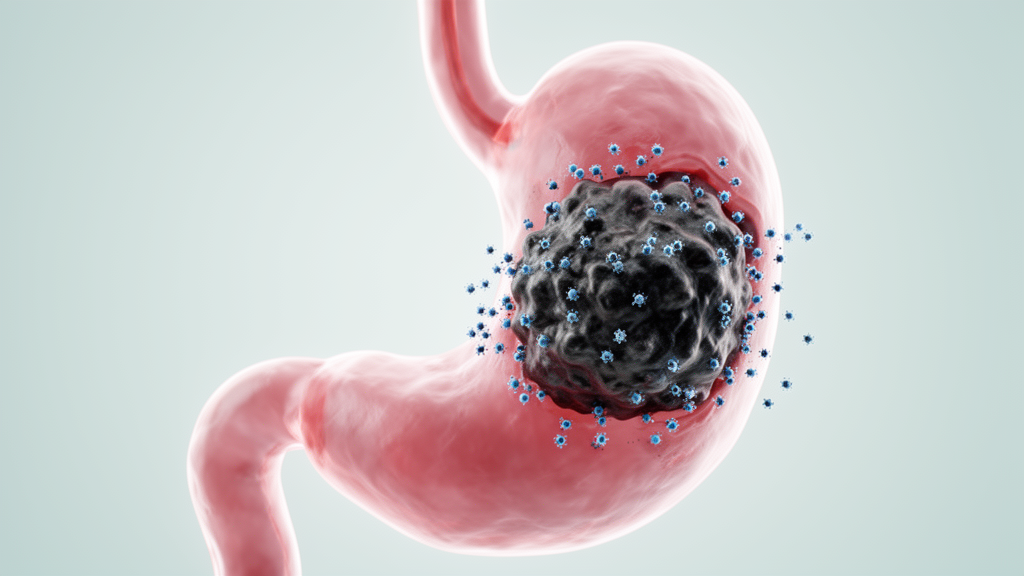
Image Credits: AI Generated

DOI: 10.1186/s12885-026-17003-0

Keywords: early tumor shrinkage, advanced gastric cancer, gastroesophageal junction cancer, immune checkpoint inhibitors, first-line chemotherapy, progression-free survival, overall survival, retrospective cohort study, RECIST 1.1, survival analysis, Early, tumor

Cite Scienmag News

Nathaniel Bowman. (October 20, 2026). Early tumor shrinkage associated with longer progression-free survival in measurable advanced gastric or gastroesophageal junction cancer. Scienmag. https://scienmag.com/early-tumor-shrinkage-associated-with-longer-progression-free-survival-in-measurable-advanced-gastric-or-gastroesophageal-junction-cancer/


Nathaniel Bowman. "Early tumor shrinkage associated with longer progression-free survival in measurable advanced gastric or gastroesophageal junction cancer." Scienmag, 20 October 2026, https://scienmag.com/early-tumor-shrinkage-associated-with-longer-progression-free-survival-in-measurable-advanced-gastric-or-gastroesophageal-junction-cancer/. Accessed 20 October 2026.

Nathaniel Bowman. "Early tumor shrinkage associated with longer progression-free survival in measurable advanced gastric or gastroesophageal junction cancer." Scienmag. October 20, 2026. https://scienmag.com/early-tumor-shrinkage-associated-with-longer-progression-free-survival-in-measurable-advanced-gastric-or-gastroesophageal-junction-cancer/

Tags: advanced gastric cancerearlyearly tumor shrinkagefirst-line chemotherapyfirst-line immunotherapy outcomesgastroesophageal junction cancerimmune checkpoint inhibitor chemotherapy gastric cancerimmune checkpoint inhibitorslandmark survival analysisobjective response rate gastric canceroverall survivalProgression-Free Survivalprogression-free survival gastric adenocarcinomaradiological tumor measurementRECIST 1.1RECIST 1.1 tumor response assessmentretrospective cohort studyretrospective study gastric cancersurvival analysistumortumor response and survival associationtumor response predictionunresectable advanced gastroesophageal junction cancer
Share26Tweet16
Previous Post

Questionnaire study associates healthcare professionals’ BPD knowledge with positive attitudes

Next Post

UVB photoprotection by thiourea and (thio)semicarbazone derivatives: cellular and molecular evidence

Related Posts

Gene Variant Doubles as Risk Marker and Drug Target in HPV-Linked Cervical Cancer
Cancer

MAPK1 variant linked to cervical disease in 300-person study; simulations predict stronger SCH772984 binding to mutant

October 20, 2026
Synthetic Immune Niche Supercharges T Cell Killing by Speeding Lethal Hits, Study Finds
Cancer

CCL21-ICAM1 synthetic niche accelerates lytic hit delivery by OT-I T cells against B16 melanoma in vitro

October 20, 2026
Fusing CT Scans Before and During Surgery Makes Radioactive Seed Dose Checks More Reliable
Cancer

CT co-registration yields more stable D90 verification in 30-patient retrospective lung cancer study

October 20, 2026
Major Trial Tests Drug and Precise Radiation Boost Against High-Risk Prostate Cancer
Cancer

Randomized phase III trial with a factorial design assessing the efficacy and safety of darolutamide and stereotactic dose-escalated radiotherapy in patients with high-risk localized prostate cancer: the PEACE 7 (GETUG-AFU 45) study protocol

October 20, 2026
METTL14 stabilizes FDX1 RNA and restrains clear cell kidney cancer
Cancer

METTL14 stabilizes FDX1 RNA and restrains clear cell kidney cancer

October 20, 2026
Simple Risk Score Could Catch Lung Cancer Earlier in Ethiopia
Cancer

Ethiopian case-control study yields internally validated lung cancer risk model

October 20, 2026
Next Post
Sulfur-Rich Small Molecules Show Powerful Defense Against Sun-Damaging UVB Light

UVB photoprotection by thiourea and (thio)semicarbazone derivatives: cellular and molecular evidence

  • Mothers who receive childcare support from maternal grandparents show more optimized

    Mothers who receive childcare support from maternal grandparents show more parental warmth, finds NTU Singapore study

    27656 shares
    Share 11059 Tweet 6912
  • University of Seville Breaks 120-Year-Old Mystery, Revises a Key Einstein Concept

    1061 shares
    Share 424 Tweet 265
  • Bee body mass, pathogens and local climate influence heat tolerance

    682 shares
    Share 273 Tweet 171
  • Researchers record first-ever images and data of a shark experiencing a boat strike

    546 shares
    Share 218 Tweet 137
  • Groundbreaking Clinical Trial Reveals Lubiprostone Enhances Kidney Function

    531 shares
    Share 212 Tweet 133
Science

Embark on a thrilling journey of discovery with Scienmag.com—your ultimate source for cutting-edge breakthroughs. Immerse yourself in a world where curiosity knows no limits and tomorrow’s possibilities become today’s reality!

RECENT NEWS

  • Work-life balance and wellbeing among teachers in Bangladesh: a reflexive thematic analysis of stress, coping, and institutional support
  • Observational survey analysis finds declining unmet home-visiting needs among disabled older adults in China
  • Review identifies shrinkage-control measures and prediction models for geopolymer composites
  • Qualitative systematic review identifies social-capital themes in healthcare AI implementation

Categories

  • Agriculture
  • Anthropology
  • Archaeology
  • Athmospheric
  • Biology
  • Biotechnology
  • Blog
  • Bussines
  • Cancer
  • Chemistry
  • Climate
  • Earth Science
  • Editorial Policy
  • Marine
  • Mathematics
  • Medicine
  • Pediatry
  • Policy
  • Psychology & Psychiatry
  • Science Education
  • Science News
  • Social Science
  • Space
  • Technology and Engineering

Subscribe to Blog via Email

Success! An email was just sent to confirm your subscription. Please find the email now and click 'Confirm Follow' to start subscribing.

Join 5,150 other subscribers

© 2025 Scienmag - Science Magazine

Welcome Back!

Login to your account below

Forgotten Password?

Retrieve your password

Please enter your username or email address to reset your password.

Log In
No Result
View All Result
  • HOME
  • SCIENCE NEWS
  • CONTACT US

© 2025 Scienmag - Science Magazine