


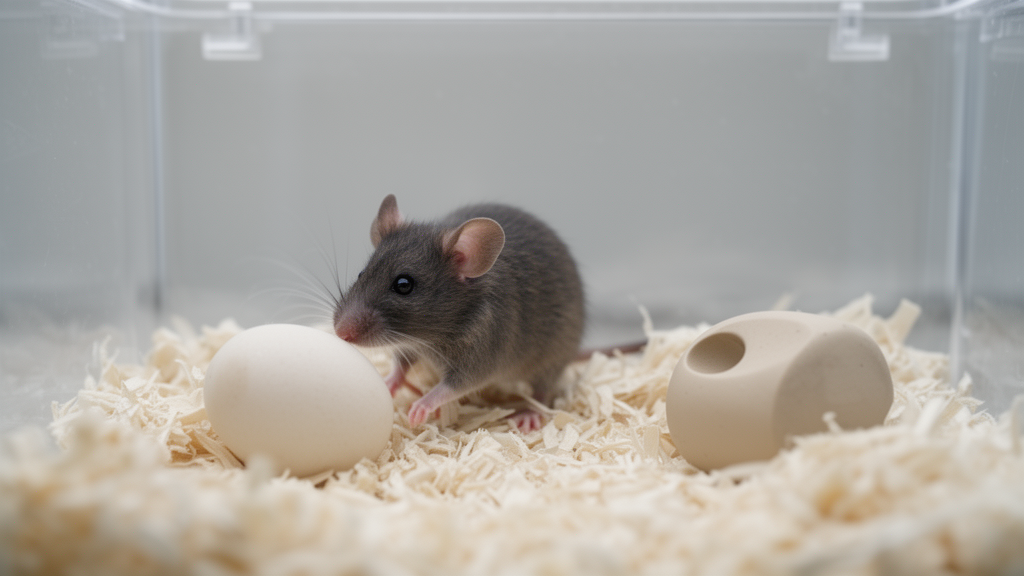
Researchers have developed an open-source platform called Operant House that automates operant conditioning tests in individually housed mice. The system detected significant working-memory deficits at five months of age in a knock-in mouse model carrying familial Alzheimer’s disease-associated amyloid precursor protein mutations, alongside subtle, spatially heterogeneous synaptic alterations in the prefrontal cortex.
Operant conditioning is a powerful method for probing cognitive functions, but its widespread use is constrained by low throughput, labor-intensive procedures and high costs. Operant House was designed to reduce experimenter intervention while allowing testing inside the home cage. The programmable device combines a touchscreen, retractable levers and a water-reward port, with live camera observation and recorded videos providing continuous monitoring of behavior. Because mice are individually housed, the researchers note that careful attention to animal welfare is required.
The team demonstrated the platform through two cognitive protocols. A delayed non-match-to-position test was used to assess working memory by requiring mice to remember the location of a stimulus across a delay. A two-choice spatial discrimination test addressed working-memory-related processes and behavioral flexibility. These tasks illustrate how Operant House can deliver automated operant conditioning with minimal experimenter intervention rather than relying on manually conducted procedures.
When applied to the familial Alzheimer’s model, the delayed non-match-to-position protocol revealed significant working-memory deficits as early as five months of age. At this stage, the researchers also detected subtle and spatially heterogeneous synaptic changes in the prefrontal cortex. Conventional electrophysiological measures were largely preserved at the same age, showing that the automated behavioral and synaptic observations occurred alongside electrophysiological findings that did not show comparable changes.
The study is a proof of concept centered on automated testing of higher cognitive functions in mice. Its results demonstrate the platform’s use for detecting behavioral and prefrontal synaptic differences in a familial Alzheimer’s disease model; they do not establish clinical benefits in people or show that the observed age of onset applies to humans. The findings also underscore the welfare requirements associated with individual home-cage testing. By combining programmed conditioning tasks with continuous video monitoring, Operant House offers a cost-effective and scalable platform for studying learning and higher cognition in mouse disease models.
Subject of Research: Automated home-cage operant testing of working memory in a familial Alzheimer’s disease mouse model
Article Title: Operant House: A versatile open-source platform for automated operant conditioning testing of mice in home cages
Article References: Otsuka, S., Nakamura, Y., Ito-Ishida, A., Suzuki, K., Ishikawa, A., Matsuda, K., Suyama, S., Contractor, A., & Yuzaki, M. (2026). Operant House: A versatile open-source platform for automated operant conditioning testing of mice in home cages. PLOS One, 21(10), e0360626. https://doi.org/10.1371/journal.pone.0360626
Image Credits: AI Generated
DOI: 10.1371/journal.pone.0360626
Keywords: operant conditioning, home cage, touchscreen testing, working memory, Alzheimer’s disease, mouse model, prefrontal cortex, synaptic alterations, automated behavior, open-source platform, Operant, House
Cite Scienmag News
Diana Fleming. (October 20, 2026). Home-cage testing finds early memory deficits in Alzheimer’s mouse model. Scienmag. https://scienmag.com/home-cage-testing-finds-early-memory-deficits-in-alzheimers-mouse-model/
Diana Fleming. "Home-cage testing finds early memory deficits in Alzheimer’s mouse model." Scienmag, 20 October 2026, https://scienmag.com/home-cage-testing-finds-early-memory-deficits-in-alzheimers-mouse-model/. Accessed 20 October 2026.
Diana Fleming. "Home-cage testing finds early memory deficits in Alzheimer’s mouse model." Scienmag. October 20, 2026. https://scienmag.com/home-cage-testing-finds-early-memory-deficits-in-alzheimers-mouse-model/


