

Tuesday, October 20, 2026
Science
No Result
View All Result
  • Login
  • HOME
  • SCIENCE NEWS
  • CONTACT US
  • HOME
  • SCIENCE NEWS
  • CONTACT US
No Result
View All Result
Scienmag
No Result
View All Result
Home Science News Earth Science

Midwest soil carbon monitoring requires deeper sampling, study finds

October 20, 2026
in Earth Science
Alan Morgan
By Alan Morgan Scienmag Editorial Profile - Precision Agriculture
Reading Time: 2 mins read
0
Midwest soil carbon monitoring requires deeper sampling, study finds

Midwest soil carbon monitoring requires deeper sampling, study finds

65
SHARES
587
VIEWS
Share on FacebookShare on Twitter
ADVERTISEMENT

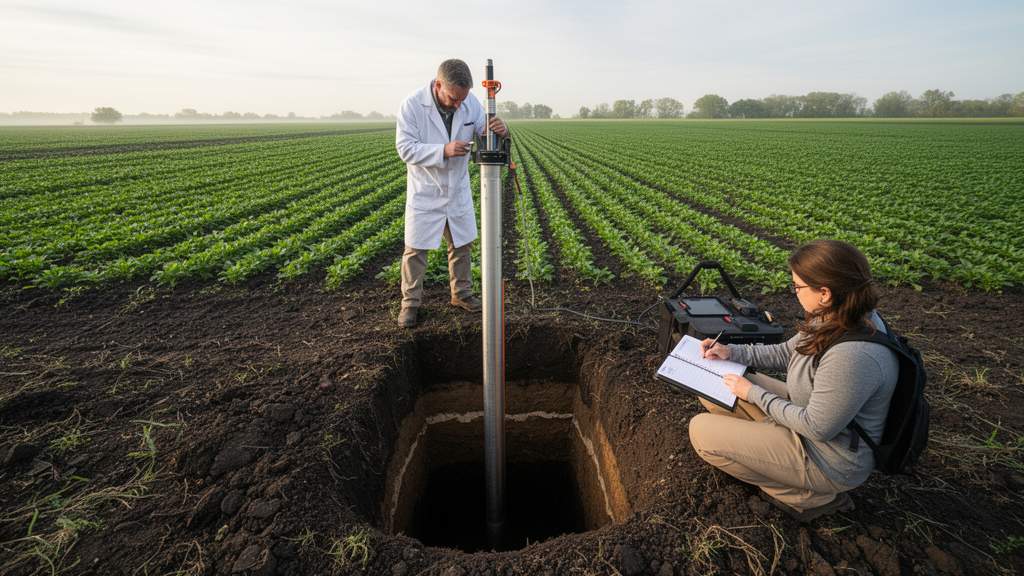
Soil organic carbon changes in long-term Midwest agricultural fields can differ sharply with sampling depth and carbon fraction, according to an analysis of archived soils from three field trials. In the study, permanganate oxidizable carbon, or POXC, consistently tracked gains and losses in total soil organic carbon more closely than particulate organic carbon, mineral-associated organic carbon or mineralizable carbon. Extending sampling below the surface also revealed larger changes than measurements limited to topsoil captured.

The researchers analyzed samples from two long-term Nebraska experiments that compared crop-residue removal with retention in continuous corn, lasting 10 and 19 years, respectively. A third experiment, conducted for nine years at the Great Lakes Bioenergy Research Center, compared continuous corn with perennial switchgrass. These agricultural trials provided soil samples spanning multiple depths, allowing the team to examine whether surface measurements alone captured the carbon trajectories observed across the soil profile.

At the 19-year Nebraska site, increasing plant inputs through residue retention enhanced total soil organic carbon, particularly in surface soils. The depth pattern also differed at the Great Lakes Bioenergy Research Center. Surface soil organic carbon declined under corn, while switchgrass exhibited losses through the whole soil profile. These contrasting observations demonstrate how a restricted sampling depth can change the apparent distribution of carbon beneath agricultural land. They do not, by themselves, establish an overall performance ranking for corn and switchgrass.

The carbon fractions showed distinct responses across sites. Particulate organic carbon varied, mineral-associated organic carbon changed minimally, and mineralizable carbon often declined. Total soil organic carbon did not move in parallel with every measured fraction, so increases or decreases in one component could not be used as a direct proxy for the entire carbon stock. At both Nebraska experiments, POXC more closely followed changes in total soil organic carbon than particulate organic carbon, mineral-associated organic carbon or mineralizable carbon did.

These results support a combined approach to carbon monitoring in the studied systems: sample across multiple depths, track total soil organic carbon and examine more than one fraction or soil-health metric. POXC emerged as the most reliable indicator of overall gains and losses in this dataset, but the evidence comes from three Midwest trials with different crops, durations and management conditions. The findings therefore identify POXC as a promising metric for carbon-focused monitoring while showing why deeper and fraction-specific measurements remain important for accurately describing soil-carbon trajectories.

Subject of Research: Soil organic carbon monitoring across depths and fractions in long-term Midwest agricultural trials

Article Title: Tracking soil organic carbon trajectories: depth and fractions matter for carbon monitoring in US midwestern long-term no-tilled systems

Article References: Naasko, K., Smychkovich, A., Mahmood, S., Lin, Y., Lavallee, J. M., Córdova, S. C., Schmer, M. R., & Sprunger, C. D. (2026). Tracking soil organic carbon trajectories: depth and fractions matter for carbon monitoring in US midwestern long-term no-tilled systems. Biogeochemistry. https://doi.org/10.1007/s10533-026-01382-4

Image Credits: AI Generated

DOI: 10.1007/s10533-026-01382-4

Keywords: soil organic carbon, carbon monitoring, soil depth, POXC, particulate organic carbon, mineral-associated organic carbon, no-till agriculture, corn systems, switchgrass, Midwest agriculture, Tracking, soil

Cite Scienmag News

Alan Morgan. (October 20, 2026). Midwest soil carbon monitoring requires deeper sampling, study finds. Scienmag. https://scienmag.com/midwest-soil-carbon-monitoring-requires-deeper-sampling-study-finds/

Alan Morgan. "Midwest soil carbon monitoring requires deeper sampling, study finds." Scienmag, 20 October 2026, https://scienmag.com/midwest-soil-carbon-monitoring-requires-deeper-sampling-study-finds/. Accessed 20 October 2026.

Alan Morgan. "Midwest soil carbon monitoring requires deeper sampling, study finds." Scienmag. October 20, 2026. https://scienmag.com/midwest-soil-carbon-monitoring-requires-deeper-sampling-study-finds/


Tags: carbon monitoringcorn systemscrop residue impact on soil carbondeep soil sampling for carbon assessmenteffects of crop management on soil carbon storagelong-term agricultural soil studiesMidwest agricultureMidwest soil carbon monitoringmineral-associated organic carbonno-till agricultureparticulate organic carbonperennial switchgrass versus corn soil carbonpermanganate oxidizable carbon (POXC) as soil health indicatorPOXCsoilsoil carbon fraction analysissoil depthsoil organic carbonsoil organic carbon changessoil organic carbon monitoring methodssoil profile analysis in agricultural trialssoil sampling depth importanceswitchgrassTracking
Share26Tweet16
Previous Post

Coconut frond biochar reveals a temperature trade-off between carbon recovery and stability

Next Post

Soybean seed pigmentation is associated with oil and lipid differences

Related Posts

Aquila-optimized XGBoost improves reinforced subgrade strength predictions
Earth Science

Aquila-optimized XGBoost improves reinforced subgrade strength predictions

October 20, 2026
Hybrid AI model nears perfect oil-presence prediction in synthetic reservoirs
Earth Science

Hybrid AI model nears perfect oil-presence prediction in synthetic reservoirs

October 20, 2026
Review maps limits of biological PCB soil remediation at field scale
Earth Science

Review maps limits of biological PCB soil remediation at field scale

October 20, 2026
Editorial reviews five coastal-monitoring approaches for management decisions
Earth Science

Editorial reviews five coastal-monitoring approaches for management decisions

October 20, 2026
Physics-informed deep learning forecasts marine oil spill growth and spread
Earth Science

Physics-informed deep learning forecasts marine oil spill growth and spread

October 20, 2026
Research report: Spatio-temporal distribution of microplastics in the protected transboundary Thaya/Dyje River (Central Europe): implications of hydrological connectivity for microplastic monitoring
Earth Science

Research report: Spatio-temporal distribution of microplastics in the protected transboundary Thaya/Dyje River (Central Europe): implications of hydrological connectivity for microplastic monitoring

October 20, 2026
Next Post
Soybean seed pigmentation is associated with oil and lipid differences

Soybean seed pigmentation is associated with oil and lipid differences

  • Mothers who receive childcare support from maternal grandparents show more optimized

    Mothers who receive childcare support from maternal grandparents show more parental warmth, finds NTU Singapore study

    27656 shares
    Share 11059 Tweet 6912
  • University of Seville Breaks 120-Year-Old Mystery, Revises a Key Einstein Concept

    1061 shares
    Share 424 Tweet 265
  • Bee body mass, pathogens and local climate influence heat tolerance

    682 shares
    Share 273 Tweet 171
  • Researchers record first-ever images and data of a shark experiencing a boat strike

    546 shares
    Share 218 Tweet 137
  • Groundbreaking Clinical Trial Reveals Lubiprostone Enhances Kidney Function

    531 shares
    Share 212 Tweet 133
Science

Embark on a thrilling journey of discovery with Scienmag.com—your ultimate source for cutting-edge breakthroughs. Immerse yourself in a world where curiosity knows no limits and tomorrow’s possibilities become today’s reality!

RECENT NEWS

  • Soybean seed pigmentation is associated with oil and lipid differences
  • Midwest soil carbon monitoring requires deeper sampling, study finds
  • Coconut frond biochar reveals a temperature trade-off between carbon recovery and stability
  • Dusty mining jobs linked to higher pneumoconiosis prevalence in US miners

Categories

  • Agriculture
  • Anthropology
  • Archaeology
  • Athmospheric
  • Biology
  • Biotechnology
  • Blog
  • Bussines
  • Cancer
  • Chemistry
  • Climate
  • Earth Science
  • Editorial Policy
  • Marine
  • Mathematics
  • Medicine
  • Pediatry
  • Policy
  • Psychology & Psychiatry
  • Science Education
  • Science News
  • Social Science
  • Space
  • Technology and Engineering

Subscribe to Blog via Email

Enter your email address to subscribe to this blog and receive notifications of new posts by email.

Join 5,150 other subscribers

© 2025 Scienmag - Science Magazine

Welcome Back!

Login to your account below

Forgotten Password?

Retrieve your password

Please enter your username or email address to reset your password.

Log In
No Result
View All Result
  • HOME
  • SCIENCE NEWS
  • CONTACT US

© 2025 Scienmag - Science Magazine

Discover more from Science

Subscribe now to keep reading and get access to the full archive.

Continue reading