


Microplastics in the protected Thaya/Dyje River did not accumulate steadily downstream, instead shifting between low and high concentrations as flow conditions changed across two field campaigns. Researchers sampled a 30 km reach within the transboundary Thayatal/Podyjí National Park in Central Europe and found that the relationship between local flow velocity and particle concentration reversed between November 2024 and July 2025. The result indicates that a single surface-water snapshot can conceal substantial hydrological and spatial variability in riverine microplastic pollution.
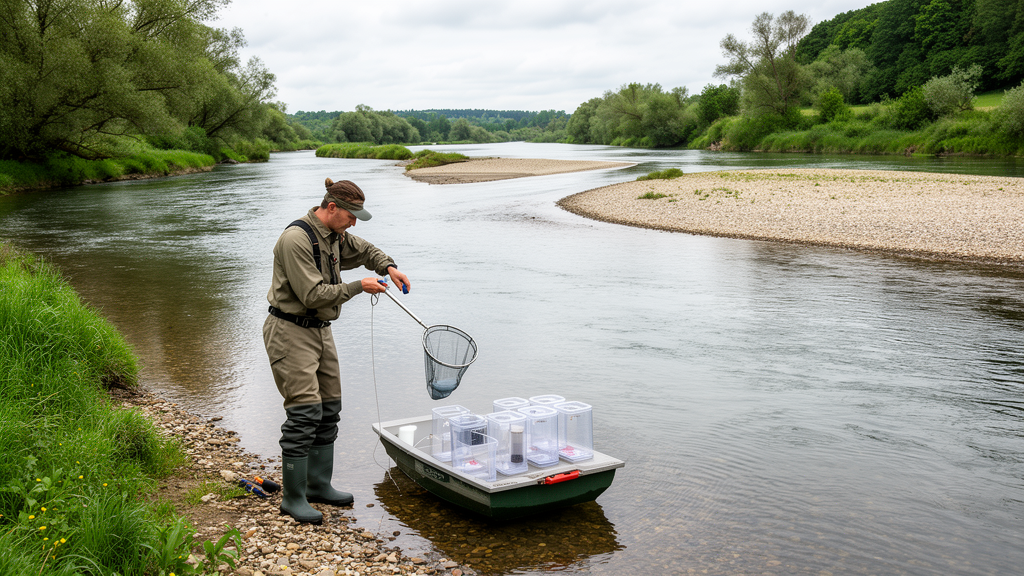
The study, published in Frontiers in Environmental Science in 2026, was the first comprehensive microplastic assessment of the protected river reach. Investigators collected 35 large-volume water samples, each averaging about 5 cubic metres, from the Thaya/Dyje and two tributaries. The November campaign included 20 samples and the July campaign included 15, with sampling distributed along the river, across its width and, where depth allowed, near the bed.
In total, approximately 171 cubic metres of water passed through a plankton net with a 150-micrometre mesh. Concentrations were relatively low across the study area but ranged widely, from 1.09 to 22.66 microplastic particles per cubic metre. Average surface-water concentration in the main river was 8.18 ± 5.32 particles per cubic metre, while concentrations in the Fugnitz and Kaja tributaries averaged 3.14 ± 0.94 particles per cubic metre.
Fibres made up 56.22% of the particles, followed by fragments at 32.71% and films at 10.09%. Polyamide and polyester were the most frequent polymer categories, each accounting for nearly one-fifth of the total. The findings provide a baseline for a protected river system that remains connected to surrounding catchments and potentially receives microplastics from upstream human activities.
Spatial sampling revealed that the river’s main channel, banks and bed could tell different pollution stories. In November 2024, mean surface concentrations generally decreased downstream, from 12.68 ± 6.58 particles per cubic metre near Vranov to 4.38 ± 3.45 particles per cubic metre at the downstream Lipinská bridge. In July 2025, the pattern instead rose downstream: concentrations reached 5.04 ± 3.91 particles per cubic metre at the Hamerská bridge, 8.00 ± 1.45 after Hardegg and 11.35 after the Kaja junction.
The highest individual value, 22.66 particles per cubic metre, occurred in a low-velocity inner bend, while another peak of 20.14 particles per cubic metre was also recorded near an inner bend. These observations describe spatial and temporal differences; they do not demonstrate a single, persistent downstream trend. Flow velocity showed opposite relationships with concentration in the two campaigns.
In November, microplastic concentrations increased as velocity decreased, a pattern consistent with enhanced retention under reduced flow energy. The linear relationship explained 37% of the variation, with a Spearman correlation of −0.69. By July, concentrations instead rose with increasing velocity; the linear relationship explained 40% of the variation, and the monotonic correlation was positive at 0.59, although its p-value was 0.056.
A multiple-regression model containing an interaction between flow velocity and campaign performed better than an additive model, with an adjusted R² of 0.325 and a significant interaction term of p = 0.014. The authors interpreted this reversal primarily as a response to hydrological context and antecedent flow history rather than as a standalone seasonal effect. The contrast was consistent with the river’s recent history.
The November campaign followed an exceptional flood approximately six weeks earlier, while July brought generally lower and more stable discharge interrupted by occasional pulse releases associated with the upstream Vranov Dam. The flood could have expanded catchment-scale connectivity and mobilized stored sediments and associated particles, whereas summer pulses may have resuspended material temporarily stored within the regulated channel. Between October 2024 and September 2025, discharge at the Vranov–Hamry gauging station ranged from 3.26 to 30.3 cubic metres per second, underscoring the dynamic environment in which the particles moved.
Average discharge during the week before and after sampling was 6.33 ± 1.45 cubic metres per second in November and 4.50 ± 2.03 in July, based on hourly data. Discharge data offered a possible but less certain explanation for the combined observations. Across eight centre-channel samples, travel-time-corrected 10-minute discharge had a moderate positive linear relationship with concentration, explaining 51% of the variation.
However, the result depended strongly on the single highest-discharge July observation. Removing it left a similar estimated slope but reduced the explained variation to 21% and made the relationship statistically non-significant. The dataset also excluded the Czech Klaperův and Lukov creeks because they were dry during both campaigns, and tributary samples were omitted from formal regression models because the dataset was small, uneven and lacked complete discharge information.
Without tributary-specific flow data, the contribution of the Fugnitz and Kaja could not be quantified as particle fluxes. Local channel structure appeared to influence where denser particles were retained. Although meander position did not significantly alter total concentration, elevated readings at low-velocity bends suggest that incomplete lateral mixing and local retention can produce hotspots.
The findings also show why centre-channel sampling alone is insufficient: in July, near-bed concentrations at the Hamerská bridge ranged from 1.19 to 3.20 particles per cubic metre, below the local surface-water value, while a near-bed sample after the Kaja junction reached 8.46 particles per cubic metre compared with 11.35 at the surface. The study did not establish that channel structure influenced particle size. Quality-control results support the relative reliability of the measurements in this low-contamination setting.
Across 22 blank samples, field contamination was negligible, and all environmental results were corrected using measured blank contamination. Recovery averaged 87.3% for polyethylene spherules and 75.2% for low-density polyethylene fragments, with an overall recovery of 83.2% across six spiked samples. Analysing one-quarter of each filter recovered 25.9% of polyethylene microspheres, consistent with the proportion examined.
Thin fibres were recovered less efficiently, however, so the reported fibre concentrations primarily represent the size range retained by the combined 150-micrometre field mesh and laboratory procedure rather than the complete environmental fibre population. The authors also used non-synthetic clothing, glassware, filtered solutions and laminar-flow cabinets to reduce contamination during laboratory work. The results establish a baseline for microplastic monitoring in a protected freshwater system, but they also define limits on what the two campaigns can establish.
The observations are snapshots and cannot fully capture short-lived events such as storms, dam releases or rapid discharge changes. Discharge was reconstructed from gauges about 10 km apart rather than measured directly at every sampling point, and the restricted range of channel forms limited analysis of geomorphological controls. Sediments upstream of the Vranov Dam and within its reservoir were not sampled, leaving the potential long-term storage of microplastics unresolved.
The study also did not independently quantify connectivity or directly compare microplastic transport with natural sediment transport. The authors therefore treat hydrological connectivity as an interpretive framework involving transport, temporary storage, remobilization and incomplete mixing, rather than as a quantity independently measured by the particles themselves.
Subject of Research: Microplastic transport and hydrological variability in a protected transboundary river
Article Title: Spatio-temporal distribution of microplastics in the protected transboundary Thaya/Dyje River (Central Europe): implications of hydrological connectivity for microplastic monitoring
Article References: Roudbar, S., Young, R., Poeppl, R., Le Heron, D., & Wagreich, M. (2026). Spatio-temporal distribution of microplastics in the protected transboundary Thaya/Dyje River (Central Europe): implications of hydrological connectivity for microplastic monitoring. Frontiers in Environmental Science, 14, Article 1946645. https://doi.org/10.3389/fenvs.2026.1946645
Image Credits: AI Generated
DOI: 10.3389/fenvs.2026.1946645
Keywords: microplastics, river monitoring, hydrological connectivity, Thaya/Dyje River, flow velocity, large-volume sampling, particle remobilization, national park, environmental baseline, spatial variability, Spatio-temporal, distribution
Cite Scienmag News
Violet Maxwell. (October 20, 2026). Research report: Spatio-temporal distribution of microplastics in the protected transboundary Thaya/Dyje River (Central Europe): implications of hydrological connectivity for microplastic monitoring. Scienmag. https://scienmag.com/research-report-spatio-temporal-distribution-of-microplastics-in-the-protected-transboundary-thaya-dyje-river-central-europe-implications-of-hydrological-connectivity-for-microplastic-monitoring/
Violet Maxwell. "Research report: Spatio-temporal distribution of microplastics in the protected transboundary Thaya/Dyje River (Central Europe): implications of hydrological connectivity for microplastic monitoring." Scienmag, 20 October 2026, https://scienmag.com/research-report-spatio-temporal-distribution-of-microplastics-in-the-protected-transboundary-thaya-dyje-river-central-europe-implications-of-hydrological-connectivity-for-microplastic-monitoring/. Accessed 20 October 2026.
Violet Maxwell. "Research report: Spatio-temporal distribution of microplastics in the protected transboundary Thaya/Dyje River (Central Europe): implications of hydrological connectivity for microplastic monitoring." Scienmag. October 20, 2026. https://scienmag.com/research-report-spatio-temporal-distribution-of-microplastics-in-the-protected-transboundary-thaya-dyje-river-central-europe-implications-of-hydrological-connectivity-for-microplastic-monitoring/


