


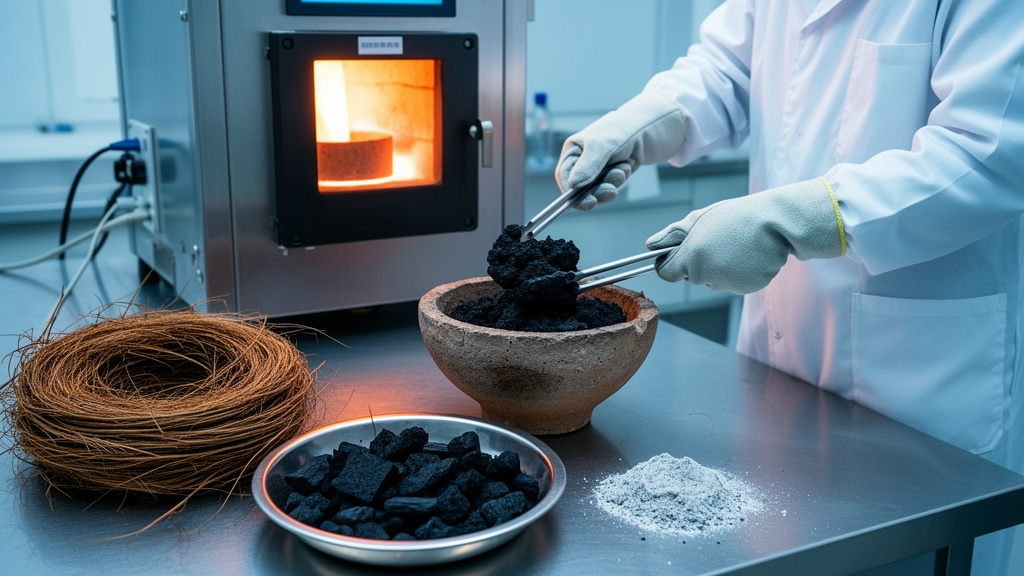
Pyrolyzing coconut fronds at 550 °C produced a biochar with the highest carbon concentration, largest measured pore surface and lowest apparent carbon mineralization during a 90-day soil incubation, while pyrolysis at 350 °C retained the greatest amount of feedstock carbon in the solid product. The laboratory study shows that hotter conversion creates a more structurally ordered and energy-dense material, but it also lowers biochar yield and transfers more of the frond’s original carbon into gases and other products. The results point to a practical trade-off rather than a universally optimal temperature: 350 °C maximized carbon and nutrient recovery, whereas 550 °C favored surface development, fuel quality, structural recalcitrance and lower short-term mineralization in the tested soil.
The researchers collected coconut fronds from a cultivation field at the College of Agriculture, V.C. Farm, in Mandya district, India. After sun-drying, chopping the material into pieces of approximately 0.51.0 cm and oven-drying it at 105 °C for 12 hours, they pyrolyzed the feedstock in an electric reactor under oxygen-limited conditions. The experimental treatments were 350, 450 and 550 °C, each held for two hours with a heating rate of 10 °C per minute under nitrogen. A conventionally carbonized biochar, designated BCTrad, was prepared separately using a mud-covered heap method; its temperature was not measured directly but was estimated from process characteristics and comparable systems to be about 400430 °C. Coconut frond feedstock contained 46.2% carbon, 72.5% volatile matter, 16.8% fixed carbon and 10.7% ash.
Temperature changed both the amount and the character of the solid biochar. BC350 had the highest yield at 59.90%, compared with 34.65% for BC450, 29.04% for BC550 and 33.50% for BCTrad. It also retained 2.92 kg of carbon from an initial approximately 3.69 kg, corresponding to 78.91% carbon recovery. The corresponding recovery values were 52.61% at 450 °C, 45.86% at 550 °C and 41.08% for the traditional material. Nitrogen recovery followed the same broad pattern, falling from 51.52% at 350 °C to 23.04% at 450 °C and 14.52% at 550 °C. These figures distinguish carbon concentration from total carbon recovery: BC550 was more carbon-rich, but BC350 contained more carbon because much more of the original frond remained in the solid product.
At the same time, higher temperatures produced a progressively carbonized material. Carbon concentration rose to 72.97% in BC550, while fixed carbon increased from 45.55% in BCTrad to 65.82% in BC550. The thermostable fraction expanded from 59.85% in BCTrad to 80.99% in BC550, and ash rose as organic constituents were lost and inorganic material became relatively concentrated. The atomic hydrogen-to-carbon ratio declined from 1.015 in BC350 to 0.664 in BC450 and 0.536 in BC550, while atomic oxygen-to-carbon fell from 0.222 to 0.098 and 0.060. These transformations are consistent with progressive devolatilization, deoxygenation and aromatic condensation rather than simple dilution of otherwise unchanged material.
Structural measurements reinforced that interpretation. Nitrogen adsorption analysis showed that BET surface area increased from 4.45 m² g⁻¹ in BCTrad to 5.62 m² g⁻¹ in BC350, 6.71 m² g⁻¹ in BC450 and 16.67 m² g⁻¹ in BC550. Total pore volume rose from 0.014 to 0.024 cm³ g⁻¹ on the BET analysis, while average BJH pore diameter narrowed from 12.40 nm at 350 °C to 5.79 nm at 550 °C. FTIR spectra showed progressive depletion of hydroxyl, aliphatic and oxygen-containing bands, with most oxygenated features nearly absent in BC550. Raman spectroscopy recorded a declining disorder ratio, with the reported ID/IG value falling from 1.28 in BCTrad to 0.80 in BC550, while X-ray diffraction showed a broad carbon reflection becoming sharper and shifting toward higher angles. Together, the methods indicated more condensed aromatic carbon and a more developed pore network at higher temperatures.
Physical and chemical properties also changed markedly. BC550 had the lowest bulk density, at 0.34 g cm⁻³, the highest total porosity, at 70.50%, and the greatest water-holding capacity, at 298.64%. Its pH reached 9.55, compared with 8.54 for BC350, while electrical conductivity rose from 1.35 to 1.74 dS m⁻¹ and total dissolved solids increased from 845.57 to 1,040.40 mg L⁻¹. Cation exchange capacity also increased from 22.84 cmol(+) kg⁻¹ in BC350 to 29.12 cmol(+) kg⁻¹ in BC550. Although loss of oxygen-containing functional groups might be expected to reduce exchange sites, the measured increase was associated with higher pH, greater surface area and enrichment of mineral constituents. These are measured material characteristics, not demonstrated improvements in crop yield or soil fertility, which were not tested in field trials.
The biochars also became progressively better suited to combustion as fuel quality indicators. Estimated higher heating value increased from 20.72 MJ kg⁻¹ in BCTrad to 21.73 MJ kg⁻¹ in BC350, 23.63 MJ kg⁻¹ in BC450 and 25.56 MJ kg⁻¹ in BC550. The fuel ratio, defined as fixed carbon divided by volatile matter, rose from 1.49 to 4.26 across the same sequence. Energy densification reached 1.49 at 550 °C, compared with 1.21 for the traditional biochar. Yet 350 °C produced the strongest overall recovery of feedstock energy, with an energy retention efficiency of 75.86%, versus 47.73% at 450 °C and 43.26% at 550 °C. The higher-temperature product therefore contained more energy per kilogram, while the lower-temperature product retained more of the frond’s original energy in solid form.
Carbon persistence was evaluated through three distinct approaches that produced complementary, but not identical, results. BC350 had the highest total pyrogenic carbon, at 0.29 kg C per kg of feedstock, and the highest screening-level stable-carbon retention estimate, at 0.86 kg CO² per kg of feedstock. That estimate used a fixed assumption that 80% of pyrogenic carbon would be stable and did not adjust it for treatment-specific persistence. The model-derived BC+100 index instead rose to 0.72 for BC550, compared with 0.42 for BC350, and estimated mean residence time increased to 371.29 years, compared with 221.31 years for BC350. These are empirical model outputs, not direct measurements of centuries-long soil storage. In the 90-day incubation, by contrast, cumulative CO²-C release was lowest for BC550 among the biochars.
For the incubation, the team applied seven amendments to neutral red sandy clay loam Alfisol at 1% by weight: unamended soil, farmyard manure, vermicompost, BCTrad, BC350, BC450 and BC550. Each treatment had three independent jars, maintained at 60% of water-holding capacity and 25 ± 2 °C for 90 days. Carbon dioxide was trapped in sodium hydroxide and quantified by back-titration. Cumulative CO²-C release was 1,041.2 mg kg⁻¹ soil for BCTrad, 1,020.9 mg kg⁻¹ for BC350, 943.1 mg kg⁻¹ for BC450 and 746.1 mg kg⁻¹ for BC550, versus 669.2 mg kg⁻¹ for the control. BC550’s apparent net increase above the control was 76.9 mg kg⁻¹ and was not statistically distinguishable from the control, whereas the other biochars produced significant increases. A repeated-measures mixed-effects model confirmed significant effects of treatment, time and their interaction.
The incubation result must be interpreted cautiously because measured CO²-C represented total soil respiration. Without isotope-based partitioning, the researchers could not separate mineralization of native soil organic carbon, carbon derived from the amendment, possible priming effects and other contributions. A constant-temperature incubation of one soil over 90 days also cannot reproduce field conditions involving changing moisture, temperature, microbial communities, soil mineralogy, pore occlusion and biochar ageing. Moreover, each pyrolysis temperature was represented by a single production batch, and the five measurements used to characterize each batch were analytical subsamples rather than independent production replicates. The pyrolysis results are therefore descriptive patterns, not statistically proven treatment effects. Within those limits, the study shows a clear temperature-dependent trade-off: lower-temperature biochar retained more carbon and nutrients, while higher-temperature biochar developed a more ordered, porous and energy-dense structure with lower apparent short-term mineralization. Field studies, longer incubations, isotope tracing and life-cycle assessment will be needed to determine how those laboratory advantages translate into durable carbon storage, practical soil amendment performance and net climate benefits.
Subject of Research: Effects of pyrolysis temperature on carbon recovery, physicochemical properties and short-term mineralization of coconut-frond biochar
Article Title: Temperature-directed valorisation of coconut frond through pyrolysis for carbon sequestration and sustainable agricultural residue management
Article References: Sachin, M. L., Boregowda, Y. S., Thimmegowda, M. N., Ananthakumar, M. A., Fathima, P. S., Sunil, C. M., Pravalika, K. M., Anjali, M. C., Sathisha, G. S., Divya, B., Shruthi, M. K., Onte, S., & Kumar, S. (2026). Temperature-directed valorisation of coconut frond through pyrolysis for carbon sequestration and sustainable agricultural residue management. Frontiers in Sustainable Food Systems, 10, Article 1966170. https://doi.org/10.3389/fsufs.2026.1966170
Image Credits: AI Generated
DOI: 10.3389/fsufs.2026.1966170
Keywords: coconut fronds, biochar, pyrolysis temperature, carbon recovery, carbon stabilization, soil incubation, biofuel properties, agricultural residues, porosity, carbon mineralization, Temperature-directed, valorisation
Cite Scienmag News
Alan Morgan. (October 20, 2026). Coconut frond biochar reveals a temperature trade-off between carbon recovery and stability. Scienmag. https://scienmag.com/coconut-frond-biochar-reveals-a-temperature-trade-off-between-carbon-recovery-and-stability/
Alan Morgan. "Coconut frond biochar reveals a temperature trade-off between carbon recovery and stability." Scienmag, 20 October 2026, https://scienmag.com/coconut-frond-biochar-reveals-a-temperature-trade-off-between-carbon-recovery-and-stability/. Accessed 20 October 2026.
Alan Morgan. "Coconut frond biochar reveals a temperature trade-off between carbon recovery and stability." Scienmag. October 20, 2026. https://scienmag.com/coconut-frond-biochar-reveals-a-temperature-trade-off-between-carbon-recovery-and-stability/


