


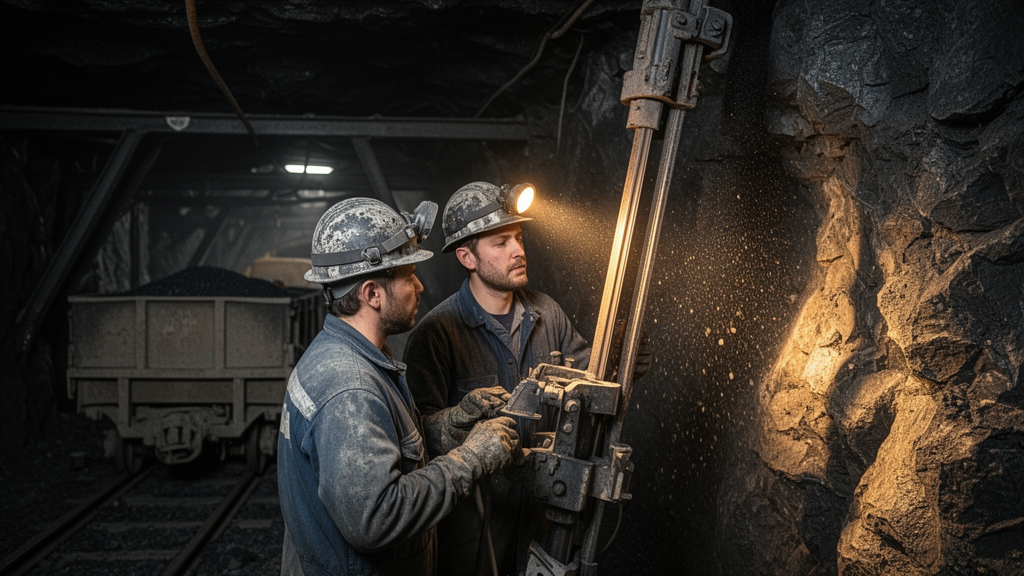
An observational analysis of 30,319 working underground coal miners found that continuous miner operators and roof bolters had the highest prevalence of coal workers’ pneumoconiosis and progressive massive fibrosis, the most severe form of pneumoconiosis. The study used radiographs and occupational histories from the Coal Workers’ Health Surveillance Program between 1991 and 2024. It also found markedly higher disease prevalence in Central Appalachia than elsewhere in the United States, even after adjustment for underground mining tenure. These comparisons identify associations; they do not show that a particular occupation or location directly caused an individual case.
Researchers retained the most recent eligible screening encounter for each participating miner, providing current information on age, underground mining tenure, region, occupational history and radiographic classification. They excluded unreadable radiographs, records from retired miners and miners with any surface-mining experience, leaving 30,319 miners whose recorded experience was underground. The sample was overwhelmingly male, with 98.9% identifying as men, and 94.6% identifying as White. Among participants who reported ethnicity, 10.0% identified as Hispanic. At their most recent encounter, miners had a median age of 44 years and a median underground tenure of 17 years.
Miners were classified as having coal workers’ pneumoconiosis when chest radiographs showed small opacities at an International Labour Organization profusion of at least 1/0. Progressive massive fibrosis was identified through large opacities exceeding 1 cm. Occupational histories were collected with a standardized federal questionnaire, usually at screening encounters occurring every three to five years. Miners reported the jobs they had held during their careers, and each occupation category was recorded as “ever” or “never.” Because job categories overlapped, a miner could appear in more than one occupational group, and the analysis did not measure occupation-specific duration or individual dust exposure.
Continuous miner operators had an adjusted prevalence ratio of 1.8 for coal workers’ pneumoconiosis compared with miners who had never been continuous miner operators. The estimate had a 95% confidence interval of 1.6 to 2.0. For progressive massive fibrosis, their adjusted prevalence ratio was 3.0, with a 95% confidence interval of 2.3 to 4.0. Roof bolters also had elevated adjusted prevalence ratios: 1.4 for coal workers’ pneumoconiosis, with a 95% confidence interval of 1.3 to 1.6, and 1.4 for progressive massive fibrosis, with a 95% confidence interval of 1.1 to 1.9. In absolute numbers, 663 continuous miner operators and 770 roof bolters had pneumoconiosis, while 117 and 103, respectively, had progressive massive fibrosis.
Some other occupational groups had lower prevalence after adjustment for total underground tenure. The adjusted coal workers’ pneumoconiosis prevalence ratio was 0.9 for shuttle car operators, with a 95% confidence interval of 0.8 to 1.0; 0.7 for laborers, with a 95% confidence interval of 0.6 to 0.8; and 0.8 for belt, conveyor and belt-cleaning workers, with a 95% confidence interval of 0.7 to 0.9. Corresponding progressive massive fibrosis ratios were 0.9 for shuttle car operators, 0.6 for laborers and 0.5 for belt-related workers. These values should not be interpreted as protective effects of those jobs. The models compare broad lifetime occupational categories while adjusting only for total mining tenure, not the timing, duration or intensity of exposure within each job.
Central Appalachia, defined for the study as Kentucky, Virginia and West Virginia, accounted for 14,284 of the 30,319 miners. Coal workers’ pneumoconiosis was detected in 1,204 of them, a prevalence of 8.4%, compared with 243 of 16,035 miners elsewhere, or 1.5%. Progressive massive fibrosis occurred in 182 Central Appalachian miners, or 1.3%, compared with 13 miners elsewhere, or 0.1%. After adjustment for underground mining tenure, the regional prevalence ratio was 3.9 for coal workers’ pneumoconiosis, with a 95% confidence interval of 3.4 to 4.5, and 10.0 for progressive massive fibrosis, with a 95% confidence interval of 5.7 to 17.5. These are cross-sectional geographic contrasts rather than evidence of a change in prevalence over time.
The regional disparity was visible across occupational groups rather than being confined to the two jobs with the highest overall prevalence. Within Central Appalachia, tenure-adjusted coal workers’ pneumoconiosis prevalence ratios ranged from 3.3 for laborers, with a 95% confidence interval of 2.6 to 4.2, to 5.1 for continuous miner operators, with a 95% confidence interval of 4.1 to 6.3. Progressive massive fibrosis ratios ranged from 8.0 for continuous miner operators, with a 95% confidence interval of 4.2 to 15.3, to 19.1 for laborers, with a wide 95% confidence interval of 4.7 to 78.4. The number of cases was small in some comparisons, so estimates based on few outcomes had substantially greater uncertainty.
Underground mining tenure was associated with greater radiographic severity. Among the 1,447 miners classified as having coal workers’ pneumoconiosis, 921 had at least 25 years of underground mining experience. Of the 195 miners with progressive massive fibrosis, 149 were in that tenure group. Miners with pneumoconiosis had a median tenure of 28 years, compared with 16 years among miners without it, and their median age was 51 years rather than 43. Progressive massive fibrosis also appeared among miners with shorter tenures, including four cases among those with fewer than 10 years and 10 among those with 10 to 14 years. The observational analysis could not determine how such outcomes related to exposure intensity, individual disease progression or other factors.
The occupational pattern was consistent with earlier exposure measurements cited by the researchers, which found some of the highest respirable coal mine dust concentrations among continuous miner operators and roof bolters. Continuous mining can involve cutting coal and surrounding rock, while roof bolting can involve drilling into overhead rock and may generate respirable crystalline silica. Thin-seam conditions common in Central Appalachia can require more extensive cutting through surrounding strata. Previous pathology and radiographic investigations cited in the paper associated substantial silica and silicate burdens in miners’ lungs with severe or rapidly progressive disease. The present study, however, contained no quantitative individual dust-exposure data and therefore could not establish an exposure-response relationship or attribute risk to a single job.
The study has several limitations. Participation in the surveillance program was voluntary, so participants may not represent all US underground coal miners. Restriction to working miners could also introduce a healthy-worker survivor effect. Occupational histories were self-reported, workers frequently moved among jobs, and categories did not distinguish job-specific tenure or exposure intensity. Although the prevalence models adjusted for total underground tenure, residual confounding by age, sex and other factors remains possible. The analysis also included an observational sample of participants rather than a nationally representative random sample. Despite these constraints, its large sample, coverage of multiple US mining regions and standardized radiographic classifications show a persistent association between dusty mining work, mining tenure and the prevalence of radiographically detected occupational lung disease.
Subject of Research: Occupation- and region-specific prevalence of coal workers’ pneumoconiosis among 30,319 underground coal miners
Article Title: Assessment of pneumoconiosis by dusty job type among underground coal miners participating in the Coal Workers’ Health Surveillance Program,1991–2024
Article References: Myers, N. T., Blackley, D. J., Reynolds, L., Laney, A. S., & Hall, N. B. (2026). Assessment of pneumoconiosis by dusty job type among underground coal miners participating in the Coal Workers’ Health Surveillance Program,1991–2024. Frontiers in Public Health, 14, Article 1970741. https://doi.org/10.3389/fpubh.2026.1970741
Image Credits: AI Generated
DOI: 10.3389/fpubh.2026.1970741
Keywords: coal workers’ pneumoconiosis, progressive massive fibrosis, underground coal mining, respirable coal dust, crystalline silica, occupational exposure, Central Appalachia, radiographic surveillance, mining tenure, continuous miner operators, roof bolters, NIOSH
Cite Scienmag News
Ophelia Keating. (October 20, 2026). Dusty mining jobs linked to higher pneumoconiosis prevalence in US miners. Scienmag. https://scienmag.com/dusty-mining-jobs-linked-to-higher-pneumoconiosis-prevalence-in-us-miners/
Ophelia Keating. "Dusty mining jobs linked to higher pneumoconiosis prevalence in US miners." Scienmag, 20 October 2026, https://scienmag.com/dusty-mining-jobs-linked-to-higher-pneumoconiosis-prevalence-in-us-miners/. Accessed 20 October 2026.
Ophelia Keating. "Dusty mining jobs linked to higher pneumoconiosis prevalence in US miners." Scienmag. October 20, 2026. https://scienmag.com/dusty-mining-jobs-linked-to-higher-pneumoconiosis-prevalence-in-us-miners/


