


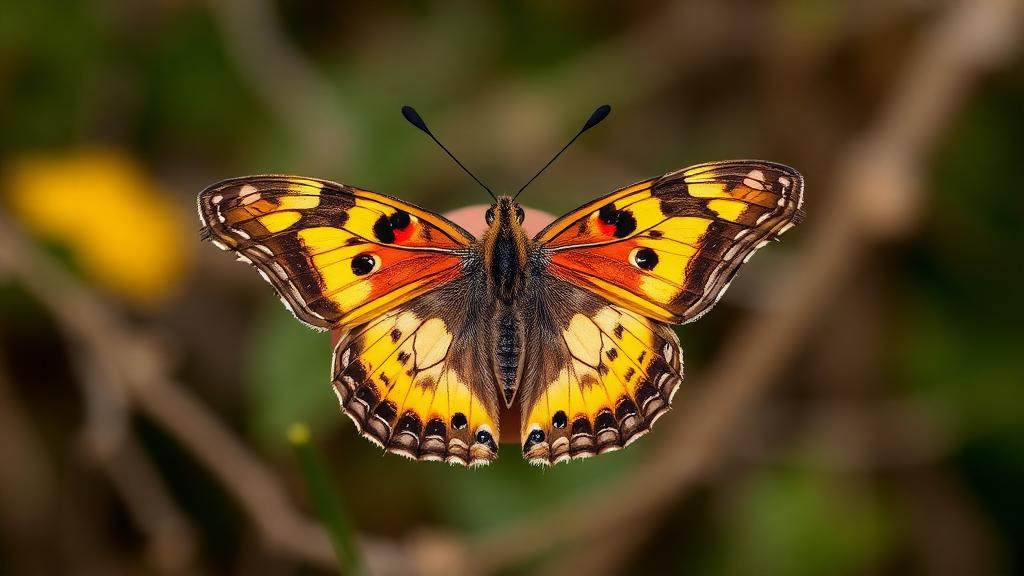
A conservation translocation has created a new population of the Transylvanian Bavius Blue, a locally endemic butterfly whose survival in Romania is threatened by the loss and mismanagement of its habitat. Eleven females moved from Suatu to the Apold landslide hills in Mureș County in 2023 established the first nucleus of a population outside the subspecies’ known range. Within a year, the site supported an estimated 30 to 40 butterflies, and six additional females from two source populations were introduced in 2024 to reinforce the colony. The result offers a practical refuge for a highly specialized insect and illustrates how carefully planned transfers can complement protection of deteriorating grasslands.
Pseudophilotes bavius hungarica is protected under European and Romanian legislation and is confined to the Transylvanian Plain in central Romania. Unlike the broader Bavius Blue, which occurs in the steppe and forest-steppe of Dobrogea in southeastern Romania, the Transylvanian subspecies occupies a restricted mosaic of dry grassland. Its caterpillars feed almost exclusively on nodding sage, Salvia nutans, and the butterfly is strongly associated with steep, south-facing slopes where high temperatures, strong sunlight, low humidity and high evaporation create a steppe-like microclimate. These ecological requirements place the subspecies in a small number of separate colonies, each vulnerable to a change in grazing, mowing, vegetation structure or land ownership.
That vulnerability became especially apparent at Suatu in Cluj County, where the butterfly historically maintained one of its strongest populations in a botanical reserve. A management plan introduced after 2000 included fences and hedges that excluded traditional grazing and mowing, while planting invasive non-native species. The resulting dense vegetation favored competitive grasses and reduced both nodding sage and the butterflies associated with it. No further specimens were recorded in the reserve from 2005 to 2010. The population persisted on abandoned vineyard terraces about 600 to 700 metres farther west, where an estimated 900 to 1,000 butterflies were recorded between 1998 and 2010, but intensive sheep grazing subsequently damaged the sage and erased much of that colony. One female was observed laying an egg on an unopened sage inflorescence within ten minutes of her release at Apold in April 2023, indicating that the newly arrived females had found suitable host plants quickly. The source population had recently numbered roughly 150 to 300 individuals on about 1.5 hectares, making it the strongest known colony at the time, but it too was vulnerable to the same damaging grazing that had overwhelmed the vineyard terraces.
The Apold destination was selected using species distribution models, together with the researchers’ long-term knowledge of local ecology and land management. The models incorporated the distribution of nodding sage, microclimatic conditions and edaphic variables, while field observations and the appearance of rare steppe plants helped identify the most plausible habitat. Apold’s “tumps”—small slump or landslide hills formed above impermeable clay—can reach slopes of about 70 degrees and are generally small, averaging roughly 1.2 hectares. Their southern faces are exceptionally warm: published measurements give an average annual temperature of about 18 °C, compared with approximately 9 °C on the northern slopes. Nodding sage grows densely on the larger southern slopes, where the thermal environment resembles that of the butterfly’s existing Transylvanian populations.
The site also offered a degree of control that is often absent from traditional reserves. The ADEPT Foundation had acquired the principal mound for conservation purposes and could therefore coordinate grazing, mowing and monitoring without depending on decisions by multiple land managers or a distant reserve authority. The surrounding habitat supports other uncommon plants, including Carex humilis, Stipa pulcherrima, Jurinea mollis, Artemisia pontica, Brassica elongata, Cephalaria radiata, Centaurea micranthos and Koeleria gracilis. It also contains a diverse butterfly community, including the Large Blue, Scarce Swallowtail, Eastern Festwing, Chequered Skipper and several Polyommatinae. The arrival of a small, host-specialized butterfly was therefore not the introduction of a generalist into an empty environment, but the restoration of a taxon already ecologically embedded in a similar grassland community.
Four Romanian lepidopterists collected the 11 donor females in April 2023, selecting recently emerged individuals to reduce the likelihood that they had already deposited eggs. Six were freshly emerged when captured. Proterandry, the early emergence of males, is characteristic of the species, and females normally mate soon after emergence, so the selection of fresh individuals did not substantially raise the risk of moving unmated butterflies. Each female was placed in an individual plastic box and the boxes were carried in a cooler maintained at 7 to 8 °C. The approximately 170-kilometre journey took two and a half hours. The butterflies were released between 12:15 and 13:00 near the foot of the large Apold hill, where they settled on nodding sage or nearby vegetation only 3 to 10 metres from the release point. Although the first cohort was small, the speed of oviposition and the presence of a dense host-plant population suggested that the site could support reproduction rather than merely hold temporary visitors.
Monitoring in 2024 provided the decisive evidence that the transfer had produced a viable population. On 12 April, before the second release, researchers saw a female flying over flowering nodding sage on the large hill. During the next 30 minutes they counted 17 butterflies across that hill and a neighboring mound. The team then added six more females: three collected from Suatu and three from Bărăi, a separate colony, to increase genetic variation in the emerging population. The 2024 collection was unusually early, reflecting a spring that advanced by at least two weeks. It also produced the earliest record of the butterfly’s flight period in 30 years, with both sexes already active by mid-April, suggesting that the season may have begun five or six days earlier than normal. On 23 May, the second survey found several larvae on open or partly open inflorescences of nodding sage, directly confirming successful reproduction at the new site.
The Apold project nevertheless faces scientific uncertainties that require long-term assessment. A founder population originating from only two sites and a small number of individuals may have limited genetic diversity, although the authors note that naturally isolated populations of some butterflies can retain effective variation despite small numbers and severe fragmentation. The butterflies may also interact facultatively with two species of ant, Crematogaster sordidula and C. atricolor, both recorded locally, while parasitoid pressures are poorly documented for the genus. The authors consider neither factor likely to prevent establishment, but the abundance of ant nests and the impacts of parasitoids remain unknown. Translating butterflies to a site outside their established range also carries a general risk of unforeseen ecological effects. In this case, the concern is limited because the caterpillars specialize on abundant nodding sage and no other insect at Apold is reported to depend exclusively on the same plant. Continued monitoring is needed to detect any changes in abundance, host-plant condition or community interactions.
Management plans combine protection with reinforcement. The first measure is a complete grazing ban on the occupied tumps, with an alternative under consideration that would restrict grazing to no earlier than 15 June. Because removal of livestock also removes the disturbance that once maintained open vegetation, the site will be mown annually or every two years after 15 June, with the cut material removed. The timing is critical because sheep grazing during the flowering period, approximately 15 April to 15 May, can remove the exact sage structures on which eggs and young larvae are deposited. Fire risk must also be controlled, especially in April when dry vegetation is vulnerable. The population and its host plant will be surveyed annually, and the new nucleus may receive further female translocations over the next two to three years from other Transylvanian colonies. Efforts are under way to give the Apold complex local nature-reserve status, with possible escalation to national protection, backed by cooperation with the municipality of Apold. The result is more than a short-term numerical success: it has created a potentially durable refuge under conservation control. If sustained, that refuge could provide a source for future population recovery, while the Apold example offers a testable model for conserving other narrow-range butterflies whose remaining colonies cannot wait for every existing protected site to be restored.
Subject of Research: Establishment of a new Transylvanian Bavius Blue population through conservation translocation in Romania
Article Title: Successful translocation of the Transylvanian Bavius Blue – Pseudophilotes bavius hungarica (Diószeghy, 1913) ( Lepidoptera , Lycaenidae ) in Romania, for increased protection and conservation
Article References: Popa, R., Rákosy, L., Crișan, A., Pop, F.-M., & Rákosy, D. (2025). Successful translocation of the Transylvanian Bavius Blue – Pseudophilotes bavius hungarica (Diószeghy, 1913) (Lepidoptera, Lycaenidae) in Romania, for increased protection and conservation. Nature Conservation, 59, 157-177. https://doi.org/10.3897/natureconservation.59.145873
Image Credits: AI Generated
DOI: 10.3897/natureconservation.59.145873
Keywords: Transylvanian Bavius Blue, Pseudophilotes bavius hungarica, butterfly conservation, species translocation, Romania, grassland habitat, endemic subspecies, noding sage, Apold, Suatu, Successful, translocation
Cite Scienmag News
Margaret Porter. (October 19, 2026). Romanian butterfly establishes new stronghold after conservation translocation. Scienmag. https://scienmag.com/romanian-butterfly-establishes-new-stronghold-after-conservation-translocation/
Margaret Porter. "Romanian butterfly establishes new stronghold after conservation translocation." Scienmag, 19 October 2026, https://scienmag.com/romanian-butterfly-establishes-new-stronghold-after-conservation-translocation/. Accessed 19 October 2026.
Margaret Porter. "Romanian butterfly establishes new stronghold after conservation translocation." Scienmag. October 19, 2026. https://scienmag.com/romanian-butterfly-establishes-new-stronghold-after-conservation-translocation/


