


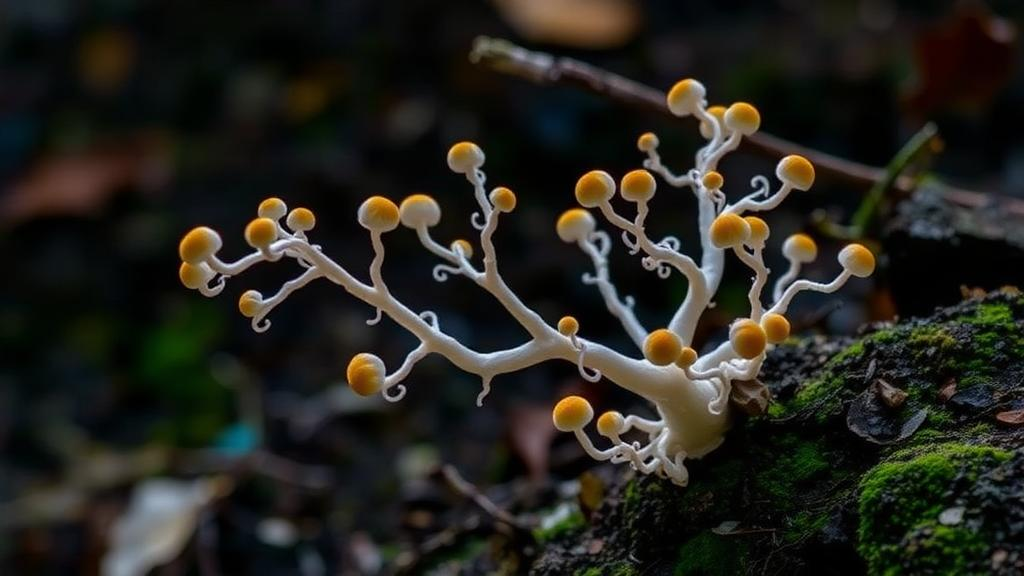
A branching woodland fungus previously reported from Europe has been documented in the western Himalayas, extending the known range of Ramaria barenthalensis into Pakistan. Researchers collected the species during field surveys in the Neelum Valley of Azad Jammu and Kashmir, a mountainous region dominated by coniferous forests. The finding was established through a combination of microscopic examination and DNA analysis, marking the first confirmed record of R. barenthalensis in Azad Jammu and Kashmir and adding a new geographic data point to a genus that has until now been documented mainly from European forests.
Ramaria belongs to the family Gomphaceae and is part of an order that includes many of the conspicuous coral-like or club-shaped fungi. Its fruiting bodies can resemble miniature trees, antlers or submerged coral, with upright branches emerging from a shared base. More than 200 Ramaria species have been described worldwide, inhabiting soil, decaying wood, tree trunks, partially decomposed organic matter and living or dead hardwood. Many species form mycorrhizal relationships with trees, exchanging nutrients for sugars and thereby helping structure forest ecosystems. The new record was made in a mixed coniferous forest at an elevation of 1,524 metres in the Neelum Valley.
The research team surveyed selected sites in 2019 and 2020, collecting fresh basidiomata and recording their appearance, habitat and surrounding vegetation in the field. Photographs and field notes were prepared before the specimens were air-dried and preserved in sealed polythene bags. Material examined by the authors was deposited in the LAH Herbarium at the Institute of Botany, University of the Punjab, in Lahore. The particular voucher assessed in the study was collected in late summer 2020 from decayed hardwood in a forest associated with Abies pindrow, the Himalayan fir, and Betula jacquemontii, a birch species.
Neelum Valley lies within a region whose climate and soils support unusually diverse vegetation. The study described cold winters, moderate summers and substantial annual precipitation, with conifer-rich forests occupying the hilly terrain. Dominant trees included Himalayan fir, Cedrus deodara, Pinus wallichiana and Aesculus indica, accompanied by shrubs such as Viburnum grandiflorum and Indigofera heterantha. The specimen was solitary or occurring in scattered clusters, and the authors recorded it as gregarious on fallen trunks and other decayed coniferous or mixed-vegetation material. This ecological setting resembles habitats in which related Ramaria species have been found elsewhere.
Microscopic analysis provided a detailed anatomical profile of the collected fungus. Its fruiting bodies measured 5–12 centimetres high and 4–9 centimetres wide. The branches were vertically oriented, forked, elongated to flattened and smooth, with light-brown coloration when young that darkened as the fungus matured. The base was variable in development and ranged from reduced to prominent, while the flesh was whitish to light brown and soft. The odor was described as pleasant but not distinctive. These features were compared with other recognized Ramaria species to assess both similarities and distinctions, because fruiting-body shape and color alone are generally insufficient for definitive identification.
Under the light microscope, the researchers measured at least 50 basidiospores and other structures from each specimen. Slides were prepared with 5% potassium hydroxide and 1% Congo red and examined at 100-fold magnification. The spores were elliptical to ovoid and roughened, measuring 6.5–9 by 3–4.6 micrometres. Basidia were 45–59 micrometres long and 7.5–9 micrometres wide, with visible sterigmata, while cheilocystidia measured 46–62 by 7–8.5 micrometres. Clamp connections were present in the trama hyphae, and basal tomentum hyphae were smooth with tapering bases. The combination of these characters closely matched the original description of R. barenthalensis, although small differences were noted in the form of the basidiomata.
Molecular evidence independently supported the anatomical assessment. DNA was extracted from dried material with a modified CTAB protocol, and the nuclear ribosomal DNA internal transcribed spacer region was amplified using universal ITS primers. The resulting sequence, 702 base pairs long, was deposited in GenBank under accession ON209680. A database similarity search found a 99.33% match to an R. barenthalensis sequence from Spain, with 98% query coverage and an E value of 0.0. Maximum-likelihood phylogenetic analysis then placed the Pakistani specimen in the same strongly supported clade as reference sequences of R. barenthalensis from Spain.
The final tree was constructed from 30 sequences aligned with MUSCLE and analysed using the RAxML-HPC2 model on the CIPRES platform, with 1,000 bootstrap replicates. The aligned dataset contained 421 conserved sites, including 256 variable positions, 167 parsimony-informative sites and 86 singletons. Hysterangium crassirhizum served as the outgroup. Because the specimen clustered with authenticated reference material while its microscopic features also matched the published description, the authors treated the identification as supported by two complementary forms of evidence rather than by visual resemblance alone.
The discovery also clarifies the species’ known distribution. Several Ramaria species have previously been reported from Pakistan, including R. flava, R. stricta, R. formosa, R. pallida and R. abietina, but before this study only R. stricta had been recorded from Azad Jammu and Kashmir using morphological characteristics. R. barenthalensis was originally described in 2019 and is therefore not a species newly named in Pakistan. Rather, the Himalayan collection represents its first verified occurrence in the territory, demonstrating that its range reaches beyond the European records available to the authors. The finding also indicates that DNA-based methods can reveal underappreciated components of the region’s fungal biodiversity.
The result should not be interpreted as a recommendation to collect or eat wild fungi. Although Ramaria includes species regarded as edible, and the comparison table listed R. barenthalensis as edible when young, edibility assessments can differ among species, and the study explicitly described its food or medicinal potential only as something that could be evaluated after biochemical characterization. The demonstrated benefits of the research are taxonomic and ecological: it supplies a new occurrence for a branching fungus, expands the geographic framework used to study its evolution, and records a species associated with decaying wood in Pakistan’s temperate conifer forests. The combined morphological and phylogenetic evidence confirms that R. barenthalensis has reached the western Himalayas, giving scientists a new opportunity to investigate how a little-known coralloid fungus is distributed and associated with forest vegetation across Eurasia.
Subject of Research: The distribution and identification of Ramaria barenthalensis in Azad Jammu and Kashmir
Article Title: Ramaria barenthalensis a new record from western Himalayas, Azad Jammu and Kashmir, Pakistan
Article References: Ullah, T. S., Firdous, S. S., Shier, W. T., & Khalid, A. N. (2022). Ramaria barenthalensis a new record from western Himalayas, Azad Jammu and Kashmir, Pakistan. Italian Botanist, 14, 133-143. https://doi.org/10.3897/italianbotanist.14.96790
Image Credits: AI Generated
DOI: 10.3897/italianbotanist.14.96790
Keywords: Ramaria barenthalensis, mycology, fungal biodiversity, Azad Jammu and Kashmir, Neelum Valley, western Himalayas, DNA barcoding, ITS phylogeny, coniferous forests, taxonomy, Ramaria, barenthalensis
Cite Scienmag News
Roger Howard. (October 19, 2026). Rare branching fungus found in Pakistan’s western Himalayas. Scienmag. https://scienmag.com/rare-branching-fungus-found-in-pakistans-western-himalayas/
Roger Howard. "Rare branching fungus found in Pakistan’s western Himalayas." Scienmag, 19 October 2026, https://scienmag.com/rare-branching-fungus-found-in-pakistans-western-himalayas/. Accessed 19 October 2026.
Roger Howard. "Rare branching fungus found in Pakistan’s western Himalayas." Scienmag. October 19, 2026. https://scienmag.com/rare-branching-fungus-found-in-pakistans-western-himalayas/


