


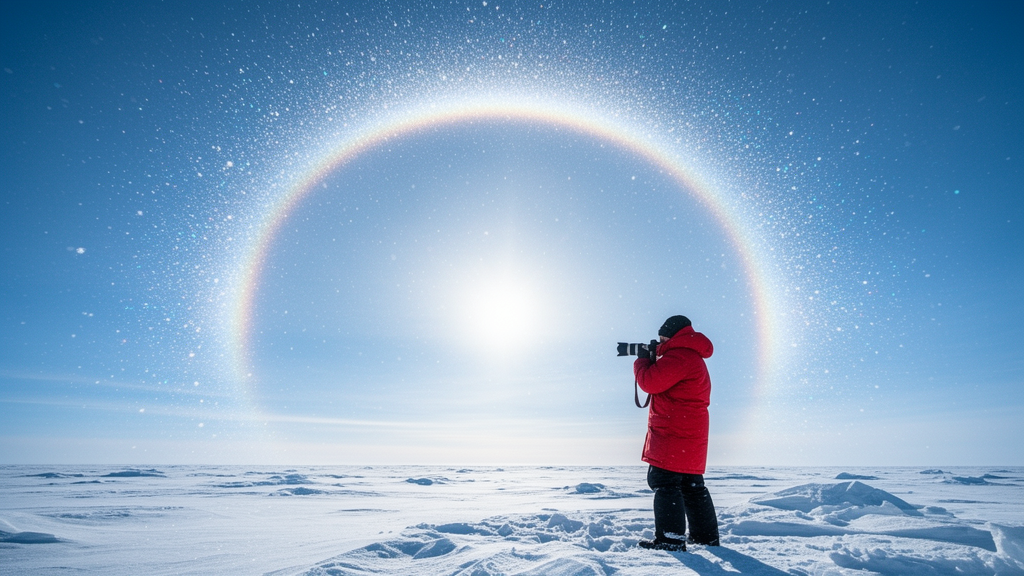
The American Meteorological Society has announced the winners of its 2026 AMS Photo Contest, an annual competition that drew submissions from 1,075 photographers representing 84 countries. The Grand Prize went to Jaroslav Fous for “Diamond Dust Sky Eye,” an image that captures one of the atmosphere’s most elusive optical phenomena. Chris Elkinton took Second Prize with “Sea Dragon,” Roberto Bueno earned Third Prize with “Cirrus, the Veils of the Moon,” and Jeremy Janus won the Members’ Choice award with “Rainbow Cataclysm.” The contest, formerly titled the AMS Weather Band Photo Contest, invites original photography depicting themes of weather, water, and climate, and it has become one of the most visible showcases of atmospheric science in popular culture.
Winning images in this contest are more than aesthetic achievements; they are observational records of atmospheric physics captured at the precise moment conditions aligned. Fous’s grand-prize photograph, whose title refers to diamond dust, documents a phenomenon that occurs when water vapor in the air crystallizes directly into tiny ice crystals at very low temperatures, typically in polar or high-latitude winter environments. These microscopic crystals, often plate-shaped hexagonal prisms, drift slowly through frigid air and act as countless miniature mirrors. When sunlight or moonlight strikes them, the crystals reflect and refract light in ways that produce glittering displays, light pillars, halos, and other optical effects that photographers prize precisely because they demand both the right meteorological conditions and split-second timing.
The physics behind diamond dust begins with supersaturation. When air cools below its dew point and reaches temperatures well under freezing, water vapor can deposit directly into ice without first condensing into liquid droplets, a process known as deposition nucleation. The resulting ice crystals are usually small, simple hexagonal plates or columns, and their uniform geometry is what gives diamond dust its characteristic sparkle. Because each crystal acts as a tiny prism, light entering one face can be refracted through another, dispersing into spectral colors, while reflections off crystal faces produce the bright glints that give the phenomenon its name. The crystals are so small and light that they remain suspended in air for extended periods, creating what observers describe as a sky filled with glittering dust.
Elkinton’s second-prize image, “Sea Dragon,” presumably captures a dramatic cloud formation or waterspout over open water, a category of atmospheric structure that has long fascinated both scientists and the public. Waterspouts and elongated cloud features over the ocean form through complex interactions between sea surface temperatures, wind shear, and atmospheric instability. When warm, moist air near the water surface rises rapidly into cooler air above, convection can organize into rotating columns or sculpted cloud shapes that appear serpentine from certain angles. Photographing such features requires positioning at a safe distance while maintaining the telephoto reach and shutter speed needed to freeze fine cloud detail against a moving sea.
Bueno’s third-prize photograph, “Cirrus, the Veils of the Moon,” turns its lens on cirrus clouds, the thin, wispy ice-cloud formations that occupy the upper troposphere at altitudes typically above 6,000 meters. Cirrus clouds are composed entirely of ice crystals, and their translucent, fibrous appearance results from wind shear stretching ice crystals into long filaments. When the Moon shines through or behind cirrus layers, the ice crystals can produce halos, coronae, and other diffraction and refraction phenomena that transform an ordinary night sky into something otherworldly. Cirrus clouds also play a significant role in Earth’s radiative budget, reflecting incoming solar radiation while trapping outgoing infrared radiation, which makes them a subject of ongoing research in climate science.
Janus’s Members’ Choice winner, “Rainbow Cataclysm,” highlights the enduring appeal of one of the atmosphere’s most recognizable optical displays. Rainbows form when sunlight enters water droplets, refracts at the air-water boundary, reflects internally off the back of each droplet, and refracts again as it exits, separating white light into its component wavelengths. The geometry is precise: the primary rainbow appears at an angle of approximately 42 degrees from the antisolar point, the point directly opposite the Sun from the observer’s perspective. Secondary rainbows, produced by two internal reflections within each droplet, appear at about 51 degrees with reversed color order. The dramatic framing implied by the word cataclysm suggests a stormy sky, where dark receding clouds provide the contrast that makes rainbow colors appear saturated and vivid.
The contest’s judging structure reflects the dual nature of atmospheric photography as both art and science. Three winners are selected by a panel of judges who evaluate submissions for technical quality, scientific interest, and aesthetic impact, while a fourth winner is chosen directly by members of the American Meteorological Society. This Members’ Choice category gives the society’s roughly 12,000 professionals, students, and weather enthusiasts a voice in recognizing images that resonate with the community of people who study the atmosphere for a living. Cash prizes range from $200 to $500, modest sums that reflect the contest’s primary purpose of celebrating and publicizing the beauty of weather, water, and climate rather than serving as a commercial competition.
The scale of participation this year, with 1,075 photographers from 84 countries, underscores how digital imaging and global connectivity have transformed amateur atmospheric observation. Modern digital cameras and smartphones can capture dynamic range and detail that once required specialized equipment, and social media platforms allow storm chasers, cloud spotters, and aurora hunters to share conditions in near real time. This democratization of observation has scientific value as well; citizen photographers frequently document rare optical phenomena, unusual cloud structures, and extreme weather events that professional monitoring networks may miss, and images submitted to contests like the AMS Photo Contest often serve as informal verification of atmospheric conditions reported elsewhere.
The American Meteorological Society, founded in 1919, advances the atmospheric and related sciences, technologies, applications, and services for the benefit of society. Beyond the photo contest, the organization publishes 12 atmospheric and related oceanic and hydrologic science journals and hosts more than 12 conferences annually, making it one of the central professional bodies in weather and climate science. Its membership spans research meteorologists, operational forecasters, broadcast professionals, educators, and students, along with a substantial community of weather enthusiasts whose engagement through activities like the photo contest helps bridge the gap between scientific research and public understanding of the atmosphere.
Winning entries and contest finalists are available for viewing on the AMS Photo Contest website, where the full gallery of this year’s submissions offers a visual survey of atmospheric diversity, from polar ice crystals to tropical convection. As climate change alters weather patterns worldwide and extreme events become more frequent, images like those honored in the 2026 contest serve a purpose beyond celebration: they document the atmosphere’s behavior in vivid, accessible form, reminding both specialists and the public that the science of weather and climate is ultimately the study of phenomena that anyone can witness, provided they look up at the right moment.
Subject of Research: The 2026 AMS Photo Contest winners and the atmospheric science behind their award-winning images
Article Title: American Meteorological Society announces winners of the 2026 AMS Photo Contest
Article References: American Meteorological Society announces winners of the 2026 AMS Photo Contest. Original publication (Bibliographic details unavailable.)
Image Credits: AI Generated
DOI: Not provided
Keywords: AMS Photo Contest, American Meteorological Society, diamond dust, atmospheric optics, cirrus clouds, rainbows, weather photography, ice crystals, cloud physics, citizen science, meteorology, climate
Cite Scienmag News
Violet Maxwell. (October 19, 2026). Diamond Dust Sky Eye Wins Grand Prize in 2026 AMS Photo Contest. Scienmag. https://scienmag.com/diamond-dust-sky-eye-wins-grand-prize-in-2026-ams-photo-contest/
Violet Maxwell. "Diamond Dust Sky Eye Wins Grand Prize in 2026 AMS Photo Contest." Scienmag, 19 October 2026, https://scienmag.com/diamond-dust-sky-eye-wins-grand-prize-in-2026-ams-photo-contest/. Accessed 19 October 2026.
Violet Maxwell. "Diamond Dust Sky Eye Wins Grand Prize in 2026 AMS Photo Contest." Scienmag. October 19, 2026. https://scienmag.com/diamond-dust-sky-eye-wins-grand-prize-in-2026-ams-photo-contest/


