


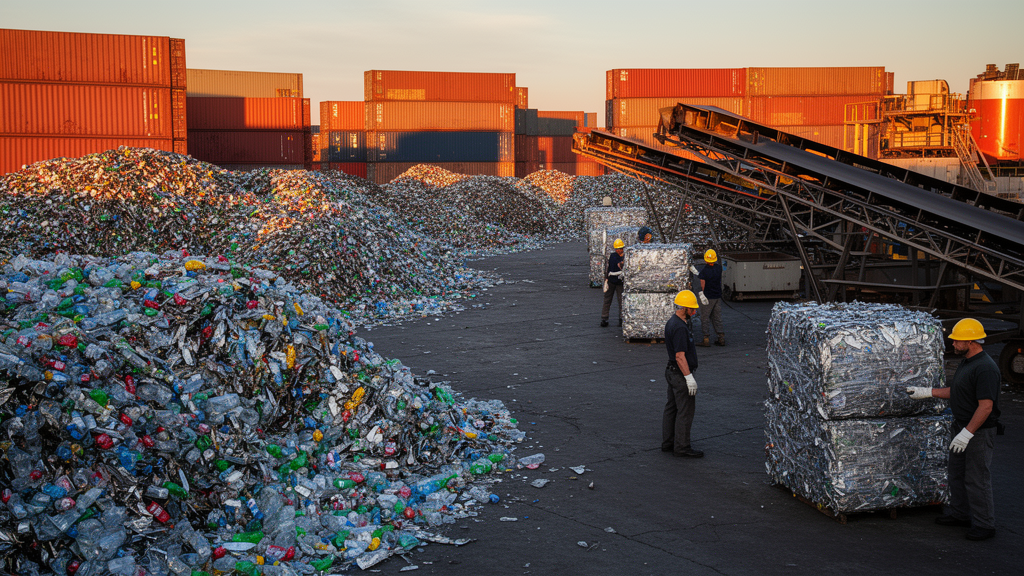
When a plastic bottle, an aluminium can or a stack of old newspapers leaves a recycling bin in Europe, its journey is often only beginning. A growing share of the world’s recycling does not happen where the waste is generated. Instead, paper, metals, plastics and glass discarded in one country are shipped across borders and re-enter the economy as raw materials somewhere else entirely. This international trade in recyclable waste has become a pillar of the modern circular economy, yet it remains largely invisible in the national recycling statistics that policymakers use to measure success.
A new study by Eugénie Joltreau and Luis Sarmiento, researchers at the CMCC Foundation – Euro-Mediterranean Center on Climate Change, published in the Journal of Applied Economics, sets out to change that. The research combines a theoretical model of international waste markets with trade data covering plastics, paper, aluminium, glass, and iron and steel. Its central finding is striking: global trade in recyclable waste has held steady at roughly 170 to 200 million tonnes per year since 2010, and between 2018 and 2021 an average of 10 to 13 percent of European Union packaging recycling actually took place outside the bloc.
The scale and concentration of this market are remarkable. In 2022, high-income countries exported up to 72 million tonnes more recyclable waste than they imported, effectively shipping their surplus discards to the rest of the world. The market is also highly concentrated: the ten largest exporting countries account for 67 percent of global exports. Recycling, in other words, is not a purely local activity but a global commodity trade with its own economics, price signals and policy distortions.
At the heart of the study lies a concept the authors call material imbalance: the mismatch between the materials a country needs for production and the waste it generates through consumption. A service-based economy may import many manufactured products and generate large volumes of waste while requiring relatively few raw materials for its own industry. A rapidly industrialising economy presents the opposite profile, with strong demand for materials but less locally available waste. These complementary differences make international trade economically attractive, with waste flowing from countries that generate relatively more of a material to those that need it more. Transport costs, along with the costs of collecting, recycling and disposing of waste, determine whether such trade actually takes place.
The researchers tested this relationship empirically using international trade data, and the results support the idea that material imbalances are a significant driver of global waste flows. The fact that waste was being directed towards countries with high material needs, such as China at the time, led us to think more deeply about the relationship between the waste countries generate and the materials they need for production, Joltreau explains. This led us to introduce the concept of material imbalance into the theoretical model and then test it empirically. We found that these imbalances do indeed play a role in explaining international trade in recyclable waste.
The theoretical model also reveals why recyclable waste does not behave like an ordinary product. Depending on demand, transport and processing costs, its price can be positive or negative. An importer may pay for waste as a useful source of materials, or an exporter may pay another country to take it away. This dual nature explains the conflicting narratives that emerged when China, then the world’s leading importer of waste, drastically reduced its imports. Some observers claimed that wealthy nations were simply exporting their trash, while others insisted that importing countries were buying valuable recyclable materials. The research shows that both narratives can contain part of the truth: recyclable waste is simultaneously an unwanted by-product that is costly to manage and a potential input for production, and its value can shift as market conditions and public policies change.
One of the insights from the model is that the price of waste traded for recycling can shift from positive to negative, depending on demand and costs, which are themselves influenced by recycling policies, Joltreau notes. This insight has direct policy consequences. Recycling and waste-management policies influence not only how much material is recycled but also where that recycling takes place. Collection and recycling subsidies, disposal taxes and recycling targets can increase or reduce the incentive to export, depending on how they are designed. Some policies can lower the cost of preparing waste for export, making it attractive to ship recyclable materials abroad rather than process them domestically.
The European Union illustrates this connection vividly. Waste exported for recycling can count towards national packaging recycling targets, which means that a higher reported recycling rate does not necessarily reflect more domestic recycling. According to the model, for countries that tend to export waste, targets requiring recycled materials to be used in domestic production may do more to support local recycling than targets focused only on the share of waste recycled. In effect, a country can appear to be recycling successfully while the actual processing, and its environmental burden, happens elsewhere.
The findings do not imply that international waste trade is inherently harmful. Trade can connect available recyclable materials with industries that genuinely need them, improving efficiency across the global economy. However, the study warns that poorly designed policies may encourage exports without strengthening domestic recycling systems, while shifting environmental pressures towards importing countries that may have lower environmental standards or weaker collection infrastructure. The environmental benefits of recycling, in such cases, may be partially offset by the impacts of transport and by substandard processing abroad.
By placing international trade at the centre of circular-economy analysis, the research highlights the need for policymakers to look beyond national recycling rates. Effective policies must consider where waste is processed, where recycled materials are used and how incentives affect global flows, while continuing to reduce overall resource use and waste generation. As the world’s waste markets continue to evolve, understanding the hidden economics of recyclable waste will be essential for building a circular economy that delivers real environmental benefits rather than simply relocating them.
Subject of Research: International trade in recyclable waste and the policy design of recycling systems
Article Title: The hidden global market behind recycling
Article References: The hidden global market behind recycling. Original publication (Bibliographic details unavailable.)
Image Credits: AI Generated
DOI: Not provided
Keywords: recycling, waste trade, circular economy, material imbalance, EU packaging recycling, waste exports, recycling policy, CMCC, Journal of Applied Economics, plastics, global waste market, environmental policy
Cite Scienmag News
Russell Cooper. (October 19, 2026). The hidden global market behind recycling. Scienmag. https://scienmag.com/the-hidden-global-market-behind-recycling/
Russell Cooper. "The hidden global market behind recycling." Scienmag, 19 October 2026, https://scienmag.com/the-hidden-global-market-behind-recycling/. Accessed 19 October 2026.
Russell Cooper. "The hidden global market behind recycling." Scienmag. October 19, 2026. https://scienmag.com/the-hidden-global-market-behind-recycling/


