


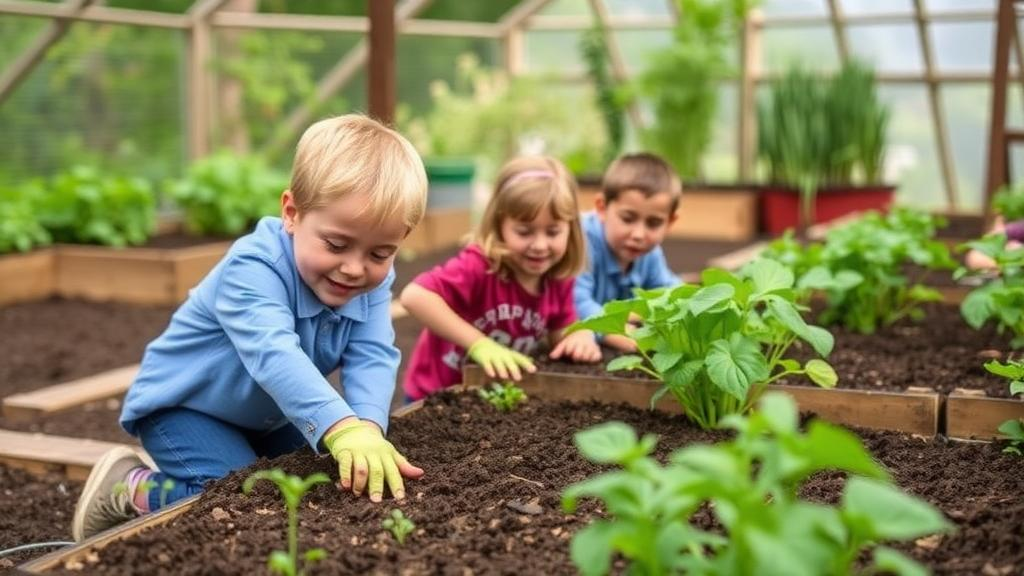
In five public primary schools scattered across economically marginalised communities in South Africa’s Tshwane School District, something quietly transformative is taking root. Mandala permaculture gardens, established as part of a post-COVID-19 initiative on sustainability, food security and community resilience, have become more than patches of spinach and compost heaps. According to new research published in Frontiers in Education, these gardens are functioning as what the researcher calls third learning spaces, sites where formal curriculum knowledge, learners’ everyday experiences and community knowledge converge. The critical ingredient in this transformation is not soil quality or rainfall but school leadership. A qualitative multiple-case study by Bongani Nhlanhla Mkhize of the University of Johannesburg reveals that principals, through deliberate vision-setting, teacher development, curriculum integration and community mobilisation, are the decisive factor in whether a school garden becomes a genuine educational asset or remains a neglected side project.
The study arrives at a moment when education systems worldwide are grappling with how to prepare young people for interconnected crises: climate change, biodiversity loss, food insecurity and widening inequality. Education for Sustainable Development, or ESD, has emerged as the leading framework for meeting this challenge, aligning with United Nations Sustainable Development Goals including Zero Hunger, Quality Education, Sustainable Cities, Responsible Consumption and Climate Action. Yet conventional classroom teaching often struggles to connect abstract sustainability concepts with learners’ lived realities. School food gardens offer an appealing alternative, allowing children to encounter plant biology, measurement, water conservation, composting and biodiversity through direct, hands-on experience. The catch, as the research makes clear, is that a garden does not educate anyone by simply existing.
Mkhize interviewed five principals from schools participating in the Transforming Education for Sustainable Futures initiative, using semi-structured interviews lasting 30 to 40 minutes and analysing the transcripts through Tesch’s eight-step qualitative coding process. The schools, serving communities marked by high unemployment, poverty and food insecurity, ranged in enrolment from around 900 to more than 1,600 learners. All five principals were experienced leaders, with tenures ranging from nine to twenty years. The analysis produced five interconnected themes describing how these leaders understood and enacted their role in turning gardens into learning environments, and the researcher is careful to note that the findings reflect principals’ perceptions rather than independently measured outcomes.
The first theme concerned visionary leadership. Principals consistently described the need to embed gardens within the school’s mission rather than treat them as peripheral food-production projects. One principal described vision as a mental picture of what the school should become, while another stressed that running a successful school requires collective effort from all stakeholders. A third observed that a clear purpose drives resilience because staff know what they are working towards. This framing aligns closely with Hallinger’s instructional leadership model, whose first dimension, defining the school mission, involves articulating and communicating a shared direction. In these schools, that direction explicitly positioned garden-based sustainability learning as legitimate, central educational work rather than an optional extracurricular activity.
Perhaps the most practically significant finding relates to teacher capacity. Principals reported that many teachers had been trained exclusively for conventional classroom environments and lacked the confidence, pedagogical skills and horticultural knowledge needed for effective outdoor teaching. One principal noted bluntly that teachers were never trained in outdoor teaching and learning, and some had never done gardening, arguing that their professional development should be prioritised. Another explained that extending learning to the garden requires teachers to broaden their knowledge and refine their practices for interactive learning. Principals responded by promoting job-embedded professional learning communities where teachers could share ideas, mentor one another and solve problems collectively. The study frames this as an ongoing process rather than a once-off workshop, reflecting the Whole School Approach’s emphasis on capacity building as the foundation of sustainable educational change.
A third theme tackled the status of garden time within the curriculum. Principals were unanimous that taking learners to the garden is not free time, insisting that garden-based learning demands careful planning, curriculum alignment and deliberate instructional leadership. One principal offered a concrete example of integration-as-contextualisation: the language curriculum remained unchanged, but the language teacher would use nouns of things found in the garden and verbs related to activities done there. This approach preserves instructional integrity while extending learning beyond classroom walls, connecting formal objectives to observable, touchable realities. The study argues that this legitimisation of gardens as curriculum spaces, rather than recreational breaks, is precisely what distinguishes meaningful ESD from superficial outdoor activity.
The fourth theme highlighted what principals perceived as growing learner agency. Participants described children developing confidence, responsibility and problem-solving capacities through direct engagement with growing food. One principal recounted the story of a learner who planted spinach seeds, cared for the seedlings, harvested the produce and took it home to her family, proudly describing every step. Another noted with satisfaction that when crops failed, learners did not blame others but took responsibility for not nurturing their plots effectively and were ready to apply alternatives in the next round. Mkhize interprets these accounts as perceived opportunities for developing sustainability competencies such as systems thinking, collaboration and responsible action, while cautioning that learner outcomes were not independently assessed in the study.
The final theme concerned community mobilisation. Principals argued that garden success depended on shared responsibility among teachers, learners, parents and community members. One observed that a school should not be a one-man show and that stakeholders have brilliant ideas needing only the chance to be expressed. Another emphasised that when people feel valued and heard, trust is earned and communication becomes a two-way conversation. A third distinguished genuine engagement from mere compliance, describing stakeholder engagement as ongoing and continuous. These accounts position the garden as a boundary-crossing space where community knowledge, educational expertise and sustainability goals intersect, echoing the Whole School Approach’s vision of schools as agents of social transformation embedded in their communities.
Theoretically, the study makes a dual contribution. It extends Hallinger’s instructional leadership model by demonstrating how its dimensions, defining mission, managing the instructional programme and promoting a positive learning climate, apply to outdoor sustainability education rather than classroom instruction alone. Simultaneously, it enriches the Whole School Approach by showing how gardens serve as integrative spaces where leadership, curriculum, learner participation and community engagement meet in practice. Crucially, Mkhize warns against romanticising leadership agency in resource-constrained settings: principals’ resourcefulness and creativity, however impressive, should not be treated as substitutes for adequate systemic support, teacher preparation and material resources. Sustainability-oriented leadership, the study concludes, is relational, context-dependent and enabling rather than simply directive.
The research carries clear caveats and clear implications. With five purposively selected principals in a single district, self-reported interview data and a single point in time, the findings are not statistically generalisable, and the study recommends future multi-stakeholder and longitudinal research involving teachers, learners, parents and community partners. Yet its message for educators and policymakers is compelling. School gardens alone do not automatically teach sustainability; their educational value depends on leaders who legitimise garden-based learning, invest in teachers’ outdoor pedagogy, protect instructional time and cultivate authentic partnerships. As schools worldwide search for scalable, place-based approaches to climate and sustainability education, the evidence from Tshwane suggests the answer may begin not in the garden bed but in the principal’s office, where visions are articulated, resources are mobilised and a handful of spinach seeds becomes a lesson in how to shape a more sustainable future.
Subject of Research: Principal leadership for education for sustainable development through school food gardens in South African primary schools
Article Title: Using school food gardens to promote education for sustainable development: leadership perspectives from school principals in South Africa
Article References: Mkhize, B. N. (2026). Using school food gardens to promote education for sustainable development: leadership perspectives from school principals in South Africa. Frontiers in Education, 11, Article 1987792. https://doi.org/10.3389/feduc.2026.1987792
Image Credits: AI Generated
DOI: 10.3389/feduc.2026.1987792
Keywords: education for sustainable development, school food gardens, instructional leadership, school principals, South Africa, whole school approach, third learning spaces, place-based learning, sustainability education, teacher professional development, community engagement, permaculture
Cite Scienmag News
Sloane Callahan. (October 19, 2026). How School Gardens Become Classrooms: Principals Hold the Key to Sustainability Learning. Scienmag. https://scienmag.com/how-school-gardens-become-classrooms-principals-hold-the-key-to-sustainability-learning/
Sloane Callahan. "How School Gardens Become Classrooms: Principals Hold the Key to Sustainability Learning." Scienmag, 19 October 2026, https://scienmag.com/how-school-gardens-become-classrooms-principals-hold-the-key-to-sustainability-learning/. Accessed 19 October 2026.
Sloane Callahan. "How School Gardens Become Classrooms: Principals Hold the Key to Sustainability Learning." Scienmag. October 19, 2026. https://scienmag.com/how-school-gardens-become-classrooms-principals-hold-the-key-to-sustainability-learning/


