


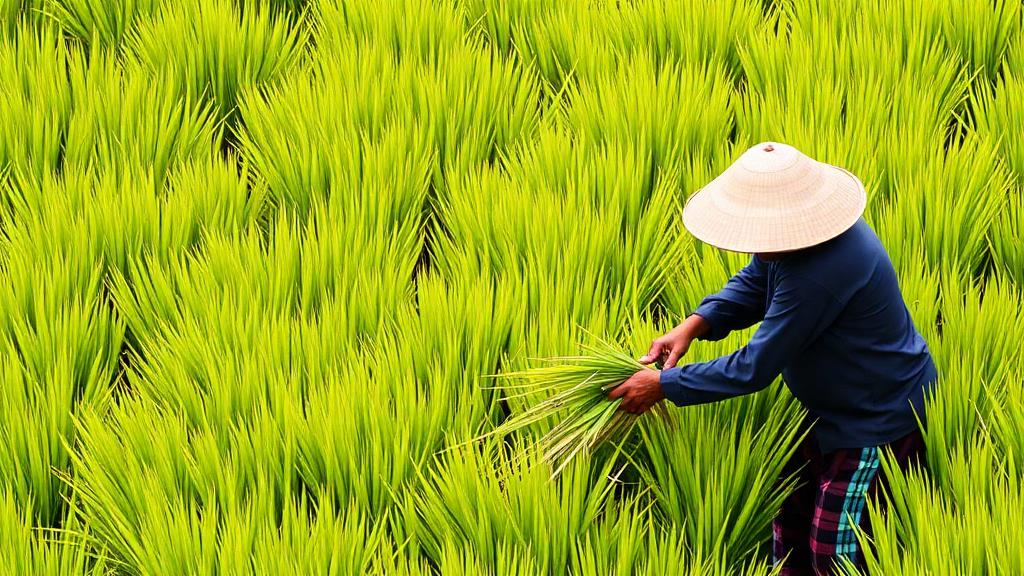
In the rice paddies of Bulukumba Regency, on the Indonesian island of Sulawesi, something remarkable is happening. Farmers who once spent fortunes on synthetic fertilizers and pesticides are now growing rice with compost, manure, neem leaves, and lemongrass—and they are earning dramatically more money for it. A new study published in Frontiers in Human Dynamics reveals that this shift to organic farming is not simply an economic calculation. It is a profound social and moral transformation, one that researchers say could offer a blueprint for sustainable agriculture across the developing world.
The research, led by Vandalisna of Hasanuddin University and the Gowa Agricultural Development Polytechnic, together with colleagues from institutions in Indonesia, Malaysia, Australia, and Sudan, focused on the Salassae Rural Swabina Community, a farmer group widely regarded as a pioneer of organic agriculture in Eastern Indonesia. Since around 2010 and 2011, farmers in the village of Salassae began abandoning chemical inputs in favor of organic methods, and their village has since become a learning center visited by farmers and students from across Indonesia and even other parts of Asia.
To understand why and how this transition succeeded, the team turned to grounded theory research, a qualitative methodology designed to build theory directly from empirical data rather than test pre-existing hypotheses. Between June 2023 and March 2024, the researchers conducted in-depth interviews with 30 participants, including organic farmers, farmer group leaders, field assistants, and community leaders. They then analyzed the transcripts using the Straussian coding procedure, moving through iterative stages of open coding, axial coding, and selective coding, with the help of NVivo 14 software to manage and map the emerging concepts.
The central theoretical category that emerged from this painstaking analysis is what the researchers call socio-ecological rationality. This concept explains how farmers integrate environmental ethics, economic needs, and socio-cultural norms into their agricultural decision-making. In other words, the choice to farm organically was never purely financial. Ecological awareness, relational solidarity, and moral commitment emerged as the main drivers of farmers’ adaptive resilience, allowing them to persist despite real obstacles such as limited market access, certification costs, and weak institutional support. Organic farming, the study concludes, is not only an economic choice but an expression of moral and social values rooted in local culture.
The technical transformation on the ground is striking. Farmers reported selecting seeds more carefully to ensure uniform, healthy growth, cultivating soil without synthetic chemicals, and replacing chemical fertilizers with locally sourced compost and manure tailored to soil conditions. For pest control, they turned to botanical pesticides such as neem leaves and lemongrass, cultivated natural predators like ladybugs and owls, and practiced crop rotation. The researchers emphasize that this is not merely a substitution of inputs but a paradigm shift—from input-intensive to knowledge-intensive, ecology-based farming—consistent with the principles of IFOAM–Organics International and the Food and Agriculture Organization.
The economic numbers are perhaps the most eye-catching part of the story. Production costs for organic farmers ranged from roughly IDR 80,000 to 100,000 per hectare per planting season, compared with IDR 1.5 to 2 million for conventional systems, because compost, manure, and botanical pesticides are produced on-farm at near-zero cost. Organic brown rice sells for up to IDR 25,000 per kilogram and organic white rice for IDR 15,000 to 18,000, while non-organic rice fetches only IDR 9,000 to 12,000. As a result, organic farmers earn between IDR 30 million and 75 million per hectare per season—several times the IDR 9 to 25 million earned by conventional farmers.
Just as significant are the social ripple effects. The interviews revealed a resurgence of gotong royong, the Indonesian tradition of mutual cooperation, with farmers helping each other with seeds, fertilizer, and labor. Experienced farmers now serve as trainers and independent extension workers, and some have been invited to speak as far afield as the Philippines and Vietnam. The community has seen improved family well-being, declining crime rates, and growing motivation among young people to pursue higher education. The authors argue that organic farming here functions as a genuine social movement, marked by collective action, shared ideology, and organized networks linking farmers, NGOs, and institutions.
The environmental evidence, gathered through farmers’ perceptions and community observation rather than laboratory measurement, points in the same direction. Farmers described looser, more fertile soil, vigorous crops, the return of moss to rice fields, fish reappearing in irrigation channels, and improved water and air quality. Pest infestations became rare. These accounts align with broader research showing that organic systems can enhance soil organic carbon, microbial diversity, biodiversity, and long-term ecological efficiency, and the practices are now spreading to surrounding villages as farmers adopt them on their own initiative.
The study is candid about its limits: the environmental findings reflect local experiences and perceptions in the study area and should not be generalized beyond that context. Still, the researchers draw clear policy lessons. They recommend improving access to organic certification, strengthening farmer education and training, revitalizing farmer organizations, securing government support through regulations and incentives, guaranteeing stable markets, improving infrastructure, and involving micro, small, and medium enterprises and women’s farmer groups in the organic value chain.
The broader message resonates far beyond South Sulawesi. As the global backlash against chemical-intensive agriculture grows—from the European Union’s Farm-to-Fork Strategy to India’s fully organic state of Sikkim—the Bulukumba experience suggests that the transition to sustainable farming succeeds when it is anchored in community solidarity and local values, not just subsidies and markets. In a world grappling with soil degradation, water pollution, and climate change, these Indonesian farmers may have stumbled onto something the rest of the world is only beginning to understand: that the most resilient agriculture grows from both healthy soil and strong social bonds.
Subject of Research: The socio-economic and ecological impacts of the shift from conventional to organic rice farming in Bulukumba Regency, Indonesia
Article Title: The impact of the dynamic shift to organic farming practices in bulukumba regency, Indonesia: evidence from grounded theory research
Article References: Vandalisna, Nadja, R. A., Salam, M., Fudjaja, L., Salman, D., Patandjengi, B., Heliawaty, Diansari, P., Kamarulzaman, N. H., Akzar, R., Bakheet Ali, H. N., Amir, A. A., Syam, S. H., & Summase, A. P. (2026). The impact of the dynamic shift to organic farming practices in bulukumba regency, Indonesia: evidence from grounded theory research. Frontiers in Human Dynamics, 8, Article 1820445. https://doi.org/10.3389/fhumd.2026.1820445
Image Credits: AI Generated
DOI: 10.3389/fhumd.2026.1820445
Keywords: organic farming, Indonesia, grounded theory, sustainable agriculture, smallholder farmers, rice cultivation, socio-ecological rationality, South Sulawesi, agricultural economics, rural development, food security, soil health
Cite Scienmag News
Alan Morgan. (October 19, 2026). Why Indonesian Rice Farmers Are Ditching Chemicals—and Earning Up to Seven Times More. Scienmag. https://scienmag.com/why-indonesian-rice-farmers-are-ditching-chemicals-and-earning-up-to-seven-times-more/
Alan Morgan. "Why Indonesian Rice Farmers Are Ditching Chemicals—and Earning Up to Seven Times More." Scienmag, 19 October 2026, https://scienmag.com/why-indonesian-rice-farmers-are-ditching-chemicals-and-earning-up-to-seven-times-more/. Accessed 19 October 2026.
Alan Morgan. "Why Indonesian Rice Farmers Are Ditching Chemicals—and Earning Up to Seven Times More." Scienmag. October 19, 2026. https://scienmag.com/why-indonesian-rice-farmers-are-ditching-chemicals-and-earning-up-to-seven-times-more/


