


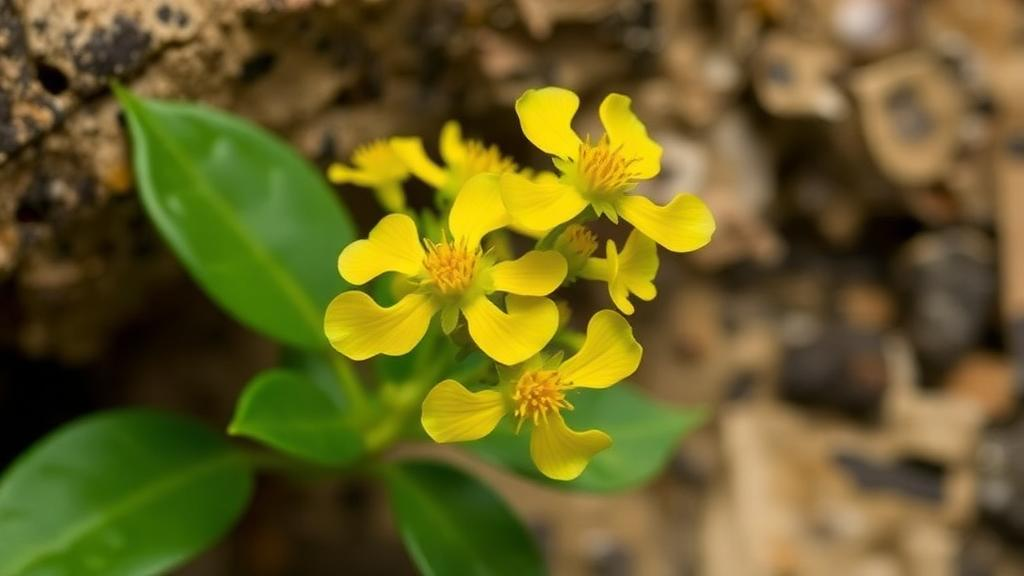
High on a moist limestone cliff in western Yunnan, China, botanists have identified a strikingly beautiful plant that turns out to be entirely new to science. The species, now formally named Oreocharis fulvovillosa, belongs to the large and botanically celebrated family Gesneriaceae, the group that includes African violets and countless ornamental gemplants of Asian forests. Its discovery, published in the journal PhytoKeys, reads like a miniature field detective story: a single population of roughly seventy mature individuals, clinging to a rock face of barely fifty by fifty metres, hiding in plain sight on an isolated karst hill near the summit of which nothing similar had ever been recorded. The find underscores how much unexplored biodiversity still survives in small, fragmented habitats that fall far outside the boundaries of formal protected areas.
The first encounter took place in 2019, when one of the researchers, surveying orchids in Dehong County in Yunnan Province, came across an unidentified member of the genus Oreocharis growing on a rock wall. At the time, the plants could not be confidently assigned to any described species. Only in August 2025, during a carefully planned revisit, did the team manage to document the full range of morphological variation within the population and to search adjacent habitats that looked superficially suitable. Remarkably, no additional populations were found anywhere in the surrounding landscape, a result that immediately raised conservation concerns and sharpened the scientific case for describing the plant as a new species.
Oreocharis is a genus of perennial, rock-dwelling herbs in the gesneriad subfamily Didymocarpoideae, tribe Trichosporeae, subtribe Didymocarpinae. After a major taxonomic redefinition in 2011, which folded several formerly recognised genera such as Ancylostemon into its circumscription, and after a wave of subsequent new descriptions, the genus now contains more than 160 species. Its members are distributed widely across the tropical and subtropical regions of East Asia, and the great majority grow on steep mountain cliffs, typically on siliceous substrates. That preference for vertical, nutrient-poor, structurally complex rock faces has made Oreocharis a classic example of lithophytic specialization, and it also explains why new species continue to turn up in terrain that few collectors ever bother to climb.
The newly described plants are perennial herbs with very short rhizomatous stems and crowded roots, forming a basal rosette of seven to twelve leaves. The leaf blades are ovate to broadly ovate, papery when dried, shallowly heart-shaped at the base, and conspicuously bullate, meaning their upper surface is puckered or blistered between the veins. Dense, long, fulvous, yellowish-brown hairs cloak the petioles, and this character directly inspired the scientific name, whose epithet literally means tawny-haired. The inflorescences are pair-flowered cymes borne in the leaf axils, each carrying two to six zygomorphic flowers with slender yellow tubular corollas roughly two centimetres long. Four fertile stamens are hidden inside the tube, their filaments sharply bent back near the apex so that the anthers, which cohere in pairs, point upward. A single staminode and a ring-shaped disc complete the floral architecture.
It is the combination of yellow corollas and bullate leaves that places Oreocharis fulvovillosa within a small, morphologically coherent species group, and it is the fine details of that combination that set it apart. Among the more than 160 known species, only a handful share this pairing of traits. The new species most closely resembles O. bullata in its vegetative morphology and O. fulva in the form of its corolla, and it shows a general resemblance in leaf shape to O. hekouensis. The authors therefore conducted a rigorous comparative analysis, examining living plants in the field, studying herbarium material at major Chinese and international herbaria, consulting digital images of type specimens through JSTOR Global Plants, and reviewing the relevant taxonomic literature in detail.
The resulting comparison is decisive. Oreocharis fulvovillosa has crenulate, softly scalloped leaf margins, whereas O. bullata is doubly dentate, and the two species differ dramatically in flower and fruit proportions: the corolla tube of the new species is a slender tube of roughly one centimetre, compared with a tube of about 2.7 centimetres in O. bullata, and its capsules measure only one to 1.9 centimetres against 3.0 to 4.2 centimetres in its relative. Against O. fulva, which shares the yellow tubular corolla, the new species is separated by its strongly bullate leaves and crenulate rather than serrate to crenate margins. O. hekouensis lacks bullate leaves, has a much longer corolla tube of 2.4 to 3.0 centimetres, longer calyx lobes of around ten millimetres, stamens fused to the corolla tube for seven to eight millimetres rather than two to two and a half, and larger capsules. Taken together, these differences comfortably justify recognition of the Dehong population as a distinct species.
The formal description rests on a holotype specimen collected on 27 August 2025 at 1,950 metres elevation on the surface of moist cliffs in Mang City, Dehong Dai and Jingpo Autonomous Prefecture, and deposited at the herbarium of the Kunming Institute of Botany, with isotypes at other institutions. The species flowers from August to September and fruits in September. Internally, the anatomy follows the classic gesneriad blueprint: the ovary is single-loculed with two bifid, intrusive parietal placentas, the stigma is two-lobed, and the capsules dehisce loculicidally, splitting along the locule walls to release the seeds. The calyx is divided into five nearly equal lanceolate lobes almost to its base, a feature that again helps distinguish the plant from O. bullata, whose calyx is lobed only from the middle.
Perhaps the most consequential part of the paper concerns conservation. Targeted surveys within approximately one kilometre of the type locality failed to locate any additional subpopulations, meaning the entire known global range of Oreocharis fulvovillosa consists of a single cliff face near the summit of one small limestone hill. Using the IUCN standard two-by-two-kilometre grid, the area of occupancy is estimated at just four square kilometres, and the extent of occurrence cannot be meaningfully calculated from a single point. With approximately seventy mature individuals, the species is exposed to stochastic environmental events and to human pressures such as habitat degradation or collection. The authors accordingly assessed it as Critically Endangered under criterion B1ab(iii)+B2ab(iii) and D of the IUCN Red List Categories and Criteria, while noting that the assessment is preliminary and may be revised if future surveys in adjacent karst areas reveal more plants.
Beyond its formal taxonomy, the discovery carries a broader message about isolated karst landscapes. The scattered karst landform patches of western Yunnan, with their thin soils and rugged topography, often retain primary subtropical broad-leaved forest, and the cliff faces beneath these forests create ecological niches in which narrow endemics can persist for millennia. Oreocharis fulvovillosa grows on limestone rather than the siliceous rocks favoured by most of its relatives, hinting at the evolutionary versatility of the genus and at the role of edaphic specialization in driving local diversity. Because many of these karst islands lie outside nature reserves, their unique cliff-dwelling floras remain effectively unprotected, and the authors explicitly call for further investigation, research, and conservation action in such areas before small, irreplaceable populations vanish.
The story also illustrates how modern plant taxonomy actually works. Recent phylogenetic studies based on extensive sampling have clarified species relationships within Oreocharis and confirmed that characters such as corolla form, indumentum, and stamen structure are genuinely informative for delimiting species, giving morphological comparisons a molecular anchor. In the case of the new species, the diagnosis could be framed entirely on reproducible morphological evidence, checked against type specimens held in herbaria across several continents. For now, a tiny yellow-flowered herb with tawny, hairy stalks, known in Mandarin as Dehong zhiban jutai, survives on a single fifty-metre stretch of cliff in Dehong. Whether it remains there for another century will depend less on taxonomic science, which has now done its part, than on whether the fragile karst habitat it inhabits receives the protection it so clearly deserves.
Subject of Research: Taxonomic description and conservation assessment of a new cliff-dwelling plant species from Yunnan, China
Article Title: Oreocharis fulvovillosa ( Gesneriaceae ), a new species from western Yunnan, China
Article References: Wang, Y., Jiang, H., Xu, B., & Han, M.-Q. (2026). Oreocharis fulvovillosa (Gesneriaceae), a new species from western Yunnan, China. PhytoKeys, 276, 17-23. https://doi.org/10.3897/phytokeys.276.182136
Image Credits: AI Generated
DOI: 10.3897/phytokeys.276.182136
Keywords: Oreocharis fulvovillosa, Gesneriaceae, new species, Yunnan, karst, limestone cliffs, Critically Endangered, IUCN Red List, taxonomy, endemic plants, Dehong, China
Cite Scienmag News
Margaret Porter. (October 19, 2026). Yellow-flowered cliff dweller revealed as new plant species from Yunnan karst. Scienmag. https://scienmag.com/yellow-flowered-cliff-dweller-revealed-as-new-plant-species-from-yunnan-karst/
Margaret Porter. "Yellow-flowered cliff dweller revealed as new plant species from Yunnan karst." Scienmag, 19 October 2026, https://scienmag.com/yellow-flowered-cliff-dweller-revealed-as-new-plant-species-from-yunnan-karst/. Accessed 19 October 2026.
Margaret Porter. "Yellow-flowered cliff dweller revealed as new plant species from Yunnan karst." Scienmag. October 19, 2026. https://scienmag.com/yellow-flowered-cliff-dweller-revealed-as-new-plant-species-from-yunnan-karst/


