


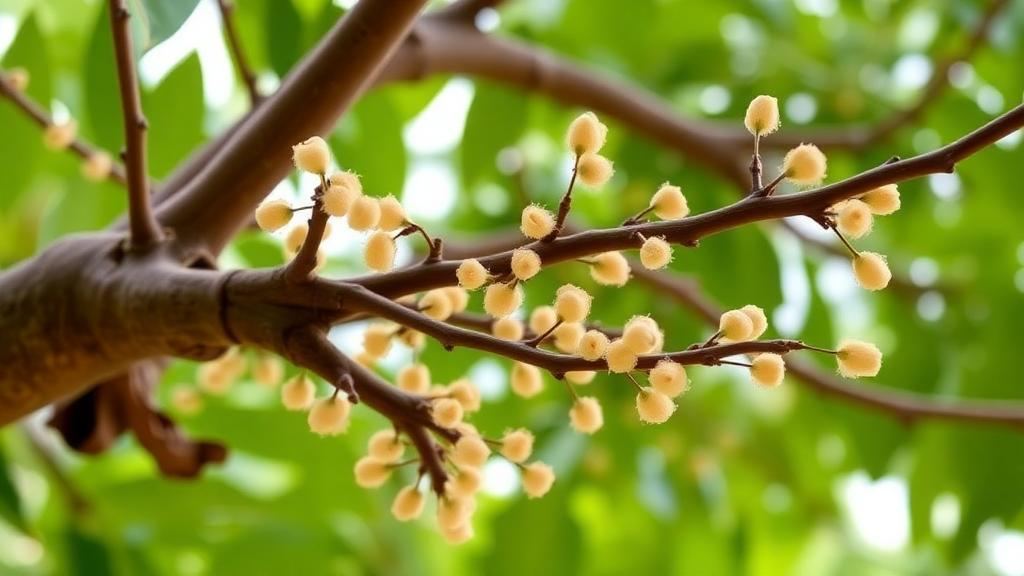
Deep in the dry forests of Bahia, Brazil, a spiny shrub known locally as “pau-de-jararaca” has quietly been used in traditional medicine for ulcers and gastritis. Now, chemists at the Federal University of Minas Gerais have peeled back its molecular secrets, and what they found in its branches includes a triterpene never before described by science, along with a known compound that kills chronic lymphocytic leukemia cells while sparing healthy blood cells. The study, published in Frontiers in Natural Products, represents the first phytochemical investigation of the branches of Monteverdia acanthophylla, a Celastraceae species endemic to the Cerrado and Caatinga biomes and long confused with its relatives in the old genus Maytenus.
The team, led by Rafael do Prado Gomes and Grasiely Faria de Sousa, collected one kilogram of dried branch material in the municipality of Maracás, Bahia, and subjected it to extraction with solvents of increasing polarity. Maceration with hexane yielded 2.54 grams of extract, while successive chloroform extractions delivered 8.3 grams. Preliminary thin-layer chromatography suggested the presence of triterpenoids, the pentacyclic molecules for which the Celastraceae family is famous. The chloroform extract posed a practical challenge familiar to anyone working with this plant family: it contained gutta-percha, a 1,4-trans-polyisoprene polymer common in Celastraceae species that can contaminate fractions and complicate purification. The chemists exploited the polymer’s insolubility in methanol, loading the extract onto a silica column and eluting first with methanol, which selectively stripped out the triterpenoid constituents while the sticky polymer stayed trapped at the top of the column.
From the hexane extract, classical column chromatography over silica gel produced two compounds: friedelan-3β-ol, a friedelane-type triterpene, and 11α-hydroxylup-20(29)-en-3-one, a lupane-type ketone reported here for the first time as a metabolite of M. acanthophylla. The chloroform extract, after its methanolic portion was fractionated into 170 subfractions, yielded a white solid that would turn out to be entirely new to the chemical literature: lup-20(29)-ene-2α,3α,11α-triol, a triply hydroxylated lupane derivative. Total yields were vanishingly small, as is typical for natural product chemistry, with the new compound representing roughly 0.0008 percent of the dry plant mass.
Establishing the structure of the new molecule demanded a full battery of spectroscopic weapons. High-resolution electrospray ionization mass spectrometry nailed the molecular formula as C30H50O3, with characteristic chlorine-adduct and sodium-adduct ions at m/z 493.34613 and 481.36481. The proton NMR spectrum revealed seven methyl singlets and the pair of broad singlets around 4.7 and 4.5 parts per million that betray the terminal alkene of the lupane skeleton, alongside three oxygenated methine protons. The carbon spectrum showed thirty resonances, including alkene carbons at 150.3 and 109.9 ppm and three hydroxyl-bearing carbons at 78.5, 69.8, and 66.1 ppm.
The tricky part was stereochemistry. Chemical shift comparisons suggested the new compound resembled the known 2β,3β-dihydroxylup-20(29)-ene, but carbon-2 appeared significantly more shielded, hinting that the configuration at that position differed. The answer came from coupling constants and nuclear Overhauser effect correlations. The H-3 proton appeared as a small doublet with a coupling constant of just 2.8 hertz, which could only arise from a cis relationship with H-2, since C-4 carries no hydrogen. That placed both H-2 and H-3 on the β-face of ring A, flipping the hydroxyl groups to α-orientations. Meanwhile, the H-11 signal, a doublet of triplets with a large 10.3-hertz axial-axial coupling, established that proton as axial and β-oriented, putting the third hydroxyl in an α-equatorial position. NOESY cross-peaks between the methyl groups H-24 and H-25 and the oxygenated methine protons confirmed the assignments from three dimensions of the molecule at once.
With structures secured, the team turned to biology, testing the new compound and its ketone cousin against human leukemia cell lines using the MTT colorimetric assay. Compound 1 was evaluated against THP-1 acute monocytic leukemia cells and MEC-1 chronic B-cell leukemia cells, while compound 2 was tested against MEC-1. Crucially, the researchers also measured toxicity toward non-cancerous peripheral blood mononuclear cells from a healthy donor to gauge selectivity, an essential control when screening potential anticancer agents.
The results were starkly asymmetric. The new triol, compound 1, was essentially inert, with IC50 values above 218 micromolar in both leukemia lines and no detectable harm to healthy cells. Compound 2, by contrast, killed MEC-1 cells with an IC50 of 39.75 micromolar while leaving healthy mononuclear cells unharmed even at 227 micromolar, yielding a selectivity index greater than 5.7. Previous work had reported much weaker selectivity for this compound, with indices of only 1.82 and 1.55 against THP-1 and K562 cells, making the present result a notable improvement in the compound’s anticancer credentials. It also outperforms lupeol, a well-known lupane triterpene that required concentrations above 155 micromolar to achieve comparable leukemia cell killing.
The structural contrast between the two molecules offers a preliminary lesson in structure-activity relationships. Both share the same lupane framework and the same 11α-hydroxyl group, yet only compound 2, which bears a ketone at carbon-3 and lacks the extra hydroxylation at carbon-2, showed cytotoxicity. The authors suggest that the oxidation pattern of ring A, particularly the C-3 carbonyl, may be a decisive factor in modulating activity against this leukemia model. They caution, however, that confirmatory studies with additional analogues and mechanistic experiments will be needed, and they also note a subtlety in their own data: resting peripheral blood cells differ markedly in metabolic activity from proliferating leukemia cells, so the selectivity index should be treated as a preliminary estimate rather than a definitive therapeutic window.
Beyond the anticancer angle, the discovery matters for what it says about plant chemistry and evolution. The identification of a new hydroxylated lupane widens the known structural diversity within the genus Monteverdia and contributes to chemotaxonomic mapping of the Celastraceae, a family of roughly 1,300 species across 98 genera. That family already supplies Brazil’s public health system with an herbal medicine, the dry leaf extract of Monteverdia ilicifolia, one of just twelve herbal drugs on the national essential medicines list, used against gastric ulcers. That a spiny shrub from the same lineage, sampled under Brazilian genetic heritage regulations and deposited as a voucher specimen, can still hand chemists an entirely new molecule with a hint of leukemia-selective activity is a reminder of how much pharmacological potential remains locked in understudied branches, literally, of the plant tree of life.
Subject of Research: Isolation of new lupane-type triterpenes from Monteverdia acanthophylla branches and their cytotoxicity against leukemia cell lines
Article Title: Triterpenoid constituents from the branches of Monteverdia acanthophylla
Article References: Gomes, R. D. P., Souza, L. B. E. D., Jardim, M. E. C. D. S., Aguilar, M. G. D., Sabino, A. D. P., Duarte, L. P., & Sousa, G. F. D. (2026). Triterpenoid constituents from the branches of Monteverdia acanthophylla. Frontiers in Natural Products, 5, Article 1893762. https://doi.org/10.3389/fntpr.2026.1893762
Image Credits: AI Generated
DOI: 10.3389/fntpr.2026.1893762
Keywords: Monteverdia acanthophylla, triterpenes, lupane, Celastraceae, natural products, cytotoxicity, leukemia, NMR spectroscopy, phytochemistry, MEC-1, selectivity index, anticancer
Cite Scienmag News
Nathaniel Bowman. (October 19, 2026). Brazilian Tree Branches Yield New Triterpene With Selective Activity Against Leukemia Cells. Scienmag. https://scienmag.com/brazilian-tree-branches-yield-new-triterpene-with-selective-activity-against-leukemia-cells/
Nathaniel Bowman. "Brazilian Tree Branches Yield New Triterpene With Selective Activity Against Leukemia Cells." Scienmag, 19 October 2026, https://scienmag.com/brazilian-tree-branches-yield-new-triterpene-with-selective-activity-against-leukemia-cells/. Accessed 19 October 2026.
Nathaniel Bowman. "Brazilian Tree Branches Yield New Triterpene With Selective Activity Against Leukemia Cells." Scienmag. October 19, 2026. https://scienmag.com/brazilian-tree-branches-yield-new-triterpene-with-selective-activity-against-leukemia-cells/


