


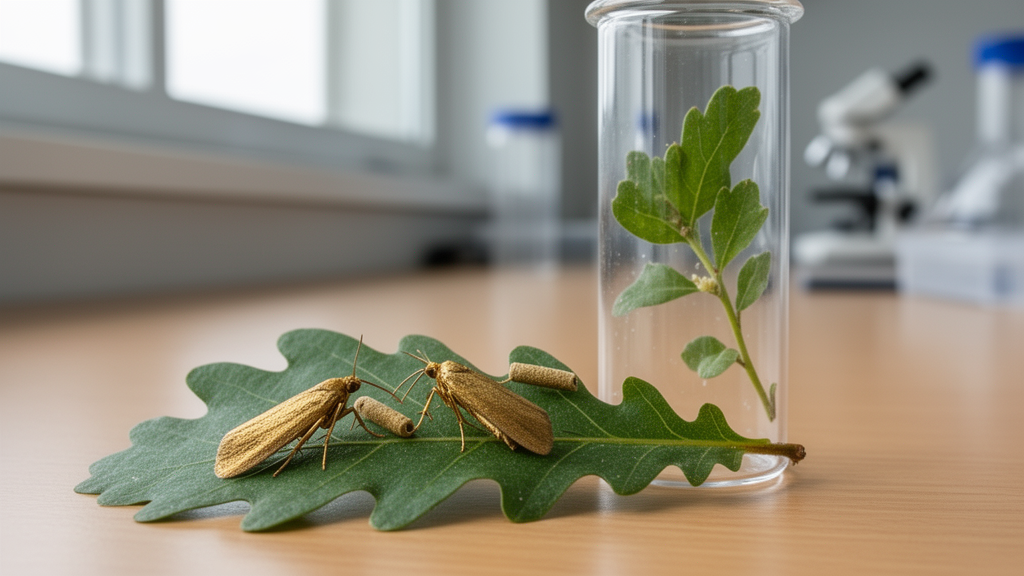
Some of Europe’s smallest moths have spent centuries hiding in plain sight, wrapped in silken portable houses that mimic seeds, flower heads and dried leaves. Now a team of Hungarian and Italian lepidopterists has pulled back the curtain on two of these elusive insects, documenting for the first time the host plants, larval cases and full life histories of Coleophora lessinica Baldizzone, 1980 and Coleophora impalella Toll, 1961. The study, published in the journal Nota Lepidopterologica, combines painstaking field rearing with DNA barcode sequencing, and along the way adds Romania to the known range of one species and expands the Hungarian record of the other.
The family Coleophoridae, commonly known as case-bearer moths, includes more than 1,500 described species worldwide, with the overwhelming majority concentrated in the Palaearctic region. Europe alone hosts 621 species in the genus Coleophora, while Hungary’s fauna counts 211 members of the family. What makes these moths remarkable is their larvae’s architecture: each caterpillar constructs and carries a case made of silk, often reinforced with pieces of its host plant, retreating inside when threatened and extending only its head and thorax to feed. Because the cases are so distinctive, they can serve as powerful identification characters, yet for countless species those cases, and indeed the host plants themselves, have never been described by science.
Coleophora lessinica was originally described from the Lessini mountains near Verona in Italy and had been recorded from Bulgaria, Croatia, France, Italy and North Macedonia. Its biology, however, remained entirely unknown. The first Hungarian specimen had been collected in Fejér county back in 2000, but nothing was known about what the species ate or how its larvae lived. The new research shows that the larvae feed on Artemisia alba, a white wormwood of dry, rocky habitats. The discovery emerged from systematic surveys of this host plant across Hungarian limestone and dolomite hills, from the Bakony and Vértes mountains to the Balaton Uplands and the Villány Hills.
The case-building behaviour of C. lessinica turns out to be elaborate. The young larva starts by hollowing out the centre of a dry inflorescence of Artemisia alba, reinforcing the leftover husk with silk so that the flower head keeps its original shape while providing mobile camouflage. Up to three or four larvae may feed on a single plant. After consuming several inflorescences from within this protective shell, the fourth-instar larva constructs a tubular silk case beneath the first one. As the seeds fall away from the tubular case, the larva seeks out a fresh, intact inflorescence, attaches its case, chews its way inside, and undergoes its final moult in this shelter before descending to the base of the plant for the winter.
Overwintering occurs at the base of the host plant, with the larva climbing the stem to its lowest leaves during August and September, permanently attaching the case to the stem and then performing a crucial U-turn inside it in preparation for pupation. The mature case has its mouth opening at a right angle to the case’s long axis and a trivalved anal end, changing colour from light brown before winter to dark brown afterwards. The researchers note that the early case closely resembles that of the related Coleophora absinthii, but there is a telling difference: C. lessinica builds its first case from a single inflorescence, whereas C. absinthii unites three flower heads before making its overwintering case.
The second species, Coleophora impalella, has an even more checkered history. It was described in 1961 from a single old male collected in southern Russia, with the female only described decades later from the mid-Volga region. Outside the Volga area and the Crimean Peninsula, the only known population was at Bélmegyer in Hungary. The new study documents larvae feeding on Galatella sedifolia, a coast-daisy relative of the Pannonic salt steppes, contradicting a 2021 report that had linked the species to a different host, Galatella linosyris. The larva builds a sheath case from leaf strips of two to six millimetres long, spun together with overlap, eventually reaching about twelve millimetres before overwintering attached to the dried host plant. Feeding resumes on fresh spring leaves, and adults emerge ten to twelve days after the case is finally secured.
The discovery also extended the species’ geography: a single case collected at Grăniceri, in Romania’s Arad county near the Hungarian border, represents the first record of C. impalella outside Russia and Hungary, and a new country record. The finding matters ecologically because the moth inhabits Asteretum sedifolii salt steppe and salt marsh communities, habitats formed by secondary salinisation and shaped by the harsh continental climate of extreme temperatures and erratic rainfall that stretches into the Ukrainian and Russian steppe belt. Given how widespread the host plant is, the authors argue that a truly disjunct distribution for the moth is unlikely, and further populations probably await discovery.
Connecting adult moths, larvae and host plants is where DNA barcoding proved decisive. The team sequenced the standard COI barcode region from four larvae, amplifying it with the classic Folmer primers LCO-1490 and HCO-2198, purifying the products and sequencing them bidirectionally. For the Galatella-feeding larva, a GenBank search found no exact match, but the closest hit, at 99.5 per cent similarity, was a Russian specimen of C. impalella, and the BOLD identification engine assigned the larva to that species with 99.5 per cent probability. The Hungarian and Russian populations differ by just three nucleotide positions, a 0.5 per cent intraspecific distance, and form a monophyletic cluster in neighbour-joining analysis.
The Artemisia-feeding larvae posed a subtler challenge. Their closest GenBank matches were three specimens of Coleophora artemisicolella at 97.57 per cent similarity, and BOLD’s similarity-based tool could not choose between C. lessinica and the closely related C. magyarica, since related species in this group carry highly similar barcodes. Tree-based identification pointed decisively to C. lessinica, and the molecular verdict was confirmed by dissection of adult genitalia, the gold standard of moth taxonomy. Notably, the DNA sequences of Macedonian and Hungarian populations of C. lessinica were identical, and every Hungarian location where Artemisia alba occurs yielded the moth, suggesting the species is considerably more widespread than published records imply. The sequences have been deposited in both the BOLD System and GenBank, creating reference barcodes that future researchers can match.
Behind these results lies a lesson in patience. The authors describe rearing young case-bearer larvae as difficult and cumbersome: the caterpillars are hypersensitive to food quality and disturbance, larvae in unventilated containers succumb to mould, while open containers let the food plant dry out. The most dangerous moment is the case change, and even larvae that reach the final fifth instar often fail to perform the fatal U-turn inside their case and die. After overwintering, the larval stage drags on for another four to five months, with pupation occurring only three to four weeks before the adult emerges. Yet rearing on host plants grown in the authors’ own gardens, covered with tulle bags to block escaping larvae and marauding parasitoids, remains the most efficient way to unlock the biology of these insects, and it is precisely this marriage of old-fashioned natural history and modern molecular tools that has finally given two obscure moths a documented life story.
Subject of Research: Biology, host plants, larval cases and DNA barcoding of the case-bearer moths Coleophora lessinica and Coleophora impalella
Article Title: Biology and DNA barcode analysis of Coleophora lessinica Baldizzone, 1980 and Coleophora impalella Toll, 1961 ( Lepidoptera , Coleophoridae ) with description of their larval cases
Article References: Takács, A., Szabóky, C., Boldog, G., Jordán, S., Bozsó, M., Fülöp, D., & Tóth, B. (2022). Biology and DNA barcode analysis of Coleophora lessinica Baldizzone, 1980 and Coleophora impalella Toll, 1961 (Lepidoptera, Coleophoridae) with description of their larval cases. Nota Lepidopterologica, 45, 191-205. https://doi.org/10.3897/nl.45.80106
Image Credits: AI Generated
DOI: 10.3897/nl.45.80106
Keywords: Coleophora, Lepidoptera, Coleophoridae, DNA barcoding, COI, larval case, host plants, Artemisia alba, Galatella sedifolia, Hungary, Romania, BOLD
Cite Scienmag News
Margaret Porter. (October 18, 2026). Hidden Lives of Two Case-Bearer Moths Revealed by Rearing and DNA Barcodes. Scienmag. https://scienmag.com/hidden-lives-of-two-case-bearer-moths-revealed-by-rearing-and-dna-barcodes/
Margaret Porter. "Hidden Lives of Two Case-Bearer Moths Revealed by Rearing and DNA Barcodes." Scienmag, 18 October 2026, https://scienmag.com/hidden-lives-of-two-case-bearer-moths-revealed-by-rearing-and-dna-barcodes/. Accessed 18 October 2026.
Margaret Porter. "Hidden Lives of Two Case-Bearer Moths Revealed by Rearing and DNA Barcodes." Scienmag. October 18, 2026. https://scienmag.com/hidden-lives-of-two-case-bearer-moths-revealed-by-rearing-and-dna-barcodes/


