


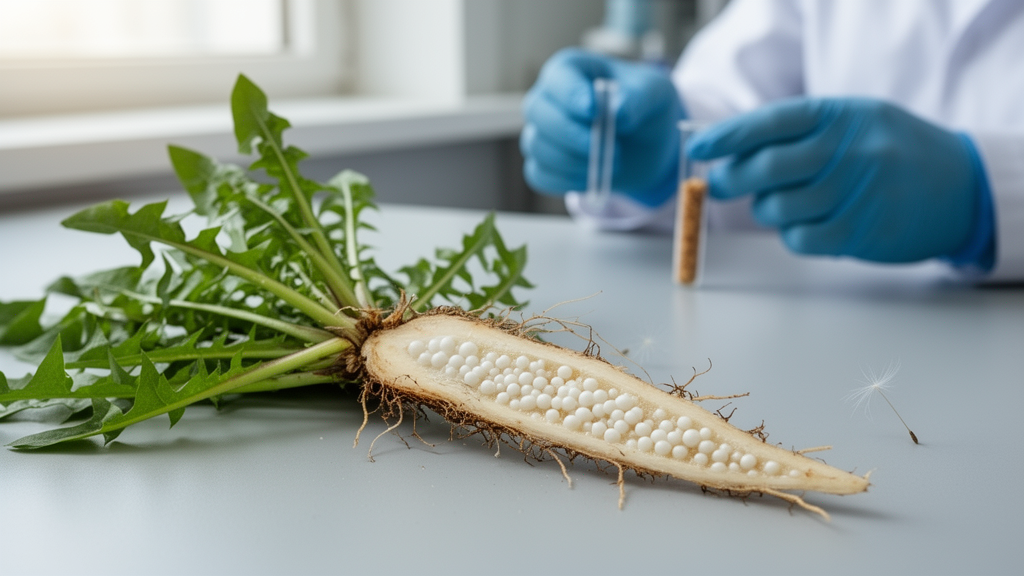
Deep in the roots of a humble Kazakh dandelion lies a molecule the modern world cannot do without: natural rubber. Taraxacum kok-saghyz, often called TKS or the Russian dandelion, accumulates natural rubber and inulin in quantities that have made it one of the most closely watched alternative industrial crops of the past decade. Now a research team led by Juanying Wang and Xuchu Wang of Guizhou University, working with colleagues at Lakehead University in Canada and Shaoyang University in China, has published a dual omics dissection of how this plant builds its rubber, identifying a latex-centered regulatory module that could steer the molecular breeding of high-rubber-yielding lines. The study, published in BMC Plant Biology, integrates transcriptomic and proteomic analyses across four tissues to reveal the genes and proteins that make TKS tick.
The motivation is straightforward. Nearly all natural rubber in commerce comes from the rubber tree, Hevea brasiliensis, a tropical species whose cultivation is geographically concentrated and increasingly vulnerable to disease and land-use pressure. TKS offers a temperate alternative: its roots produce rubber particles suspended in latex, and its taproots also store inulin, a high-added-value fructan used in food and pharmaceutical applications. Yet the tissue-specific regulation of natural rubber biosynthesis in TKS has remained poorly resolved. Which tissues actually run the biosynthetic program, which genes are switched on there, and which proteins carry out the work are questions that a single omics layer cannot fully answer.
To close that gap, the team profiled four TKS samples in parallel: main roots, lateral roots, main leaves, and latex. The scale of the survey was substantial. Across the four tissues, the researchers identified 31,569 genes and 2,782 proteins, and then asked which of these showed pronounced tissue specificity. The answer was revealing. Genes and proteins specific to latex were mainly enriched in terpenoid backbone biosynthesis, the metabolic highway that supplies the isoprenoid building blocks from which rubber polymer is assembled. That enrichment pattern places the latex compartment, not the bulk root tissue, at the center of the rubber-building enterprise.
The analytical machinery behind this conclusion is worth unpacking. Transcriptomics measures the messenger RNA output of every gene, telling researchers which genetic instructions are being read in each tissue. Proteomics measures the actual protein complement, telling them which molecular machines are physically present. Because mRNA abundance and protein abundance do not always track each other, integrating the two layers is the only rigorous way to distinguish genes that are merely transcribed from genes whose products are actively deployed. The team used a nine-quadrant analysis to cross-reference the two datasets, plotting transcripts and proteins together and isolating candidates whose expression correlated positively across tissues.
That cross-referencing paid off. The nine-quadrant analysis highlighted 19 natural rubber biosynthesis-related candidates with positively correlated expression, and among them three names recurred consistently across tissue comparisons: SRPP5, SRPP9, and REF1. These are not random picks. SRPP proteins, short for small rubber particle proteins, and REF proteins, short for rubber elongation factors, are the canonical structural components of rubber particles in latex. They are thought to stabilize the rubber polymer as it is synthesized and to govern particle architecture, making their consistent presence across tissue comparisons a strong signal that the same core machinery operates wherever rubber is made in the plant.
Going further, the researchers built co-expression subnetworks centered on natural rubber biosynthesis, derived from latex-associated modules. In these networks, genes that rise and fall together across tissues are treated as functionally connected, and the most connected nodes are interpreted as hubs of coordinated activity. The subnetworks highlighted SRPP4, SRPP5, SRPP6, SRPP9, REF1, CPTL1, and ACAT4 as highly connected nodes. CPTL1 belongs to the cis-prenyltransferase-like family, enzymes directly involved in polymerizing isopentenyl units into the rubber backbone, while ACAT4 is an acetyl-CoA acetyltransferase that feeds the mevalonate pathway upstream of isoprenoid production. The network picture therefore spans the entire biosynthetic pipeline, from precursor supply to polymer assembly and particle stabilization.
Perhaps the most intriguing layer of the study concerns regulation rather than structure. Superimposed on the biosynthetic machinery, the team identified transcription factors of the bHLH, C3H, and TCP families, together with proteins annotated as HP, LEA, and R40G3, linked to multiple natural rubber biosynthesis-related genes and proteins. Transcription factors are the switches that turn gene programs on and off, and the fact that three distinct families converge on the rubber module suggests an additional coordinated regulatory layer that the structural genes alone do not capture. LEA proteins, typically associated with dehydration tolerance, and the other associated proteins hint that rubber accumulation may be entwined with the latex cell’s stress physiology, a connection that deserves targeted follow-up.
The researchers did not rely on the omics data alone. They validated selected natural rubber biosynthesis genes by quantitative real-time PCR, an independent technique that measures transcript abundance with high sensitivity. The qPCR results corroborated the robustness of the transcriptomic dataset, confirming that the tissue-specific expression patterns were not artifacts of sequencing depth or normalization. This kind of orthogonal validation is what separates a credible candidate list from a speculative one, and it strengthens the case that the 19 candidates and the seven network hubs are genuine leads rather than statistical noise.
The practical implications reach into molecular breeding. Rubber yield in TKS is a quantitative trait shaped by many genes, and breeders have historically relied on phenotypic selection, a slow process constrained by the plant’s life cycle and the difficulty of measuring rubber content non-destructively. A prioritized list of candidate regulators changes the calculus. Markers linked to SRPP and REF variants, or to the bHLH, C3H, and TCP transcription factors identified here, could accelerate selection for high-rubber-yielding lines. The same candidates could also inform genome editing or transgenic approaches aimed at rerouting carbon flux toward rubber synthesis, potentially raising yields in a crop that can be grown on temperate farmland rather than tropical plantations.
The study also leaves open questions that the field will now pursue. How the latex-centered regulatory module is switched on during root development, whether the LEA and HP proteins reflect a stress-coupled dimension of rubber accumulation, and how the transcription factor layer communicates with the biosynthetic enzymes are all unresolved. What the current work establishes is the molecular framework: a latex-centered module comprising SRPP and REF proteins and associated transcription factors plays a pivotal role in coordinating natural rubber biosynthesis in TKS. For a world searching for secure, sustainable rubber supply, that framework is a map, and the candidates it highlights are the signposts for the next generation of rubber crops.
Subject of Research: Plant Molecular Biology
Article Title: Tissue-specific transcriptome and proteome analyses of Taraxacum kok-saghyz reveal key genes for natural rubber biosynthesis
Article References: Wang, J., Ma, J., Yuan, B., He, L., Nie, Q., Deng, T., Wang, S., Qin, W., & Wang, X. (2026). Tissue-specific transcriptome and proteome analyses of Taraxacum kok-saghyz reveal key genes for natural rubber biosynthesis. BMC Plant Biology. https://doi.org/10.1186/s12870-026-09968-8
Image Credits: AI Generated
DOI: 10.1186/s12870-026-09968-8
Keywords: Taraxacum kok-saghyz, natural rubber biosynthesis, transcriptomics, proteomics, transcription factors, latex, SRPP, REF, molecular breeding, BMC Plant Biology, Tissue-specific, transcriptome
Cite Scienmag News
Juliet Wilcox. (October 18, 2026). Dandelion Rubber Genes Uncovered in Dual Omics Map of Taraxacum kok-saghyz. Scienmag. https://scienmag.com/dandelion-rubber-genes-uncovered-in-dual-omics-map-of-taraxacum-kok-saghyz/
Juliet Wilcox. "Dandelion Rubber Genes Uncovered in Dual Omics Map of Taraxacum kok-saghyz." Scienmag, 18 October 2026, https://scienmag.com/dandelion-rubber-genes-uncovered-in-dual-omics-map-of-taraxacum-kok-saghyz/. Accessed 18 October 2026.
Juliet Wilcox. "Dandelion Rubber Genes Uncovered in Dual Omics Map of Taraxacum kok-saghyz." Scienmag. October 18, 2026. https://scienmag.com/dandelion-rubber-genes-uncovered-in-dual-omics-map-of-taraxacum-kok-saghyz/


