


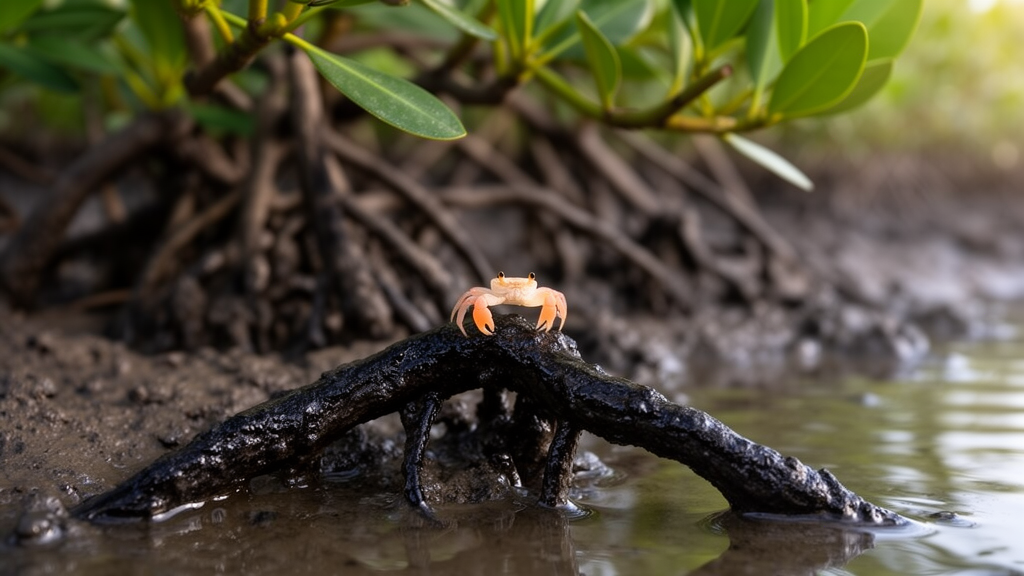
A new species of intertidal crab, designated as Ilyoplax kagga, has been formally described by researchers from the Aghanashini River Estuary on the west coast of India. This discovery adds to the growing catalogue of crustacean diversity in the Indo-West Pacific region, highlighting the continued biological richness of coastal ecosystems in India. The species belongs to the genus Ilyoplax, which currently comprises twenty-eight recognized species, all of which inhabit muddy coastal flats. The identification of Ilyoplax kagga marks a significant addition to the five species of this genus previously known from the Indian subcontinent, underscoring the importance of detailed taxonomic surveys in well-studied yet biologically complex areas.
The new species was collected from the upper mudflat areas within the mangroves of the Aghanashini River Estuary, a site recently designated as a RAMSAR wetland of international importance. The estuary is located in the state of Karnataka, bordering the Arabian Sea. The habitat consists of soft-muddy substrates and oyster beds, providing a specific niche for this small crab. The designation of the area as a RAMSAR site emphasizes its ecological value and the need for conservation efforts to protect the unique biodiversity found within its boundaries. The discovery of a new species in such a protected area further validates the conservation status of the estuary.
Ilyoplax kagga is distinguished from its closest relative, Ilyoplax gangetica, by several marked morphological differences. These distinctions include the shape of the carapace, the armature of the anterolateral margins, and the specific structure of the stridulatory ridges. The number and type of tubercles present on the carapace also differ significantly between the two species. Additionally, the dentition on the carpus and palm of the chela, as well as the extent of setae on the ambulatory legs, provide clear diagnostic features. The structure of the male first gonopods offers further confirmation of the species’ distinct identity, ensuring accurate classification within the family Dotillidae.
The carapace of Ilyoplax kagga is transversely rectangular and smooth, measuring approximately 1.5 to 1.6 times wider than it is long. The surface is microscopically granular, featuring low ridges and transverse setae that contribute to its cryptic appearance in the muddy substrate. The frontal margin is bilobed with gently convex margins, while the external orbital angle forms an acutely triangular, sharp tooth. This tooth is separated from the rest of the margin by a distinct concavity. The anterolateral margin is minutely denticulated, with the first tooth being low and lacking a second tooth or lobe. These features contrast with the subrectangular carapace of Ilyoplax gangetica, which has a different ratio of width to length and distinct marginal granulation.
The stridulatory ridge, a key feature for species identification in dotillid crabs, is particularly complex in Ilyoplax kagga. In males, the ridge bifurcates around the median part of the suborbital region. The outer half of the main ridge contains 22 to 24 subconical tubercles with corneous tips, while the inner half features 5 to 7 fungiform tubercles. The last tubercle in the inner half is the largest, with a cap that is entirely corneous. Females exhibit a similar pattern but with an additional short ridge of stridulatory granules containing 30 rounded tubercles. This intricate arrangement of tubercles and ridges serves as a definitive marker separating Ilyoplax kagga from other congeners, such as I. delsmani and I. stapletoni, which possess different tubercle shapes and ridge configurations.
The chelipeds of adult male Ilyoplax kagga are heterochelous, meaning they are unequal in size, with the major chela being distinctly swollen and broader. The carpus is short and rhomboidal, armed with a short inner tooth. The palm is broad, with its lower margin lined by two rows of granules that gradually increase in size towards the dactylus. In contrast, the chelipeds of Ilyoplax gangetica are subequal, with a more elongate and slender carpus. The ambulatory legs of Ilyoplax kagga are proportionately longer and more slender, with tufts of plumose setae present on the carpus and propodus of the second and third legs in males. These setae are absent on the second leg in females but present in a less dense form on the third leg. This sexual dimorphism in setation provides additional diagnostic criteria for the species.
The species is named in recognition of Kagga, an endemic rice variety that is highly salt-tolerant and traditionally cultivated in the Aghanashini village. The name honors the many generations of ethnic farmers who have preserved and cultivated this unique rice variety through traditional practices. The specific epithet is used as a noun in apposition, linking the biological discovery to the cultural and agricultural heritage of the region. This naming convention highlights the interconnectedness of local biodiversity and human history, emphasizing the role of traditional knowledge in preserving unique ecological and agricultural resources in the estuary.
Ilyoplax kagga is currently known from the coastal villages of Aghanashini near Kumta and the Kali River Estuary near Karwar in Karnataka. The species may also occur in the Mandavi River Estuary in Goa. The crabs are often difficult to collect due to their small body size, cryptic coloration, and burrowing behavior. They reside in narrow burrows in the muddy-sandy bottom of the upper intertidal areas, emerging only briefly under suitable tidal conditions for feeding. Males are dark brown dorsally with reddish inner sides of the ambulatory legs, while females have a greenish-brown carapace when frozen and a reddish hue in life. The presence of this species in large numbers in the Aghanashini River Estuary suggests a stable population within this specific habitat.
The description of Ilyoplax kagga contributes to the broader understanding of crustacean diversity in the Indo-West Pacific region. The genus Ilyoplax is considered polyphyletic, meaning it contains multiple distinct evolutionary lineages, which necessitates detailed taxonomic revisions. The new species adds to the five known species from the Indian subcontinent and two from Pakistan, expanding the geographic and morphological range of the genus. The use of scanning electron microscopy in this study allowed for the detailed examination of microstructures, such as the gastric mill and setae, which are crucial for accurate species identification. This level of morphological detail ensures that the new species is correctly placed within the family Dotillidae and distinguished from similar species in the region.
The discovery of Ilyoplax kagga in a RAMSAR site underscores the importance of protecting coastal wetlands for biodiversity conservation. The Aghanashini River Estuary, with its mangroves and oyster beds, provides a critical habitat for various marine and intertidal species. The presence of a new, endemic crab species highlights the ecological complexity of the area and the need for continued scientific monitoring. As climate change and human activities pose threats to coastal ecosystems, documenting and understanding the biodiversity of these regions becomes increasingly vital. The study serves as a reminder that even well-explored areas can hold undiscovered species, emphasizing the ongoing value of taxonomic research in conservation biology.
Subject of Research: Description of a new intertidal crab species, Ilyoplax kagga, from the Aghanashini River Estuary in India
Article Title: A new species of intertidal crab of the genus Ilyoplax Stimpson, 1858 ( Decapoda , Brachyura , Dotillidae ) from the Aghanashini River Estuary, a RAMSAR site on the west coast of India
Article References: Prema, M., Kakati, V. S., & Ng, P. K. L. (2026). A new species of intertidal crab of the genus Ilyoplax Stimpson, 1858 (Decapoda, Brachyura, Dotillidae) from the Aghanashini River Estuary, a RAMSAR site on the west coast of India. ZooKeys, 1291, 19-38. https://doi.org/10.3897/zookeys.1291.201892
Image Credits: AI Generated
DOI: 10.3897/zookeys.1291.201892
Keywords: Ilyoplax kagga, Dotillidae, Aghanashini River Estuary, RAMSAR site, Intertidal crab, Karnataka, Crustacean taxonomy, Mangrove ecosystem, Biodiversity, ZooKeys, species, intertidal
Cite Scienmag News
Margaret Porter. (October 18, 2026). Tiny Crab Species Discovered in Indian Mangrove Estuary. Scienmag. https://scienmag.com/tiny-crab-species-discovered-in-indian-mangrove-estuary/
Margaret Porter. "Tiny Crab Species Discovered in Indian Mangrove Estuary." Scienmag, 18 October 2026, https://scienmag.com/tiny-crab-species-discovered-in-indian-mangrove-estuary/. Accessed 18 October 2026.
Margaret Porter. "Tiny Crab Species Discovered in Indian Mangrove Estuary." Scienmag. October 18, 2026. https://scienmag.com/tiny-crab-species-discovered-in-indian-mangrove-estuary/


