


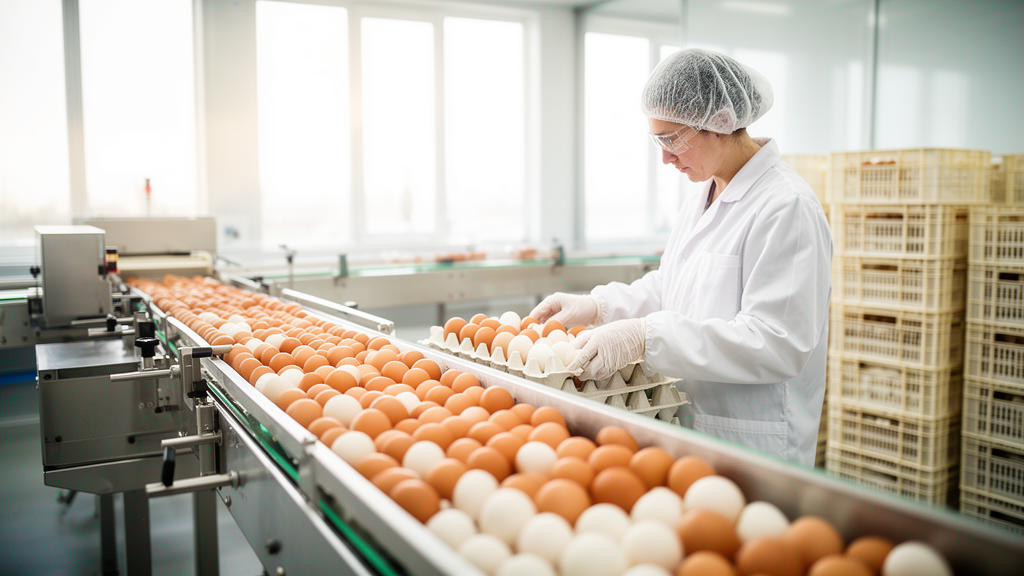
Salmonella Enteritidis remains one of the most persistent threats in the global food supply, and eggs are its most notorious vehicle. In 2017, European authorities recorded 91,662 human salmonellosis cases, equivalent to 19.7 cases per 100,000 population, with S. Enteritidis the most prevalent serovar in domestically acquired infections across the European Union. Among 269 strong-evidence food-borne outbreaks reported that year, 99 — roughly 37 percent — were traced to eggs and egg products. Now, researchers have built a generic quantitative microbial risk assessment model that follows a single contaminated egg from the moment it is laid all the way to the consumer’s plate, converting storage times, temperatures and cooking habits into an expected number of salmonellosis cases per million servings.
The new model, published in the Food Modelling Journal, estimates two key outputs: the number of illnesses per million servings of egg and the probability of illness when a random serving is ingested. It is adapted from the European Food Safety Authority’s 2014 Scientific Opinion on public health risks of table eggs, but sets new illustrative values for contamination prevalence and storage conditions. Crucially, the model is released in Food Safety Knowledge Markup Language, or FSK-ML, an open exchange format built on harmonised terms, metadata and controlled vocabulary that packages the model script, visualisation script and simulation settings together so that other risk assessors can reuse and adapt it with minimal friction.
Technically, the exposure assessment is structured as six process steps along the farm-to-household chain: on farm before collection, during grading, during transport to wholesale, during storage at wholesale, at retail, and finally at household. At each step, the model tracks the internal temperature of the egg, which starts at 41.2 degrees Celsius at laying and then decays progressively toward the ambient storage temperature. The decay follows an exponential cooling equation in which the internal temperature T equals the storage temperature plus the difference between the initial internal temperature and the storage temperature, multiplied by an exponential term governed by a cooling rate constant and the time spent in that stage. Storage temperatures and durations at each step are drawn from Pert distributions, capturing the variability introduced by ventilation systems, air humidity and handling practices.
The pivotal biological event in the model is the breakdown of the yolk membrane. While that membrane remains intact, growth of S. Enteritidis in the albumen is considered insignificant, because the albumen’s antimicrobial properties keep the bacterium in check. The membrane’s resistance, however, declines with time and temperature — and with physical vibrations during transport. The model calculates the time of yolk membrane breakdown, TRMV, through a linear relationship with temperature, using an intercept of 2.0872 hours and a slope of minus 0.042579 hours per degree Celsius. Because the temperature changes across stages, the calculation is performed hourly: the inverse of the TRMV at the prevailing temperature is cumulated across the egg’s life, and once that cumulative sum reaches or exceeds one, the membrane is deemed ruptured. From that point, yolk nutrients diffuse into the albumen and Salmonella growth becomes possible throughout the egg.
Once the membrane fails, the model switches to a Rosso-type growth rate equation to describe bacterial proliferation. The maximum growth rate is the product of the optimal growth rate, set at 1.6 log10 colony-forming units per gram per hour, and a gamma mitigation factor that depends on temperature. That factor drops to zero below the minimum growth temperature of 6.29 degrees Celsius and above the maximum of 43.46 degrees Celsius, peaking near the optimum of 40.11 degrees Celsius. Growth rates are reassessed hourly and cumulated until the end of storage, yielding a number of ten-fold increases, NCD, for each egg. The final Salmonella count per egg is then the initial concentration — drawn from a Poisson distribution with a mean of 7 and a minimum of 1 cell per egg — multiplied by ten raised to the power of NCD.
Cooking enters the model as a decisive reduction step. Three scenarios are defined: uncooked, lightly cooked and well cooked. Lightly cooked eggs experience a log10 reduction drawn from a normal distribution with a mean of 2 and a standard deviation of 0.5, while well-cooked eggs achieve a mean reduction of 12 log10 with a standard deviation of 1 — an enormous difference in surviving bacteria. The number of bacteria ingested is the pre-cooking count multiplied by ten raised to the negative reduction. A beta-Poisson dose-response model, parameterised from Thomas and colleagues’ 2006 work with coefficients alpha of 0.1345 and beta of 53.33, then converts the ingested dose into a probability of salmonellosis per contaminated serving, assuming variability in host-pathogen interaction is beta distributed.
Running the default simulation with 2,000 iterations to explore variability, and an illustrative contamination prevalence of 10 percent, the model produces striking numbers. Under the entered time-temperature conditions, lightly cooked eggs would generate 186 salmonellosis cases per million servings. The risk from well-cooked eggs is 1,690 times lower than for lightly cooked eggs, thanks to the near-sterilising effect of thorough cooking. Raw egg consumption carries roughly twice the risk of lightly cooked eggs. In the default settings, 90 percent of consumers are assumed to cook eggs well, which heavily weights the overall risk estimate toward the well-cooked scenario.
Perhaps the most practically relevant output is the relationship between egg age and risk. The model shows that the probability of illness per consumed egg rises sharply after nine days of storage, when the cumulative membrane damage under typical ambient conditions allows bacterial growth to accelerate. This gives regulators and retailers a quantitative basis for recommendations on refrigeration and shelf life: keeping eggs below the minimum growth temperature of 6.29 degrees Celsius effectively freezes the risk clock, while storage at ambient temperature rapidly advances it. The cumulative distribution of the log10 probability of illness for a random contaminated serving, weighted by the mix of lightly and well-cooked consumption practices, rounds out the risk characterisation.
The authors emphasise that the model is deliberately generic and adaptable. Prevalence, fixed at 10 percent for illustration, can be replaced with more realistic surveillance values, and the frequency of well-cooked egg consumption can be recalibrated against national dietary surveys. Time-temperature profiles for production, transport and storage can be swapped to reflect specific national supply chains. Because the model travels in FSK-ML format with its R script, visualisation script and simulation settings bundled together, a food safety authority in one country can execute it online with default parameters or upload new ones, making quantitative risk assessment for eggs a reusable, transparent and openly shared tool rather than a one-off analysis.
Subject of Research: Quantitative microbial risk assessment for Salmonella in eggs
Article Title: Quantitative microbial risk assessment for Salmonella in eggs
Article References: Desvignes, V., Buschhardt, T., Guillier, L., & Sanaa, M. (2019). Quantitative microbial risk assessment for Salmonella in eggs. Food Modelling Journal, 1, Article e39643. https://doi.org/10.3897/fmj.1.39643
Image Credits: AI Generated
DOI: 10.3897/fmj.1.39643
Keywords: Quantitative, microbial, risk, assessment, Salmonella, eggs, scientific research
Cite Scienmag News
Alan Morgan. (October 17, 2026). New Model Quantifies Salmonella Risk in Eggs From Farm to Fork. Scienmag. https://scienmag.com/new-model-quantifies-salmonella-risk-in-eggs-from-farm-to-fork/
Alan Morgan. "New Model Quantifies Salmonella Risk in Eggs From Farm to Fork." Scienmag, 17 October 2026, https://scienmag.com/new-model-quantifies-salmonella-risk-in-eggs-from-farm-to-fork/. Accessed 17 October 2026.
Alan Morgan. "New Model Quantifies Salmonella Risk in Eggs From Farm to Fork." Scienmag. October 17, 2026. https://scienmag.com/new-model-quantifies-salmonella-risk-in-eggs-from-farm-to-fork/


