


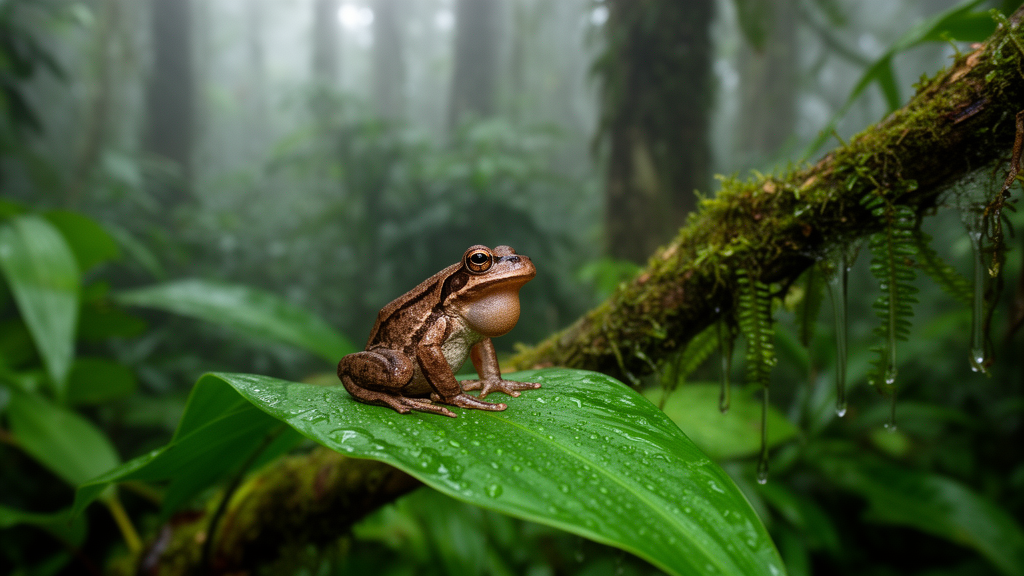
Deep in the mid-altitude rainforests of Ranomafana National Park in south-eastern Madagascar, two frogs that look almost identical to the trained eye have turned out to be entirely separate species. Researchers surveying streams and rocky cave formations at elevations of around 1,000 to 1,300 meters have formally named Spinomantis lakolosy and Spinomantis lavabato, two new members of the Spinomantis bertini species complex in the family Mantellidae. The discovery, published in the journal Evolutionary Systematics, is striking because Ranomafana is one of the most intensively surveyed amphibian sites on the island, yet these small, stream-dwelling frogs had gone undocumented until targeted night searches along fast-flowing water and within cave-like rock structures finally revealed them.
Spinomantis is a genus with one of the most convoluted systematic histories among Malagasy amphibians. Over the past century, its species were shuffled among unrelated genera including Boophis, Mantidactylus, Guibemantis, Gephyromantis, and even the Asian genus Rhacophorus. This instability reflected the genus’s exceptional ecomorphological diversity: some species are arboreal and bear striking dermal spines and fringes on their limbs, while others are ground-dwelling and partly or largely saxicolous, living on and around rocks. Molecular phylogenetics eventually showed that these morphologically varied frogs form a single monophyletic group. Fourteen Spinomantis species are currently formally named, with at least ten additional candidate species awaiting description, and only two new species have been added in the past decade, leaving much of the genus’s diversity undocumented.
The two new species belong to the S. bertini complex, a group of small, smooth-skinned frogs without fringes or spines that are associated with stream habitats. Morphologically, they are cryptic: adults measure roughly 22 to 27 millimeters in snout-vent length, and their coloration, proportions, and overall appearance overlap substantially with S. bertini, S. beckei, and S. mirus. The researchers could separate them only by combinations of subtle characters, most notably a weak or absent sharp dorsolateral color border. In most individuals of the other complex members, the transition between dorsal and flank coloration runs along a distinct, regular line; in both new species this border is diffuse, with light dorsal markings extending onto the flanks and brown flank tones matching the dorsum. Spinomantis lakolosy shows dark brown flanks with hints of red on the flanks and hind limbs and golden eyes, while S. lavabato has copper irises and a mottled frenal stripe.
What truly sets the new species apart is sound. Spinomantis lakolosy, whose name is the Malagasy word for bell, has the longest note duration in the complex, with tonal notes lasting 67 to 105 milliseconds arranged in series of 7 to 10 notes per call, and a dominant frequency of only 2,454 to 2,497 Hz. The call is powerful and rings like a bell, loud enough to be heard over the sound of rushing water in the streams where the males perch on mossy rocks and low vegetation. Spinomantis lavabato, named after the Malagasy phrase for rock hole or cave, sits at the opposite acoustic extreme: its click notes are the shortest in the complex at 20 to 26 milliseconds, the call is quiet and trill-like, and its dominant frequency is much higher at 3,789 to 4,134 Hz. Uniquely, the amplitude of each lavabato call starts low and builds to maximum in the final note.
These acoustic differences make ecological sense. The researchers suggest that S. lakolosy has evolved a longer note duration and a lower dominant frequency than expected for its body size precisely because the rest of the complex, made up of similarly sized frogs, calls at higher spectral frequencies that would overlap with the broadband noise of rushing streams. By shifting its call below the sound of the water, males ensure their signals reach females. Spinomantis lavabato, in contrast, uses its environment to its advantage: males call from within cave-like rock formations, where the quiet calls echo from the rock interiors, and the species was even observed calling during the day, a behavior known in few other Spinomantis apart from S. elegans, which occupies the same microhabitat.
Genetic evidence corroborates the species boundaries. The team sequenced a 519-base-pair fragment of the mitochondrial 16S rRNA marker from 11 specimens of the S. bertini complex and six specimens of S. guibei, reconstructed maximum-likelihood phylogenies in IQ-TREE, and calculated uncorrected pairwise distances. The two Ranomafana lineages are sister to each other and together form the sister group of all other species in the complex. They differ from all other nominal species by 7.0 to 11.3 percent uncorrected 16S distance, and from each other by 5.4 to 6.2 percent, far exceeding the 3 percent reference threshold long used to flag candidate species of Malagasy frogs. All species and candidate species in the analysis were recovered as reciprocally monophyletic with bootstrap support of 94 to 100 percent.
The concordance of high mitochondrial divergence, subtle morphological differences, and substantial bioacoustic differences in sympatry convinced the authors that the two lineages are distinct species under both evolutionary and biological species criteria. The integrated approach follows the general lineage concept, treating species as separately evolving metapopulation lineages and combining morphology, phylogenetics, bioacoustics, and biogeography. Notably, the two species occur within the same park but at different sites: S. lakolosy is known only from Miranony Forest at around 1,100 meters, while S. lavabato is known only from Maharira at 1,300 to 1,340 meters, where cave-like rock formations dot the trails.
The study also flagged two additional lineages for future work. A population from Andemaka, only 7 kilometers from Miranony but separated by low-elevation valleys, differs from the S. lakolosy type series by 1.4 percent in 16S and has a shorter note duration of less than 20 milliseconds, suggesting it may represent yet another species, an extraordinary example of recent species formation. A second lineage from Ambahavala in the Anosy Chain shows strong mitochondrial divergence of 6.4 to 6.8 percent from S. bertini and S. beckei, but cannot be formally described without voucher specimens and associated call data. If the mitochondrial tree reflects the species tree, the complex shows a clear north-to-south phylogeographic pattern, with successively splitting species occurring at progressively more southern locations.
Both new species are proposed as Endangered under IUCN criterion B1ab(iii), because each is known from a single location and their forests face intense deforestation pressure from slash-and-burn agriculture and extraction of forest products. The discoveries underscore that even relatively well-studied regions like Ranomafana, which lies far from main park entrances at sites requiring multi-day expeditions, still harbor undocumented diversity. The authors argue that survey efforts must extend beyond easily accessible parts of protected areas, and that conservation must safeguard the full ensemble of habitat and elevational diversity, given the specialization and microendemism of many of Madagascar’s amphibians.
Subject of Research: Taxonomy and bioacoustics of Malagasy mantellid frogs
Article Title: Two new species of the Spinomantis bertini species complex ( Mantellidae ) from south-eastern Madagascar
Article References: Hutter, C. R., Andriampenomanana, Z. F., Lambert, S. M., & Vences, M. (2025). Two new species of the Spinomantis bertini species complex (Mantellidae) from south-eastern Madagascar. Evolutionary Systematics, 9(2), 285-299. https://doi.org/10.3897/evolsyst.9.174833
Image Credits: AI Generated
DOI: 10.3897/evolsyst.9.174833
Keywords: Spinomantis, Madagascar, Ranomafana National Park, amphibian taxonomy, bioacoustics, new species, Mantellidae, conservation, species, bertini, complex, south-eastern
Cite Scienmag News
Margaret Porter. (October 17, 2026). Two new bell-voiced frog species discovered in Madagascar’s Ranomafana rainforest. Scienmag. https://scienmag.com/two-new-bell-voiced-frog-species-discovered-in-madagascars-ranomafana-rainforest/
Margaret Porter. "Two new bell-voiced frog species discovered in Madagascar’s Ranomafana rainforest." Scienmag, 17 October 2026, https://scienmag.com/two-new-bell-voiced-frog-species-discovered-in-madagascars-ranomafana-rainforest/. Accessed 17 October 2026.
Margaret Porter. "Two new bell-voiced frog species discovered in Madagascar’s Ranomafana rainforest." Scienmag. October 17, 2026. https://scienmag.com/two-new-bell-voiced-frog-species-discovered-in-madagascars-ranomafana-rainforest/


