


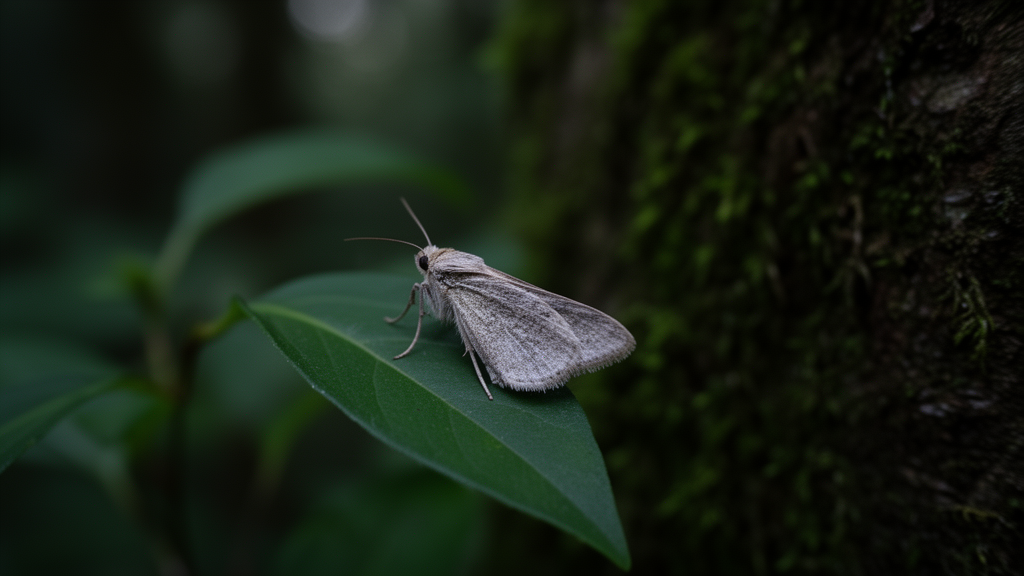
A small moth with rippling dark bands across its forewings has turned out to be a much bigger deal than its six-millimetre wingspan suggests. Researchers describing Homalernis fluctuosa, a new species of tortricid moth from Japan, have recorded the genus Homalernis — and with it the entire tribe Schoenotenini — for the first time in the country and, remarkably, anywhere in the Palaearctic region, the vast biogeographic realm that stretches across temperate Eurasia and North Africa. The discovery, published in the journal Nota Lepidopterologica, quietly redraws the map of a group of moths long thought to be confined to the tropics and subtropics of the Oriental and Australian regions.
The tribe Schoenotenini is no obscure footnote in moth taxonomy. It comprises 34 genera and 233 species, distributed from India to New Zealand, with the overwhelming majority of species living in Oriental and Australian habitats. The tribe was established in 1952 by the Dutch entomologist Alexeter Diakonoff as a family based on the genus Schoenotenes, and its classification has shifted over the decades — treated at times as a subfamily of the tortricid moths, at others as a tribe within Chlidanotinae — before settling into its current position as a tribe of the subfamily Tortricinae. What unites its members morphologically is a distinctive suite of forewing features: an M-stem vein that terminates between veins M1 and M2, an almost equally spaced arrangement of the radial veins, and often patches of raised scales that give the wings a textured, almost sculpted appearance.
The new species was uncovered not in some remote wilderness but among unidentified specimens sitting in Japanese museum collections. While examining tortricid moths gathered across Japan, Shinya Suzuki and Utsugi Jinbo of the National Museum of Nature and Science encountered numerous specimens that did not match any known species. Detailed morphological examination confirmed that they were dealing with something entirely new to science — and something entirely new to the Palaearctic biogeographic realm. The species has now been recorded from Honshu, Shikoku, Kyushu, Tsushima Island, Amamiooshima Island and Okinawajima Island, revealing a surprisingly broad distribution across the Japanese archipelago, from the warm temperate mainland south to the subtropical Ryukyu chain.
Confirming the species was only half the battle. One of the most persistent problems with Homalernis has been that no species in the genus had ever been described from both sexes. The type species, H. semaphora, was described by Edward Meyrick in 1908 from Assam in India, allegedly from a male and a female — though Diakonoff later discovered that the supposed male was in fact a female. Meyrick’s second species, H. arystis, described in 1918, was also based on a female alone. Two further species, H. jeriau and H. mankoboi, were described by Józef Razowski in 2012 from single males each, their placement in the genus resting on superficial similarity and wing venation. This lopsided knowledge base has made it genuinely difficult to know what a male Homalernis even looks like.
The Japanese team solved this problem with molecular tools. They extracted DNA from the abdomens of six adult specimens and amplified a 658-base-pair region of the mitochondrial cytochrome oxidase subunit 1 gene, the standard DNA barcode region, using the classic Folmer primers. The results were decisive: a male and a female collected on the same day at the same Hiroshima locality showed a genetic distance of just 0.15 percent under the Kimura two-parameter model, confirming beyond reasonable doubt that males and females of the new species had finally been correctly associated. All six specimens shared the same barcode index number, BOLD:AFM6059, and their sequences have been deposited in GenBank, giving future researchers an unambiguous molecular reference for the species.
Morphologically, H. fluctuosa is a textbook Schoenotenini member, and the description is rich in technical detail. The forewings, four to seven millimetres long, are greyish white with scattered pale brown scales and a striking pattern of narrow dark fasciae in the apical third — three distinct bands that inspired the species name, which derives from the Latin flucticulus, meaning a small ripple or wave. Females bear a blackish-brown dorsal blotch at a third of the way along the wing, subtriangular with rounded corners, while the corresponding mark in males is linear. The hindwing is slender and long, roughly three-quarters the length of the forewing and sparsely scaled except along the veins, another hallmark of the tribe. The forewing venation shows the diagnostic M-stem clearly present, running to a point between veins M1 and M2.
The genitalia provide the strongest evidence for the species’ placement. In the male, the uncus — a hook-like structure at the rear of the genital capsule — is deeply bifurcated into two long, narrow lobes, and the valva carries both a dorsoposterior projection reaching about half the valva’s length and a saccular projection about a third of it. The gnathos bears five short, pointed spines. In the female, the corpus bursae contains a pair of wedge-shaped signa, each a round basal plate with a flattened blade-like projection pointing inward. Suzuki and Jinbo identified these features, together with the short fused base of the bifurcate uncus and the membranous valva, as putative synapomorphies — shared derived characters — that define the genus Homalernis within the tribe.
The discovery also throws doubt on two of the genus’s existing members. The external appearance and male genitalia of H. jeriau and H. mankoboi, both from Malaysia, differ significantly from the new species and from the type species. Their hindwings are narrow and densely scaled, unlike the sparse, vein-concentrated scaling of any other schoenotenine; they lack raised scales on the forewing; and their male genitalia show a distinctly petiolate uncus, a broad median gnathos arm and a valva with a single long ventral spine-shaped process — features that instead recall the tribe Tortricini. Compounding the problem, Razowski’s original description noted only ‘a somewhat simplified venation’, yet wing venation is precisely the character that matters here: all known Schoenotenini retain at least a trace of the forewing M-stem ending between M1 and M2, whereas every other tortricid group with an M-stem has it ending between M2 and M3. The authors argue that the generic and tribal position of the two Malaysian species may need to be re-evaluated.
The wider relationships of Homalernis have long rested on fragmentary observations. Diakonoff noted similarities in wing venation with the genus Diactenis and in female genitalia with Metachorista, while Common pointed to Syncratus based on the twisted ductus bursae and paired signa. The new study, with both sexes finally available, allows a more rigorous comparison. Homalernis and Diactenis share an M-stem originating from the basal third of the median cell, whereas in Metachorista it originates near the middle; Homalernis and Metachorista share the round basal plates of their signa, which Diactenis lacks entirely; and all four genera share an elongated, tapering phallus tip. Taken together, these features suggest Homalernis sits closest to Diactenis and Metachorista, though the authors stress that a comprehensive DNA-based phylogenetic analysis of the whole tribe is needed to settle the question.
Biogeographically, the find is the most intriguing part of the story. Homalernis, excluding the questionable Malaysian species, was previously known only from Assam in India — and now Japan. H. fluctuosa is the most northerly species in the entire tribe Schoenotenini, extending the group’s range deep into the warm temperate Palaearctic. The species shows subtle geographic structure too: the specimen from Okinawajima Island carries barcodes 1.56 to 2.38 percent distant from those of mainland populations and has slightly shorter forewings, hinting at possible differentiation, though the authors provisionally assign it to H. fluctuosa pending further evidence. Given that an additional undescribed schoenotenine is already suspected in the Ryukyu Islands, the authors predict that Homalernis and its relatives will likely turn up in the northern Oriental and southern Palaearctic regions as well. A moth small enough to sit on a fingertip has, in other words, quietly rewritten the distribution of an entire lineage — and shown how much still waits in museum drawers and mountain forests across Asia.
Subject of Research: Taxonomic description of a new tortricid moth species and the first Palaearctic record of the tribe Schoenotenini
Article Title: A new species of Homalernis Meyrick, 1908 ( Lepidoptera , Tortricidae , Tortricinae ) represents the first record of the tribe Schoenotenini in Japan
Article References: Suzuki, S., Jinbo, U., Yagi, S., & Hirowatari, T. (2024). A new species of Homalernis Meyrick, 1908 (Lepidoptera, Tortricidae, Tortricinae) represents the first record of the tribe Schoenotenini in Japan. Nota Lepidopterologica, 47, 113-123. https://doi.org/10.3897/nl.47.120384
Image Credits: AI Generated
DOI: 10.3897/nl.47.120384
Keywords: Homalernis fluctuosa, Schoenotenini, Tortricidae, Lepidoptera, new species, Japan, DNA barcoding, COI gene, taxonomy, biogeography, Palaearctic region, male-female association
Cite Scienmag News
Juliet Wilcox. (October 17, 2026). New moth species makes first-ever record of an entire tribe in Japan. Scienmag. https://scienmag.com/new-moth-species-makes-first-ever-record-of-an-entire-tribe-in-japan/
Juliet Wilcox. "New moth species makes first-ever record of an entire tribe in Japan." Scienmag, 17 October 2026, https://scienmag.com/new-moth-species-makes-first-ever-record-of-an-entire-tribe-in-japan/. Accessed 17 October 2026.
Juliet Wilcox. "New moth species makes first-ever record of an entire tribe in Japan." Scienmag. October 17, 2026. https://scienmag.com/new-moth-species-makes-first-ever-record-of-an-entire-tribe-in-japan/


