


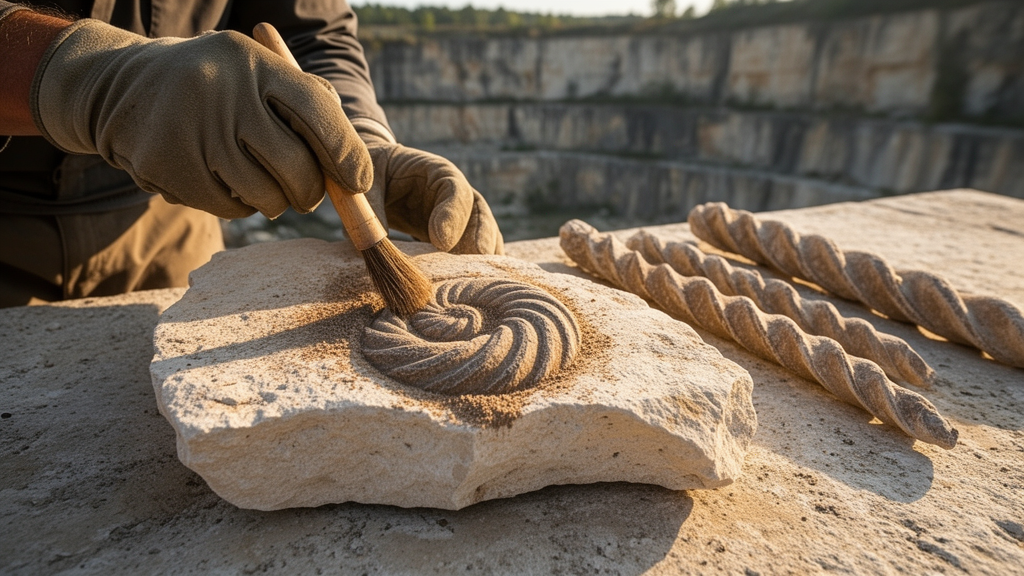
In a limestone quarry at Saal an der Donau in Bavaria, southern Germany, palaeontologists have documented a remarkable assemblage of rudist bivalves from rocks roughly 155 million years old, dating to the late Kimmeridgian stage of the Late Jurassic. The study, published in the journal Zitteliana, describes five species belonging to the order Hippuritida, including two that are entirely new to science: a bizarre, corkscrew-shaped bivalve named Saalidiceras syllai and a small reef-dweller called Hypelasma fritzlangi. The findings suggest that Late Jurassic rudist faunas were considerably more diverse than previously recognised, and that some of these animals may have been restricted to very small geographic areas.
Rudists are an unusual group of bivalves that, unlike their free-living clam relatives, cemented themselves to the seafloor and grew into a wide variety of shapes, from coiled snail-like forms to horn-shaped and cylindrical shells. They dominated shallow tropical seas during the Cretaceous, but their evolutionary roots reach back into the Jurassic. The two most basal families, the Diceratidae and the Epidiceratidae, appeared suddenly in the mid Oxfordian, around 160 million years ago. Both share two key evolutionary innovations: cementation to a hard substrate, which produced strongly asymmetric valves, and an outer shell layer made of calcite rather than the aragonite typical of most bivalves. The closest known common ancestor of these clades is thought to be a Middle Jurassic pachyrismatid called Pachyrisma grande, yet a gap of roughly five million years in the fossil record still separates that ancestor from the first definitive rudists, and researchers still do not know which of the two basal families evolved first.
The limestones at Saal an der Donau belong to the Kelheim Member of the Frankenalb Formation, a succession of massive, coarse, highly fossiliferous detrital limestones approximately 120 metres thick that interdigitate with reef bodies. The unit was originally named the Kelheimer Diceras-Kalk, or Diceras Limestone, after some of its most conspicuous fossils, the coiled early rudists collectively referred to as Diceras. Ironically, the authors note, according to modern classifications no true Diceras actually occurs in these rocks. Ammonites collected from various levels in the quarry bracket the exposed succession within the late Kimmeridgian Aulacostephanus eudoxus and Hybonoticeras beckeri zones, providing a precise age window for the fauna.
The material studied came largely from the efforts of amateur collectors, whose donations are curated at the Bavarian State Collection for Palaeontology and Geology in Munich. The largest collection was assembled by the late Jürgen Sylla, after whom the new corkscrew species is named, while additional specimens were contributed by Fritz Lang, the late Michael Reichel and Heinz Haberl. The team also restudied and rephotographed nineteenth-century type material described by Goldfuss and Boehm, and examined Gemmellaro’s original specimens from Sicily held in Palermo. Fossils were cleaned with needles and micro-chisels, whitened with ammonium chloride for photography, and measured with callipers to the nearest half millimetre.
Of the five species documented, two dominate the assemblage. Epidiceras carinatum, originally described from Sicily in 1875, is a large rudist with a sharp keel running from the umbo to the anterior-ventral corner of the shell, dividing its exterior into a flattened anterior portion and a rounded posterior one. The attached left valve can exceed 200 millimetres in height. The team demonstrated that Diceras bavaricum, named by Boehm in 1881 from the Kelheim area, is a junior synonym of this Sicilian species, resolving a taxonomic dispute that has persisted for nearly a century and a half. The second abundant species, Plesiodiceras valfinense, is a smaller form up to 60 millimetres high, with a short-conical attached valve and a tiny, operculum-like free valve, first described from the French Jura Mountains.
The first new species, Saalidiceras syllai, is unlike any other Jurassic rudist known. Its crescent-shaped commissure is bounded by two massive, broadly rounded keels that enclose a broad anterior trough, and its attached left valve coils through nearly two whorls like a corkscrew, while the free right valve forms only half a whorl. The authors speculate that the very small attachment surface may have been insufficient to keep such large shells upright, and suggest that part of the left valve may have been buried in soft sediment, anchoring the animal the way a manmade screw would, or that adults rested edgewise on the seafloor. Because the hinge and interior are unknown, and all specimens show some diagenetic alteration, the exact affinities of the genus remain based on external coiling geometry and valve asymmetry, which nonetheless justify its placement in the Epidiceratidae. So far it is known only from the type locality, making it a candidate endemic taxon.
The second new species, Hypelasma fritzlangi, belongs to the Requieniidae, a family in which the attached left valve is strongly inequivalve and the angle between the coiling axis and the commissural plane is small, bringing the flattened anterior face of the shell into close contact with the substrate. Hypelasma fritzlangi differs from its two previously known relatives in lacking the sharp carinae that characterise them, and in the details of its hinge dentition. Intriguingly, in most specimens the commissural plane intersects the spiral portion of the shell, a requieniid trait, but the growth habit remains relatively erect, more like an epidiceratid. The authors suggest this species might phylogenetically link the two families, though they assign it to the Requieniidae for now. A single specimen was found attached inside the valve of a Plesiodiceras valfinense, indicating the two species lived in close proximity.
The fifth species, Valletia auris, is the only diceratid in the fauna and is recorded from southern Germany for the first time, only the fourth report of this species overall. Its known range now extends from the late Kimmeridgian of France, through the Bau Limestone of Sarawak on Borneo, to early Berriasian strata in the Crimean Mountains. Remarkably, the Saal specimens preserve external ornament, a feature previously unknown in the genus, consisting of short commarginal costellae on the juvenile shell and a reticulate pattern on the adult anterior slope.
A peculiar taphonomic puzzle emerges from the preservation of these shells. Like all Hippuritida, the Saal rudists had a thin outer calcitic layer and a thicker inner aragonitic portion. In the fossils, the aragonite has recrystallised to calcite, while the original biogenic calcite layer, which carries the ornament, is usually dissolved away. The authors propose that early diagenetic, non-biogenic calcite formed first and was subsequently more stable than the thin original outer layer, explaining this counterintuitive pattern. Because ornament is so rarely preserved, its taxonomic value remains limited.
Ecologically, the evidence points to low-energy, protected lagoonal environments rather than open-marine settings. The rudists account for only a minor part of the assemblage, which is dominated by rich hermatypic coral communities comprising at least 25 genera that formed reef bodies interspersed with soft-sediment patches. Roughly 60 bivalve species and as many as 179 gastropod species have been collected from the quarry, making it one of the richest Late Jurassic gastropod faunas known globally. The absence of Epidiceras speciosum, documented from nearby localities of similar age, suggests differing ecological requirements among closely related rudists. The authors emphasise that without documented sedimentary context, the community structure and palaeoenvironmental settings of these assemblages remain poorly understood, and they call for renewed fieldwork to bring rudist research back into the outcrop, where the three-dimensional architecture of these ancient reef communities can finally be reconstructed.
Subject of Research: Late Jurassic rudist bivalve taxonomy and palaeoecology at Saal an der Donau, Bavaria
Article Title: The late Kimmeridgian bivalve fauna of Saal an der Donau (Bavaria, southern Germany): the Hippuritida
Article References: Schneider, S., & Werner, W. (2026). The late Kimmeridgian bivalve fauna of Saal an der Donau (Bavaria, southern Germany): the Hippuritida. Zitteliana, 100, 1-30. https://doi.org/10.3897/zitteliana.100.169922
Image Credits: AI Generated
DOI: 10.3897/zitteliana.100.169922
Keywords: rudists, Hippuritida, Late Jurassic, Kimmeridgian, Bavaria, bivalves, palaeontology, Saalidiceras, Epidiceratidae, Requieniidae, taxonomy, Franconian Alb
Cite Scienmag News
Gavin Prescott. (October 17, 2026). Corkscrew-Shaped Rudist Bivalves From Bavaria Reveal Hidden Diversity of Late Jurassic Seas. Scienmag. https://scienmag.com/corkscrew-shaped-rudist-bivalves-from-bavaria-reveal-hidden-diversity-of-late-jurassic-seas/
Gavin Prescott. "Corkscrew-Shaped Rudist Bivalves From Bavaria Reveal Hidden Diversity of Late Jurassic Seas." Scienmag, 17 October 2026, https://scienmag.com/corkscrew-shaped-rudist-bivalves-from-bavaria-reveal-hidden-diversity-of-late-jurassic-seas/. Accessed 17 October 2026.
Gavin Prescott. "Corkscrew-Shaped Rudist Bivalves From Bavaria Reveal Hidden Diversity of Late Jurassic Seas." Scienmag. October 17, 2026. https://scienmag.com/corkscrew-shaped-rudist-bivalves-from-bavaria-reveal-hidden-diversity-of-late-jurassic-seas/


