


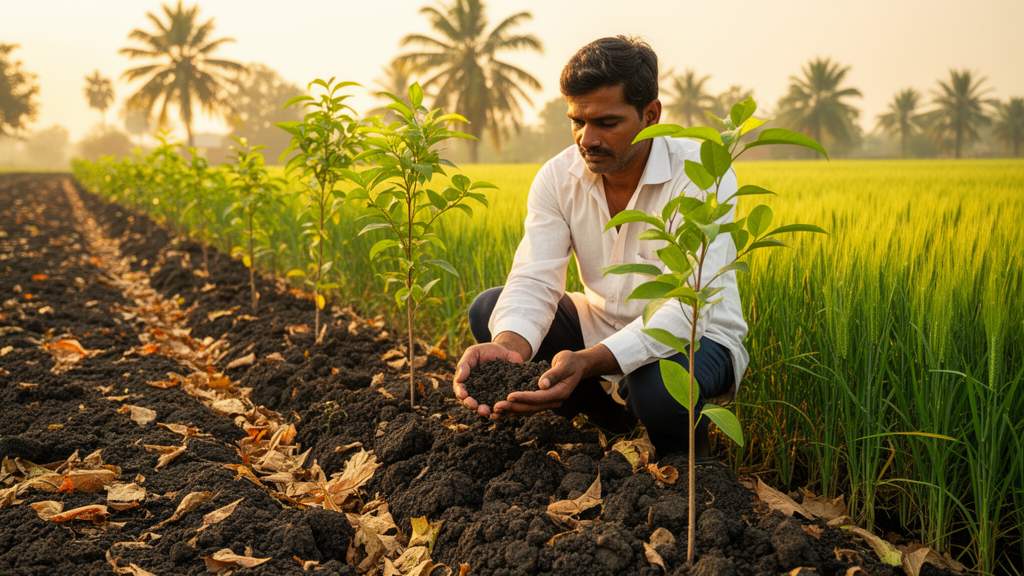
On thousands of small farms across the eastern plains of Uttar Pradesh, farmers have quietly been running one of the world’s largest uncontrolled experiments in ecological restoration. By planting trees alongside crops, along field boundaries, and on grazing land, they have been testing whether tree-based farming can reverse the slow degradation of soils that decades of intensive rice-wheat cultivation have left behind. A new study from Ayodhya district, published in Discover Forests, now provides some of the most detailed field evidence yet that they are succeeding, and that the benefits grow steadily with every year the trees stand.
The research, conducted by Ramesh Kumar Yadav and S. K. Verma of Acharya Narendra Deva University of Agriculture and Technology, set out to quantify what many agroforestry advocates have long assumed but rarely measured under real farm conditions. Rather than relying on researcher-managed experimental plots, the team sampled soils from ten working farms spread across eleven blocks of Ayodhya district, comparing areas with trees to adjacent non-tree plots of the same soil type, slope, and management history. The farms hosted five dominant agroforestry systems: agri-silviculture, agri-horticulture, agri-silvi-horticulture, boundary plantations, and silvipastoral systems, established in 2019, 2022, and 2025.
The technical scope of the sampling was considerable. The team collected 360 soil samples in total, drawn from three depths of 0 to 20, 20 to 40, and 40 to 60 centimeters using a zigzag auger pattern, and composited for each plot. Undisturbed soil cores of 98.2 cubic centimeters were taken with steel cylinders to measure bulk density. In the laboratory, the researchers applied standard analytical methods: Walkley and Black wet oxidation for soil organic carbon, Kjeldahl digestion and titration for total nitrogen, the Olsen method for available phosphorus, and 1 N ammonium acetate extraction with flame photometry for available potassium. Tree density was assessed with the quadrant method in 10 by 10 meter plots, expressed as trees per hectare.
The headline finding concerns soil organic carbon, the single most important indicator of soil fertility and a critical store of carbon that would otherwise contribute to atmospheric carbon dioxide. Organic carbon differed significantly among agroforestry practices, with the highest values recorded under agri-silviculture, followed by agri-silvi-horticulture and boundary plantations, while silvipastoral systems lagged behind. Mixed tree woodlots told an even clearer story about time: woodlots established in 2019 contained 1.37 percent organic carbon, compared with 1.26 percent for those planted in 2022 and 1.21 percent for the youngest systems established in 2025. That represents a 13.22 percent increase in carbon over just six years of system maturity.
Total nitrogen followed the same pattern, differing significantly among practices and reaching its highest levels under agri-silviculture. The researchers attribute this coupling of carbon and nitrogen to the close linkage between organic matter inputs and nutrient dynamics, and to the presence of nitrogen-fixing tree species such as Dalbergia sissoo and Albizia lebbeck, which dominated the agri-silviculture systems alongside Azadirachta indica. Symbiotic nitrogen fixation by these species, the study notes, enhances soil nitrogen availability and improves fertility over time, effectively allowing the trees to fertilize the soil from within.
Available phosphorus showed a different signature. It was highest under the fruit-based agri-silvi-horticulture and agri-horticulture systems, which the authors link to the nutrient-pumping activity of deep tree roots that lift phosphorus from subsurface layers and return it to the surface through litterfall, root turnover, and decomposition. Fallen leaves, twigs, and fruit residues add further organic phosphorus during mineralization. Available potassium, by contrast, did not differ significantly among land-use systems, suggesting a relatively uniform distribution of this nutrient across the landscape. Soil pH remained near-neutral and statistically unchanged across all systems and depths, indicating that the soils possess a buffering capacity that limits short-term shifts in soil reaction despite differences in vegetation and organic inputs.
The physical properties of the soil responded just as decisively. Bulk density was consistently higher under silvipastoral systems, particularly in the surface layers, which the researchers attribute to continuous livestock trampling and reduced organic matter inputs. Across all systems, bulk density increased with depth while total porosity, calculated from bulk density and particle density, showed the inverse trend. Tree-based systems with lower bulk density exhibited significantly higher porosity, indicating improved soil structure, aeration, and water infiltration capacity. The authors connect these improvements to greater organic matter accumulation, fine root turnover, and the biological activity that opens soil aggregates and creates pore space.
Statistical analysis reinforced the coherence of these patterns. A two-way analysis of variance confirmed significant effects of both agroforestry practice and soil depth on most properties, with mean differences separated using Fisher’s Least Significant Difference test at P ≤ 0.05. Principal component analysis revealed that the first two components explained 66.35 percent of total variability, with the first component alone accounting for 53.99 percent of the variance. This component correlated strongly and positively with soil organic carbon, total nitrogen, available phosphorus, available potassium, and tree density, while correlating negatively with bulk density. In plain terms, the more trees a farm supported, the better its soil performed on nearly every fertility and physical measure.
The species composition of the systems reflected farmer economics as much as ecology. Agri-silviculture plots were dominated by Dalbergia sissoo at 28 percent relative density and Azadirachta indica at 22 percent, while boundary plantations favored Eucalyptus camaldulensis at 30 percent and Populus deltoides at 24 percent. Silvipastoral systems supported sparser, uneven distributions of Acacia nilotica and Albizia lebbeck. Tree density itself was highest in agri-silviculture at 3450 trees per hectare and declined across all systems from 2018 to 2024 due to thinning, natural mortality, and system maturation. The authors note that this decline mirrors a broader national trend, citing recent satellite-based research reporting a severe decline in large farmland trees across India over the past decade.
The study concludes that agroforestry should be promoted as a viable land-use strategy for restoring soil quality, improving farm productivity, and enhancing climate resilience in the eastern Indo-Gangetic Plains. The authors recommend long-term, multi-location studies to refine estimates of carbon sequestration potential and to support agroforestry-based climate mitigation strategies. For the smallholder farmers of the region, whose soils suffer from nutrient mining, low organic matter, and structural instability, the message is that every year of patient tree cultivation compounds into measurable gains in fertility, and that the oldest woodlots are already functioning as carbon and nitrogen sinks while diversifying farm income through timber, fruit, and fodder.
Subject of Research: Effects of different agroforestry systems on soil physicochemical properties in the eastern plains of Uttar Pradesh, India.
Article Title: Comparative evaluation of soil physicochemical properties under different agroforestry systems in the eastern plains agro climatic zone of Uttar Pradesh
Article References: Yadav, R. K., & Verma, S. K. (2026). Comparative evaluation of soil physicochemical properties under different agroforestry systems in the eastern plains agro climatic zone of Uttar Pradesh. Discover Forests, 2(1), Article 80. https://doi.org/10.1007/s44415-026-00132-6
Image Credits: AI Generated
DOI: 10.1007/s44415-026-00132-6
Keywords: agroforestry, soil organic carbon, soil health, Uttar Pradesh, agrisilviculture, soil nitrogen, soil bulk density, soil porosity, carbon sequestration, tree density, sustainable agriculture, Indo-Gangetic Plains
Cite Scienmag News
Alan Morgan. (October 17, 2026). Trees Prove Powerful Soil Healers on Indian Farms, Study Finds. Scienmag. https://scienmag.com/trees-prove-powerful-soil-healers-on-indian-farms-study-finds/
Alan Morgan. "Trees Prove Powerful Soil Healers on Indian Farms, Study Finds." Scienmag, 17 October 2026, https://scienmag.com/trees-prove-powerful-soil-healers-on-indian-farms-study-finds/. Accessed 17 October 2026.
Alan Morgan. "Trees Prove Powerful Soil Healers on Indian Farms, Study Finds." Scienmag. October 17, 2026. https://scienmag.com/trees-prove-powerful-soil-healers-on-indian-farms-study-finds/


