


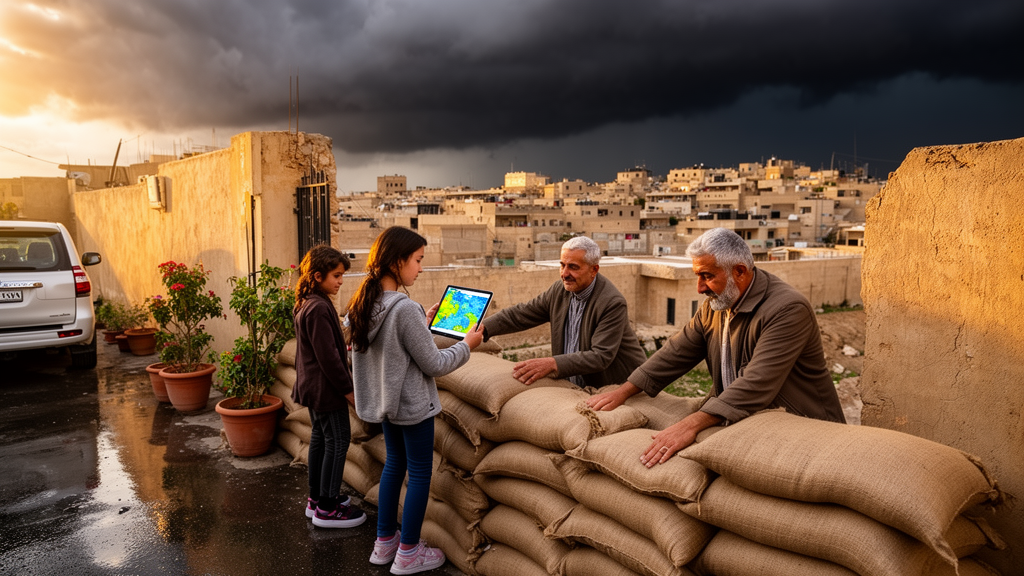
When flash floods tore through neighborhoods in Erbil, the capital of the Kurdistan Region of Iraq, they exposed more than broken drainage channels and damaged homes. They revealed a stark gap between the climate risks gathering over the Middle East and the readiness of the people living beneath them. A new study published in Theoretical and Applied Climatology has now quantified that gap with unusual precision, surveying 400 households in Erbil to determine what actually drives families to prepare for floods — and what leaves them vulnerable. The answer, the researchers found, is not fear of a warming planet in the abstract. It is the memory of water in the living room.
The study, led by Muzhda Qasim Qader of Hawler Medical University in Erbil together with colleagues from institutions across Iraq, Nigeria, and Austria, arrives at a moment when the Eastern Mediterranean and Middle East are recognized as climate change hotspots. Regional assessments have documented rising temperatures, shifting rainfall patterns, and an increase in hydroclimatic extremes across arid and semi-arid lands. In Iraq, the paradox is particularly sharp: the same region that faces intensifying drought also confronts sudden, destructive flood events when rain does fall on hardened urban surfaces and strained drainage systems. Erbil, a rapidly growing city of more than a million people, sits at the intersection of these forces, where urbanization has paved over absorbent ground and concentrated populations in flood-prone districts.
To understand how households respond to this threat, the team conducted a cross-sectional survey of 400 households, collecting data both online and in person. The questionnaire probed three dimensions: how prepared families were, how they perceived the flood risk, and what health impacts they had suffered. The researchers then applied binary logistic regression, a statistical technique that estimates the odds of a household taking preventive measures based on a set of predictor variables. The results were striking in their clarity. Households that had directly experienced flooding were nearly three times as likely to adopt preventive measures as those that had not, with an odds ratio of 2.87 and a 95 percent confidence interval of 1.89 to 4.36, significant at p less than 0.001. Higher education raised the odds by 63 percent, with an odds ratio of 1.63 and a confidence interval of 1.10 to 2.42. And households that attributed flooding to climate change were 87 percent more likely to prepare, with an odds ratio of 1.87 and a confidence interval of 1.15 to 3.04.
These three predictors — flood experience, education level, and climate change attribution — emerged as the strongest drivers of household preparedness, outperforming every other variable the team tested. Chi-square analyses reinforced the pattern, revealing significant associations between age, education, and flood experience. In other words, the demographic profile of a household shaped whether it had encountered floods before, and that encounter, more than any abstract awareness campaign, determined whether it acted. The finding echoes a broader literature on flood risk perception, which has repeatedly documented an unbalanced relationship between what people know about risks and what they actually do about them. Perception alone, studies from Nanjing to Nigeria have shown, rarely translates into preparedness without the catalyst of lived experience or the scaffolding of education.
The methodological rigor of the Erbil survey adds weight to its conclusions. The researchers compared responses collected online with those gathered face to face and found no statistically significant differences between the two modes — a confirmation that the mixed-method approach did not introduce bias. This matters for future research in resource-constrained settings, where online surveys can reach more respondents at lower cost, and it matters for policy, because it suggests the findings are robust rather than an artifact of who happened to answer the phone or the door. The study received ethical approval from the Medical Ethics Committee of Hawler Medical University, and all participants provided informed consent before completing the questionnaire.
But the survey also documented a darker side of flood exposure: the health toll. Respondents reported psychological stress, waterborne illness, and physical injuries as the principal impacts of flooding on their households. The psychological dimension is particularly significant in the Iraqi context, where populations have already endured decades of conflict and trauma, and where researchers have documented rising rates of climate change anxiety symptoms in the Kurdistan Region. Flood-related stress compounds these burdens, and the study’s authors note that the mental health impacts of natural disasters are increasingly recognized as a global concern, with evidence linking disaster exposure to depression, anxiety, and post-traumatic stress. Waterborne illness, meanwhile, reflects the contamination risks that follow flooding in cities where drainage and water treatment infrastructure are strained — a hazard the same research group has documented in earlier work on rainwater quality and atmospheric deposition in Erbil.
Against this backdrop of risk and harm, the study’s most sobering statistic may be its measure of public trust. Only 25 percent of respondents reported satisfaction with the government’s flood response. Three out of four households, in other words, felt that official institutions were not meeting their needs when floods struck. This trust deficit has technical implications. Household preparedness in Erbil is currently driven by private experience and individual education rather than by public risk communication, early warning systems, or coordinated municipal planning. If governments want to close the preparedness gap, the findings suggest, they cannot rely on awareness campaigns alone. They must build institutions that households trust enough to act on — and they must target their interventions at the populations the data identifies as most vulnerable: those without flood experience, without higher education, and without awareness of climate change as a driver of local risk.
The Erbil findings carry implications far beyond Kurdistan. Across the Middle East and North Africa, cities are expanding into flood-prone terrain while climate change intensifies hydroclimatic extremes. Regional reviews have warned that droughts and floods will increasingly coexist in the same urban systems, demanding multi-hazard approaches to planning that many MENA cities have yet to adopt. Studies from Jordan to Bangladesh have shown that community participation and risk communication are essential to building resilience in vulnerable settings, yet resource constraints and institutional weaknesses often prevent these interventions from reaching scale. The Erbil survey offers a template for measuring the problem: a validated household instrument, a mixed-mode survey design, and a statistical framework that isolates the predictors of action. It also offers a warning. In communities where flood experience is the strongest driver of preparedness, the first flood may be the most destructive — because households that have never been flooded have no reason to prepare, and no institutional prompt to do so.
What makes the study resonate beyond the academy is its reframing of climate adaptation as a household decision. Global climate negotiations focus on emissions targets and national plans, but the Erbil data shows that adaptation ultimately happens in kitchens and courtyards, in the choice to elevate an electrical socket, stock emergency supplies, or evacuate early. Those choices depend on experience, education, and attribution — three variables that policy can shape. Education systems that teach climate science raise the odds of preparedness by 63 percent. Risk communication that connects local floods to global warming raises them by 87 percent. And while no government can manufacture flood experience, it can simulate its lessons through drills, warnings, and community planning that translate the memory of one flood into protection against the next. In a region where climate models project intensifying extremes, the households of Erbil are already writing the first draft of adaptation. The question the study leaves open is whether institutions will help them finish it — or whether the next flood will have to teach the lesson again.
Subject of Research: Climate Change
Article Title: Climate-driven flood risks and public preparedness in the Middle East: evidence from Erbil, Kurdistan Region of Iraq
Article References: Qader, M. Q., Ayanlade, O. S., Ayoola, P. O., Fatah, K. K., Oyetunji-Alemede, C. O., Al-Banna, D. A., Ahmed, S. S., Ahmed, S. M., & Ayanlade, A. (2026). Climate-driven flood risks and public preparedness in the Middle East: evidence from Erbil, Kurdistan Region of Iraq. Theoretical and Applied Climatology, 157(11), Article 713. https://doi.org/10.1007/s00704-026-06647-4
Image Credits: AI Generated
DOI: 10.1007/s00704-026-06647-4
Keywords: flood risk, Erbil, Kurdistan Region of Iraq, climate change adaptation, household preparedness, public health, Middle East, logistic regression, Climate-driven, flood, risks, public
Cite Scienmag News
Violet Maxwell. (October 17, 2026). Experience, Education, and Climate Awareness Drive Flood Preparedness in Erbil, Iraq. Scienmag. https://scienmag.com/experience-education-and-climate-awareness-drive-flood-preparedness-in-erbil-iraq/
Violet Maxwell. "Experience, Education, and Climate Awareness Drive Flood Preparedness in Erbil, Iraq." Scienmag, 17 October 2026, https://scienmag.com/experience-education-and-climate-awareness-drive-flood-preparedness-in-erbil-iraq/. Accessed 17 October 2026.
Violet Maxwell. "Experience, Education, and Climate Awareness Drive Flood Preparedness in Erbil, Iraq." Scienmag. October 17, 2026. https://scienmag.com/experience-education-and-climate-awareness-drive-flood-preparedness-in-erbil-iraq/


