


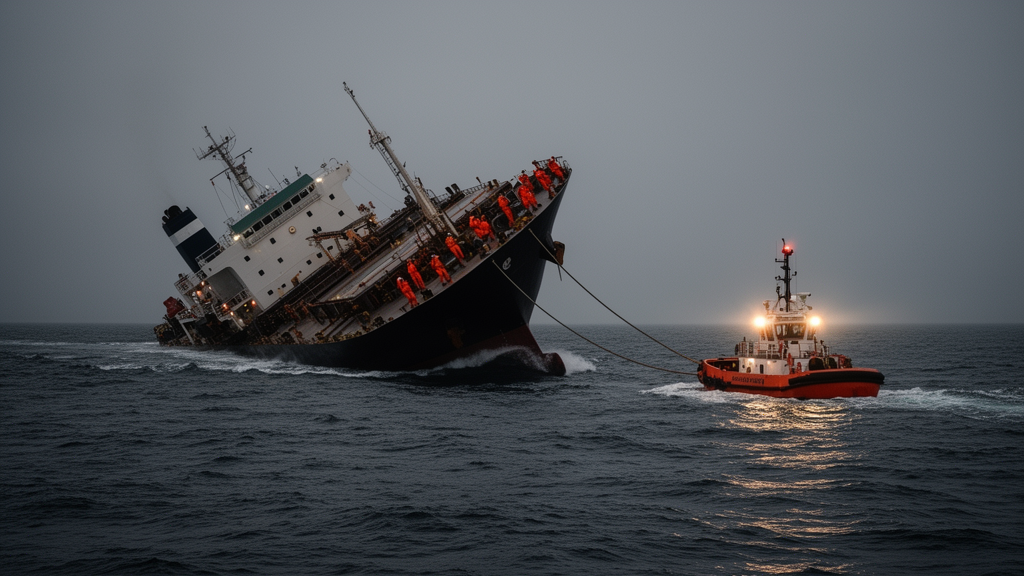
Every year, hundreds of ships around the world suddenly lose engine power or steering and begin to drift, helpless, at the mercy of wind, current, and geography. Maritime statistics suggest this is not a rare event: engine damage or failure was the leading cause of all maritime incidents reported in 2021, accounting for 30 to 40 percent of annually reported incidents according to Allianz data, while the European Maritime Safety Agency recorded an average of 503 propulsion failures per year between 2014 and 2020. Under the International Regulations for Preventing Collisions at Sea, such vessels are formally designated as not under command, or NUC. Yet whether one of these drifting hulks ends up as a grounding, a collision, or a safe recovery is often decided not by the mechanical failure itself, but by what happens in the first few minutes afterward. A new study published in Frontiers in Marine Science has now built a quantitative framework to capture exactly that.
The research, conducted by Mehmet Kaptan of the Maritime Transportation and Management Engineering Department at Recep Tayyip Erdoğan University’s Turgut Kiran Maritime Faculty in Türkiye, addresses a gap that traditional maritime risk approaches have largely neglected. Conventional models tend to treat loss of control as a technical reliability problem, focusing on machinery redundancy and procedural compliance. But as the study points out, when a ship goes NUC, it is not the failure that determines the outcome; it is the human and organizational performance in the minutes that follow. To quantify this, Kaptan assembled a hybrid methodological framework that combines three components in a single sequential data flow: large language model-supported coding of accident reports into the HFACS-PV human factors taxonomy, a Monte Carlo probabilistic simulation, and a decision tree analysis for interpretable pattern extraction.
The dataset was compiled from the publicly available archives of 32 different national marine accident investigation boards and flag state authorities, including the UK’s Marine Accident Investigation Branch, the Australian Transport Safety Bureau, the Japan Transport Safety Board, and the European Maritime Safety Agency. From 89 accident reports involving loss of control due to engine, propulsion, or steering system failure, a three-stage screening process yielded 65 cases suitable for analysis. Vessels under 500 gross tons were excluded because they fall outside the SOLAS Convention’s requirements for technical redundancy and emergency power, and reports lacking sufficient chronological detail were set aside. Three additional reports were reserved as independent cross-validation cases outside the main dataset. The outcome variable was coded dichotomously: 34 cases, or 52.3 percent, ended catastrophically in grounding or collision, while 31 cases, or 47.7 percent, saw the drift safely terminated through timely intervention.
The human factors component relies on the HFACS-PV framework, a five-layer maritime adaptation of the Human Factors Analysis and Classification System originally developed for aviation and based on Reason’s Swiss cheese model of accident causation. The five layers capture operational conditions, unsafe acts, preconditions for unsafe acts, inadequate supervision, and organizational influences. To convert the qualitative narrative sections of accident reports into structured binary coding across these layers, Kaptan developed an LLM-supported protocol using a web-based chat interface powered by Anthropic’s Claude Opus 4.8 large language model. The model was prompted with detailed category definitions and asked to make binary judgments about whether each layer was present in the narrative, then to generate a chain-of-thought justification citing the relevant passage from the report. Every positive identification was subsequently verified by an independent human coder, who compared the model’s rationale against the source text and corrected or rejected unsupported assignments. Inter-coder reliability between the language model and a blind human coder, assessed on a random subsample using Cohen’s Kappa, revealed excellent agreement at 0.88.
From the validated layer assignments, a weighted human factor score was derived. Following Reason’s latent conditions theory, higher weights were assigned to organizational and systemic vulnerabilities that accumulate before an accident: operational conditions received a weight of 1.0, unsafe acts 2.0, preconditions for unsafe acts 3.0, inadequate supervision 4.0, and organizational influences 5.0. The raw weighted sums were normalized to the interval from 0 to 1, and sensitivity analyses using equal, inverse, and random weighting schemes produced Spearman rank correlations between 0.91 and 0.97, confirming that the model outputs are robust against specific weighting preferences. The human factor score is not fed directly into the simulation but converted into a risk multiplier that scales the vessel’s time to regain power. This design choice reflects a conceptual necessity: human and organizational factors do not alter the physical parameters of drifting, such as wind speed or current, but they prolong the time it takes for a vessel to regain power by limiting response capacity and decision-making effectiveness. In the dataset, the highest observed load corresponded to a multiplier of approximately 1.90, extending the baseline recovery time by roughly 90 percent.
The Monte Carlo simulation, coded in Python using the scipy and numpy libraries with a fixed random seed for reproducibility, drew three physical input variables from distributions calibrated against the 65 accident reports: distance to shore fitted to an exponential distribution, drift speed to a normal distribution, and baseline recovery time to a log-normal distribution. The relationship between drift speed and the Beaufort wind scale was directly observed in the data, with drift speeds of roughly 1.2 knots below Beaufort 6, approximately 2.8 knots between Beaufort 7 and 9, and approximately 4.5 knots above Beaufort 10. Running the simulation for 100,000 iterations, the probability that a loss of control would result in a catastrophic outcome was estimated at 45.6 percent, with a sampling margin of error of roughly plus or minus 0.32 percentage points. The statistics for the critical time window, the time available before the drifting vessel reaches shore or another obstacle, reveal how variable the risk is: the median critical window was 76 minutes, but the average rose to 125 minutes due to a right-skewed distribution, and in the most critical 5 percent of scenarios only 5.5 minutes remained for intervention, while the longest 5 percent extended to 396 minutes.
A controlled sensitivity analysis isolated the human factor’s contribution by holding all environmental and physical variables constant and varying only the human factor multiplier. In a good management scenario with a low human factor load, the probability of a catastrophic outcome remained at 40.1 percent, while in a very poor management scenario with a high load it rose to 52.2 percent. When environmental conditions are held entirely constant, this difference in management quality alone alters the probability by approximately 12 percentage points. The study emphasizes that this effect acts as a conditional modulator dependent on the available time window: when the critical window falls within minutes, even a moderate human factor load can decisively lead to catastrophe, but when it extends to hours, even the highest load cannot alter the final outcome.
The decision tree component, built using the CART algorithm in scikit-learn with Gini impurity as the splitting criterion, fed twenty binary variables from the HFACS-PV coding into the model. Technology and interface failures determined the root node, but skill-based errors emerged as the most decisive variable in the feature importance ranking, accounting for 36 percent of the total reduction in uncertainty. The strongest pattern associated with catastrophic outcomes was the simultaneous occurrence of a technology or interface failure and a skill-based crew error in the same accident. However, the study is transparent about the limits of this component: under leave-one-out cross-validation, the model’s accuracy dropped to 41.5 percent, below the 52.3 percent majority-class baseline, meaning the HFACS-PV variables do not carry a generalizable predictive signal for unseen cases. The tree is therefore retained as a descriptive, hypothesis-generating tool rather than a predictive classifier, and the poor out-of-sample performance is attributed to the small sample size, the high-dimensional binary variable space, and the absence of physical parameters such as distance to shore in the tree model.
Three independent NUC incidents outside the dataset were evaluated as a comparative case study: the MV Dali, which struck the Francis Scott Key Bridge in Baltimore in 2024 with catastrophic consequences; the Atlantic Huron, which collided with the Soo Locks west center pier in Michigan in 2020; and the Maersk Eindhoven, which lost main engine power off the coast of Japan in 2021 but remained safe. The model correctly predicted the actual outcome in all three cases. The catastrophic cases were characterized by critical time windows on the order of minutes, where medium-to-high human factor loads extended recovery times beyond the available window, while the safe case maintained its classification because the critical window was on the order of hours. Notably, all three incidents independently revealed the same latent condition at the organizational layer: the absence of procedures specific to propulsion loss or heavy weather navigation in the Safety Management System, a deficiency identified by the respective investigative authorities across different flag states, vessel types, and failure mechanisms.
The study’s broader contribution lies in integrating four previously independent research tracks, LLM-supported text coding, HFACS-PV human factor analysis, Monte Carlo simulation, and decision tree classification, into a single coherent workflow. Existing hybrid models in the literature rely on Bayesian networks and manual coding processes that are difficult to scale, while LLM-Bayesian network integrations lack Monte Carlo and decision tree components. The proposed framework fills this gap by combining the scalability of LLM automation, the uncertainty quantification power of Monte Carlo methods, and the interpretable rule learning of decision trees. The findings also carry strategic implications for the maritime industry: pre-departure reliability verifications of propulsion and steering systems should be mandatory, emergency communication protocols between bridge and engine room should be standardized, and International Safety Management Code audits should shift from documentation compliance toward evaluating the real-world operational feasibility of established procedures. As the study concludes, the evolution of a loss of control into a catastrophic accident stems not from a single technical failure but from the dynamic interaction between the time window imposed by physical constraints and the human and organizational performance that scales that window.
Subject of Research: Hybrid quantitative modeling of grounding and collision risk for vessels not under command, integrating human and organizational factors with probabilistic simulation
Article Title: Hybrid modeling of grounding and collision risk for vessels not under command
Article References: Kaptan, M. (2026). Hybrid modeling of grounding and collision risk for vessels not under command. Frontiers in Marine Science, 13, Article 1955791. https://doi.org/10.3389/fmars.2026.1955791
Image Credits: AI Generated
DOI: 10.3389/fmars.2026.1955791
Keywords: maritime safety, not under command, HFACS-PV, Monte Carlo simulation, decision tree, large language models, grounding risk, collision risk, human factors, accident investigation, safety management systems, risk modeling
Cite Scienmag News
Violet Maxwell. (October 17, 2026). When a ship loses power, minutes decide whether it becomes a disaster. Scienmag. https://scienmag.com/when-a-ship-loses-power-minutes-decide-whether-it-becomes-a-disaster/
Violet Maxwell. "When a ship loses power, minutes decide whether it becomes a disaster." Scienmag, 17 October 2026, https://scienmag.com/when-a-ship-loses-power-minutes-decide-whether-it-becomes-a-disaster/. Accessed 17 October 2026.
Violet Maxwell. "When a ship loses power, minutes decide whether it becomes a disaster." Scienmag. October 17, 2026. https://scienmag.com/when-a-ship-loses-power-minutes-decide-whether-it-becomes-a-disaster/


