


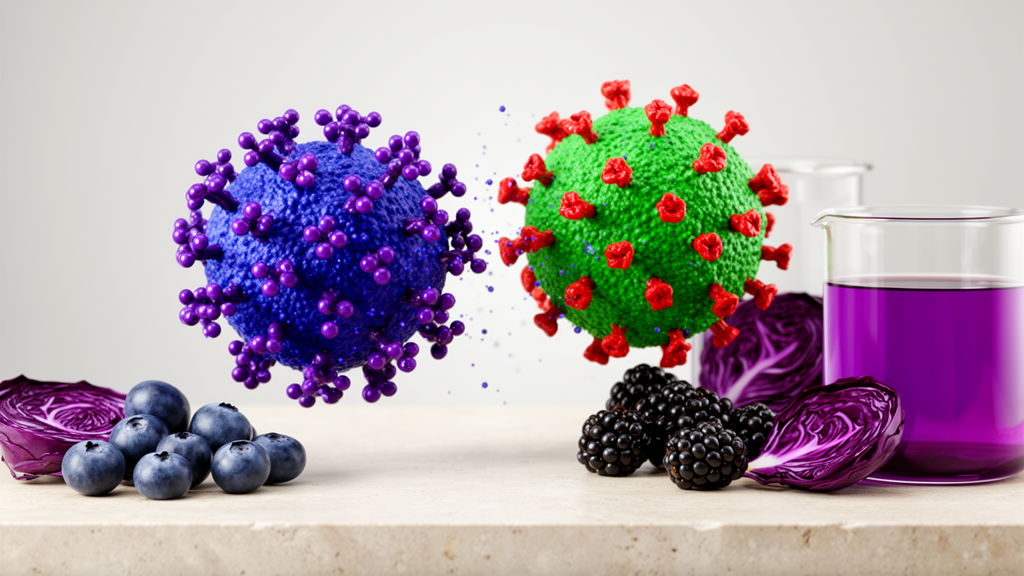
The pigments that give berries, red cabbage, and black rice their deep blue, red, and purple hues are once again under scrutiny as potential antiviral agents. A new review published in Frontiers in Virology by Peter Lu of the University of California, San Diego, synthesizes the current evidence that anthocyanins—a subclass of flavonoid polyphenols abundant in the human diet—may interfere with multiple stages of the SARS-CoV-2 life cycle. The analysis, which draws on peer-reviewed studies published between 2019 and 2026 identified through PubMed, Scopus, and Web of Science, concludes that while the molecular case is increasingly coherent, the experimental foundation remains thin and largely preclinical.
Anthocyanins are glycosylated forms of anthocyanidins, built on a flavylium ion backbone with a C6-C3-C6 carbon structure: a 15-carbon skeleton of two aromatic rings connected by a three-carbon bridge forming a heterocyclic ring. Six major anthocyanidins—petunidin, malvidin, peonidin, cyanidin, delphinidin, and pelargonidin—account for roughly 90 percent of those found in nature. Beyond their role as plant pigments, these compounds exhibit antioxidant, anti-inflammatory, neuroprotective, and anticancer activities, and previous work has documented broad-spectrum antiviral effects against several RNA viruses, including suppression of influenza neuraminidase.
The review identifies the SARS-CoV-2 main protease, Mpro, as the most extensively investigated molecular target. Because Mpro cleaves viral polyproteins into functional units required for replication and maturation—and because its structure differs substantially from any human protease—it has become one of the most attractive antiviral targets against COVID-19. Numerous independent molecular docking studies have demonstrated favorable predicted interactions between structurally diverse anthocyanins and the Mpro catalytic site, particularly the catalytic residues His41 and Cys145, with no clear cellular cytotoxicity reported. Notably, polyacylated anthocyanins such as tecophilin, cyanodelphin, gentiodelphin, and phacelianin consistently exhibited stronger predicted binding than diacylated or monomeric forms, suggesting that structural modification may enhance inhibitory activity.
Several studies have begun to provide experimental validation of these computational predictions. Cyanidin-3-O-sambubioside isolated from kokum fruit demonstrated approximately 79 percent inhibition of Mpro activity at 100 micromolar in an in vitro enzymatic assay, with favorable docking to the catalytic dyad and no cytotoxicity to BEAS-2B cells. Cyanidin 3-O-galactoside from cranberry showed potent Mpro inhibition with an IC50 of 9.98 micromolar in FRET-based enzymatic assays, while whole cranberry anthocyanin extracts achieved an IC50 of 23.58 micrograms per milliliter. More recently, a high-resolution mass spectrometry-based screening platform identified delphinidin-3-glucoside from blueberry as a covalent Mpro inhibitor, producing dose-dependent inhibition of SARS-CoV-2 replication in Vero E6 cells with an IC50 of approximately 35.8 micromolar—comparable to the established Mpro inhibitor baicalin.
Beyond Mpro, anthocyanins have been proposed to interact with other viral replication proteins, particularly the RNA-dependent RNA polymerase and helicase. A comprehensive virtual screening of naturally occurring polyphenols identified cyanidin-3-O-rutinoside, petunidin-3,5-O-diglucoside, and delphinidin-3-O-rutinoside as the strongest predicted RdRp inhibitors, with binding energies exceeding those of remdesivir. A multitarget docking study found that cyanidin 3-O-glucosyl-rutinoside bound strongly across Mpro, RdRp, and helicase simultaneously. However, the review notes that no studies have conclusively demonstrated direct enzymatic or structural inhibition of these proteins, and the available evidence remains largely limited to computational predictions.
Anthocyanins may also interfere with viral entry by disrupting the interaction between the spike glycoprotein receptor-binding domain and the host ACE2 receptor. In the large-scale multitarget docking study, cyanidin 3-O-glucosyl-rutinoside demonstrated the strongest predicted interactions with both spike protein and ACE2, with docking scores of -10.07 and -13.26 respectively, outperforming the reference compounds remdesivir and hydroxychloroquine. Additional anthocyanins, including pelargonidin-3-rhamnoside and cyanidin-7-arabinoside, were predicted to bind favorably to the spike receptor-binding domain. The review emphasizes, however, that experimental evidence supporting this entry-blocking mechanism remains scarce and should currently be regarded as computational prediction requiring biochemical and cell-based validation.
The review also highlights a complementary mechanism: modulation of host inflammatory responses. Excessive cytokine activation is associated with COVID-19 severity and tissue damage. Using an in vitro model of SARS-CoV-2 spike protein S1-induced inflammation, black rice germ and bran extract rich in cyanidin-3-O-glucoside and peonidin-3-O-glucoside significantly suppressed expression of the inflammatory genes NLRP3, IL-1β, and IL-18, while reducing secretion of IL-6, IL-1β, and IL-18 in A549 lung epithelial cells and THP-1 macrophages. The extract was effective at 12.5 to 100 micrograms per milliliter, with purified constituents active at 1.25 to 10 micrograms per milliliter, operating through inhibition of the NF-κB/NLRP3 inflammasome signaling pathway.
Evidence from anthocyanin-rich plant extracts adds further complexity. Standardized European black elderberry fruit extract, containing 4.6 percent total polyphenols and 3.5 percent anthocyanins, demonstrated in vitro antiviral activity against the original Wuhan strain and the Alpha, Beta, Gamma, Delta, and Omicron variants, with cyanidin-3-sambubioside-5-glucoside exhibiting the strongest inhibition among major components. A subsequent study found that combining elderberry extract standardized to 3.2 percent anthocyanins with quinine produced synergistic antiviral effects against SARS-CoV-2 in Calu-3 lung cells, with a Bliss independence score of 27.8. The review cautions that because extracts contain multiple polyphenols and other phytochemicals, the relative contribution of anthocyanins alone cannot be determined with certainty.
Despite encouraging computational and preclinical evidence, the review identifies poor physicochemical stability and low bioavailability as major translational challenges. Only approximately 2 percent of ingested anthocyanins are reported to retain their intact C6-C3-C6 structure after ingestion. These compounds are highly susceptible to degradation by pH, temperature, oxygen, and light—under acidic conditions they exist predominantly as the red flavylium cation, whereas neutral and alkaline environments promote quinonoidal base formation, reducing both stability and biological activity. Such degradation may occur during food processing, storage, gastrointestinal digestion, and systemic absorption, potentially limiting the concentrations required to achieve the antiviral effects observed in vitro.
Several strategies are being explored to overcome these limitations. Structural modification through glycosylation and acylation, physical protection through microencapsulation and nanoencapsulation, stabilization via complex formation with macromolecules, and co-pigmentation techniques all aim to preserve structural integrity and enhance systemic availability. Encapsulation technologies coat extracted bioactive compounds with protective materials—typically GRAS-classified biopolymers composed of proteins, carbohydrates, or their combinations—to shield them from extreme environments within the body and allow them to reach the small intestine intact. Nanoparticles are of particular interest because their high surface-area-to-volume ratio can enhance stability, solubility, and bioavailability while providing more reactive sites for interaction. The review concludes that while anthocyanins represent promising natural compounds for further antiviral investigation, additional mechanistic studies, in vivo validation using animal models, comprehensive pharmacokinetic evaluations, and well-designed clinical trials are required before their clinical potential against COVID-19 can be established.
Subject of Research: Anthocyanins as potential SARS-CoV-2 antivirals: mechanisms, evidence, and translational challenges
Article Title: Antiviral potential of anthocyanins against SARS-CoV-2: current evidence, translational challenges, and future perspectives
Article References: Lu, P. (2026). Antiviral potential of anthocyanins against SARS-CoV-2: current evidence, translational challenges, and future perspectives. Frontiers in Virology, 6, Article 1897871. https://doi.org/10.3389/fviro.2026.1897871
Image Credits: AI Generated
DOI: 10.3389/fviro.2026.1897871
Keywords: anthocyanins, SARS-CoV-2, COVID-19, antiviral, flavonoids, Mpro, RdRp, ACE2, bioavailability, elderberry, potential, against
Cite Scienmag News
Daisy Hatcher. (October 17, 2026). Anthocyanins Show Antiviral Promise Against SARS-CoV-2, But Clinical Hurdles Remain. Scienmag. https://scienmag.com/anthocyanins-show-antiviral-promise-against-sars-cov-2-but-clinical-hurdles-remain/
Daisy Hatcher. "Anthocyanins Show Antiviral Promise Against SARS-CoV-2, But Clinical Hurdles Remain." Scienmag, 17 October 2026, https://scienmag.com/anthocyanins-show-antiviral-promise-against-sars-cov-2-but-clinical-hurdles-remain/. Accessed 17 October 2026.
Daisy Hatcher. "Anthocyanins Show Antiviral Promise Against SARS-CoV-2, But Clinical Hurdles Remain." Scienmag. October 17, 2026. https://scienmag.com/anthocyanins-show-antiviral-promise-against-sars-cov-2-but-clinical-hurdles-remain/


