


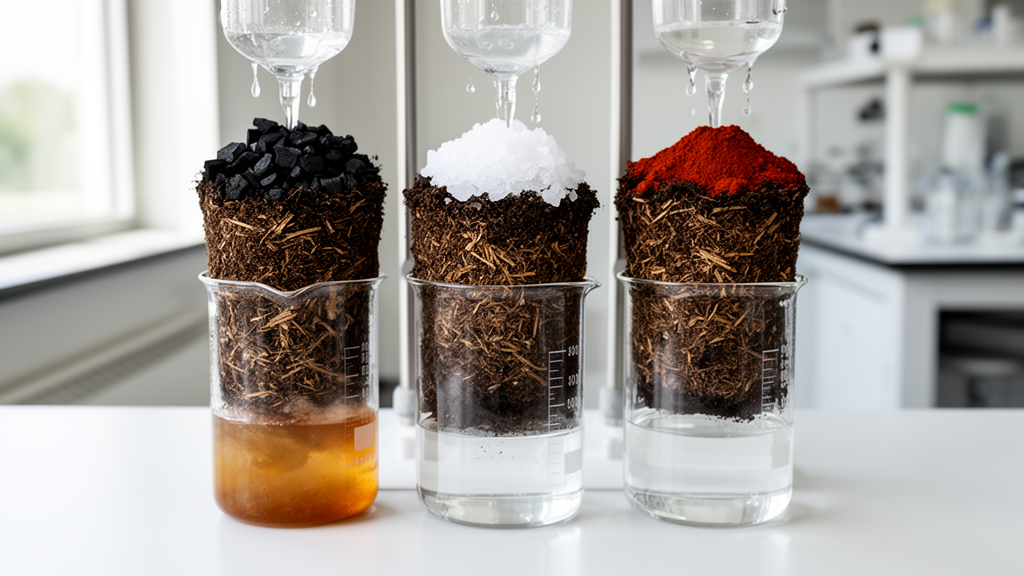
Poultry farming is booming across the United States, and with it comes a mountain of litter — a nutrient-rich mixture of manure, bedding, and feathers that farmers have long spread on fields as fertilizer. But when poultry litter is applied faster than crops can absorb it, nitrate and phosphate slip past the root zone and into groundwater, where they can fuel algal blooms, contaminate drinking water, and leave a stubborn legacy of phosphorus in the soil. A new field-scale experiment from Auburn University, published in Frontiers in Environmental Chemistry, offers some of the clearest mechanistic evidence yet on how three very different amendments — biochar, alum, and iron sulfate — can hold those nutrients in place, and why one of them may come at a hidden cost to crop yield.
The research team, led by Soura Shuvra Gupta and Rishi Prasad of Auburn’s Animal Waste and Environmental Nutrient Management Laboratory, set out to answer a deceptively simple question: when poultry litter is applied at twice the recommended rate to a coarse-textured soil, which amendment best keeps nitrate-nitrogen and phosphate-phosphorus from leaching away, and what role does manure-derived dissolved organic carbon play in the process? Conventional wisdom holds that chemical amendments like alum (aluminum sulfate) and iron sulfate can immobilize nutrients effectively, but they may acidify the soil. Biochar, a carbon-rich charcoal-like byproduct of pyrolyzed wood, has been touted as a sustainable alternative — yet its performance varies wildly depending on feedstock and production conditions, and it had never been systematically compared head-to-head with the established chemical amendments under real rainfall conditions.
To settle the comparison, the researchers built 24 leaching columns in an open-field setting at Auburn University’s Bioresource Laboratory in Alabama. Each column was packed with Marlboro loamy sand — a naturally free-draining soil with 79 percent sand content — and planted with corn (Zea mays var. DKC70-45). The team applied poultry litter at 20 tonnes per hectare, double the recommended rate for the region, deliberately simulating the legacy of historical over-application that characterizes many poultry-dense areas of the southeastern United States. Six treatments were tested: soil alone, soil plus litter, and litter plus one of four amendments — two biochars (BC-1 and BC-2, both produced from yellow pine at 550°C but from different production batches), alum, and iron sulfate — each applied at 10 percent by weight relative to the litter. No synthetic fertilizers were used, so all nutrients came from the litter itself.
Over the 105-day growing season, the researchers collected leachate after five natural rainfall events, timed to coincide with key crop growth stages: pre-planting, early emergence, early vegetative, mid-vegetative, and reproductive. The rainfall totals between events ranged from 19 to 210 millimeters, and each pot was hydraulically isolated so that leachate could only drain through a collection column at the base. Samples were filtered and analyzed for nitrate-nitrogen, phosphate-phosphorus, and dissolved organic carbon using a flow injection analyzer and a total organic carbon analyzer. The results were striking. In unamended litter-treated soil, nitrate concentrations in leachate ranged from 0.53 to 51.5 milligrams per liter, while phosphate ranged from 3.88 to 20.5 milligrams per liter — levels that would raise immediate red flags for any water quality regulator.
The amendments told very different stories. Alum was the clear champion for nitrate retention, cutting concentrations by up to 65 percent at the first rainfall event and keeping the cumulative average nitrate load 41 percent lower than unamended litter soil across all five events. Iron sulfate and BC-2 also reduced cumulative nitrate loading — by 33 and 37 percent respectively — but BC-1 actually increased nitrate leaching by 10 percent compared to unamended litter soil, a counterintuitive result the researchers attribute to biochar’s negative surface charge, which electrostatically repels nitrate anions rather than binding them. This delayed mobilization effect, where biochar initially holds nitrate and then releases it later in the season, has been reported before but rarely demonstrated so clearly under field conditions.
For phosphate, the picture was more consistent. Iron sulfate reduced cumulative average phosphate loading by 52 percent, alum by 48 percent, BC-2 by 33 percent, and BC-1 by 14.5 percent compared to unamended litter soil. The two biochars’ divergent performance likely reflects differences in their physicochemical properties: BC-2 had a specific surface area of 256 square meters per gram, nearly three times that of BC-1 at 91.6 square meters per gram, along with higher iron content. Phosphate binds to biochar surfaces through inner-sphere complexes with calcium, magnesium, aluminum, or iron via ligand exchange — a fundamentally different mechanism than the electrostatic repulsion that governs nitrate behavior — which explains why even the weaker biochar still retained some phosphate. The researchers caution, however, that they did not conduct detailed surface chemistry characterization, so the causal mechanisms behind the two biochars’ different performances remain associated with, rather than directly proven by, their measured properties.
Perhaps the most compelling finding of the study concerns dissolved organic carbon, the often-overlooked carbon fraction that leaches from manure alongside the nutrients. Across 30 leachate samples, DOC ranged from 15 to 531 milligrams per liter with an average of 158 milligrams per liter. When the researchers plotted DOC against nutrient concentrations, they found a strong positive correlation with phosphate (r = 0.83, p < 0.001) and a moderate positive correlation with nitrate (r = 0.54, p < 0.05). The mechanistic explanation is elegant: organic acids within DOC can chelate the iron and aluminum oxides that normally bind phosphate in soil, displacing phosphate into solution. DOC also competes with phosphate for adsorption sites on soil minerals and forms soluble metal-DOC complexes that facilitate co-leaching. For nitrate, DOC serves as a carbon and energy source for heterotrophic microbes, which under high nitrogen inputs become saturated and actually accelerate mineralization rather than immobilizing nitrogen. Some nitrogen may also leach as dissolved organic nitrogen alongside DOC, mineralizing deeper in the profile.
The study’s authors are careful to note that DOC was not experimentally manipulated, so the correlations should be interpreted as associations rather than direct causal relationships. DOC acts as a proxy integrator of multiple biogeochemical processes — manure loading rate, rainfall intensity, soil nutrient saturation, and microbial activity all covary with it. Still, the strength of the DOC-phosphate correlation, in particular, suggests that monitoring DOC dynamics could serve as a powerful early-warning indicator for nutrient leaching risk in heavily manured soils, something that current mitigation strategies rarely consider.
The trade-off between environmental protection and crop productivity emerged as the study’s most sobering finding. Grain yield was highest in unamended litter soil at 6,082 kilograms per hectare, and biochar-amended treatments maintained statistically similar yields — 5,939 kilograms per hectare for BC-2 and 5,647 for BC-1. But alum and iron sulfate, despite their superior phosphate retention, significantly reduced grain yield to 4,535 and 4,248 kilograms per hectare respectively. The researchers traced this agronomic penalty to nutrient antagonism: grain phosphorus uptake dropped from 34 kilograms per hectare in unamended litter soil to 28 in alum-amended and 25 in iron sulfate-amended soil, while grain potassium uptake fell from 40 to 29 and 26 kilograms per hectare respectively. Micronutrient uptake of boron and manganese was also significantly lower under the chemical amendments, suggesting that excessive aluminum and iron availability interferes with root function and nutrient absorption — a known problem in acidic soils where aluminum toxicity limits plant growth.
The broader implications are significant for sustainable manure management. Biochar, particularly BC-2 with its higher surface area, offers a more balanced approach than the chemical amendments: it retains meaningful amounts of phosphate without sacrificing grain yield, and it avoids the soil acidification risk that accompanies alum and iron sulfate. But the study also reveals that biochar’s effectiveness is highly property-dependent — BC-1’s failure to retain nitrate, and its tendency to release more nitrate than unamended litter soil, underscores that not all biochars are created equal. The researchers emphasize that their amendment rate of 10 percent by weight relative to litter represents an upper-bound mitigation scenario rather than a field-optimized recommendation, and they call for future studies to optimize amendment rates under real field conditions. Long-term trials across diverse cropping systems — monocropping, mixed cropping, and perennial grass systems under different climates and drainage regimes — will be needed to fully elucidate how DOC-associated nutrient transport can be managed for sustainable manure use and water quality protection. For now, the message is clear: the choice of amendment matters enormously, and the hidden chemistry of dissolved organic carbon may be the key to understanding why nutrients escape from manured soils in the first place.
Subject of Research: Mechanistic insights into the role of biochar, alum, and iron sulfate in nutrient retention and DOC-associated leaching from poultry litter-amended soils
Article Title: Mechanistic insights into the role of biochar, alum, and iron sulfate in nutrient retention and DOC-associated leaching from poultry litter-amended soils
Article References: Gupta, S. S., Prasad, R., Chakraborty, D., & Ray, P. (2026). Mechanistic insights into the role of biochar, alum, and iron sulfate in nutrient retention and DOC-associated leaching from poultry litter-amended soils. Frontiers in Environmental Chemistry, 7, Article 1773001. https://doi.org/10.3389/fenvc.2026.1773001
Image Credits: AI Generated
DOI: 10.3389/fenvc.2026.1773001
Keywords: Mechanistic, insights, role, biochar, alum, iron, sulfate, nutrient, retention, DOC-associated, leaching, poultry
Cite Scienmag News
William Thompson. (October 17, 2026). Biochar, Alum, and Iron Sulfate Show Contrasting Power to Curb Poultry Litter Nutrient Leaching. Scienmag. https://scienmag.com/biochar-alum-and-iron-sulfate-show-contrasting-power-to-curb-poultry-litter-nutrient-leaching/
William Thompson. "Biochar, Alum, and Iron Sulfate Show Contrasting Power to Curb Poultry Litter Nutrient Leaching." Scienmag, 17 October 2026, https://scienmag.com/biochar-alum-and-iron-sulfate-show-contrasting-power-to-curb-poultry-litter-nutrient-leaching/. Accessed 17 October 2026.
William Thompson. "Biochar, Alum, and Iron Sulfate Show Contrasting Power to Curb Poultry Litter Nutrient Leaching." Scienmag. October 17, 2026. https://scienmag.com/biochar-alum-and-iron-sulfate-show-contrasting-power-to-curb-poultry-litter-nutrient-leaching/


