


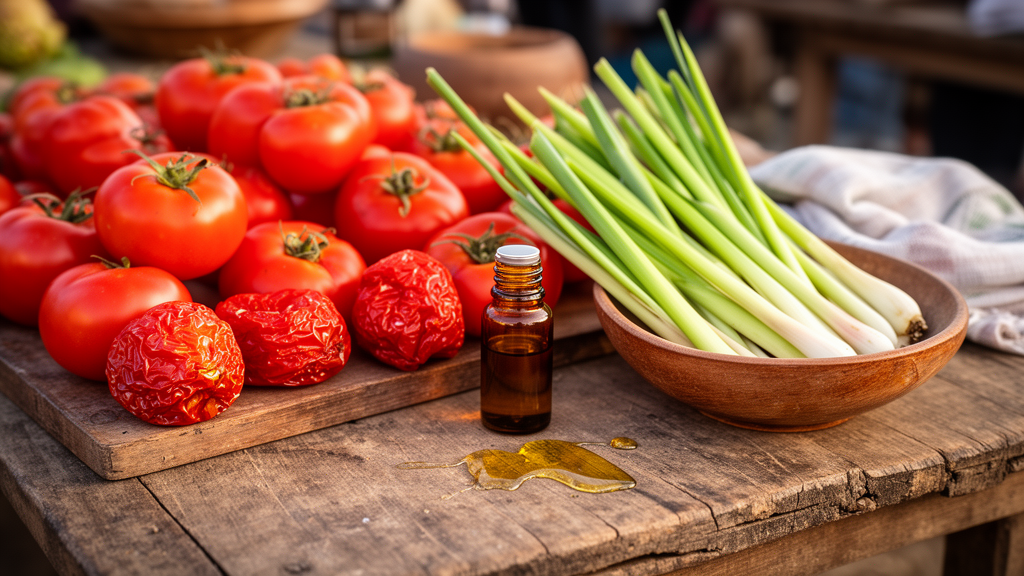
Tomatoes are among the world’s most consumed vegetables, yet they are also among its most perishable. In Nepal, where roughly 410,000 metric tons of tomatoes are produced annually across 21,000 hectares, postharvest losses can reach 33 percent, the highest of any vegetable crop. A new study from the Institute of Agriculture and Animal Science in Rupandehi, Nepal, published in Innovations in Agriculture, suggests that a simple, food-safe treatment—lemongrass essential oil—could help farmers and traders hold onto more of that harvest without resorting to chemicals with known health drawbacks.
The research team, led by Prachand Neupane and colleagues, set out to test whether essential oils could replace conventional preservatives such as Bavistin and calcium chloride, which are widely used to extend postharvest life but carry residual toxicity concerns. Essential oils have attracted growing scientific interest because of their antioxidant, antifungal, and antibacterial properties, their low mammalian toxicity, and their biodegradability. Earlier in vitro work has shown that lemongrass oil at concentrations from 25 to 500 ppm suppresses colony formation by major tomato spoilage fungi, including Colletotrichum coccodes, Botrytis cinerea, Cladosporium herbarum, Rhizopus stolonifer, and Aspergillus niger.
The experiment used the Srijana tomato variety, a popular hybrid developed by Nepal’s Horticulture Research Division that farmers favor for its adaptability to off-season cultivation and its market appeal. Fruits were harvested at the light red stage from a farm in Harisiddhi, Lalitpur, in late November 2021 and transported to the Central Lab at Paklihawa. After cleaning, manual grading, and visual sorting to ensure uniform size, color, and quality, samples were placed in 2.8-liter plastic containers holding 21 tomatoes each.
Seven treatments were arranged in a completely randomized design with three replications. Four groups received lemongrass essential oil vapor at concentrations of 50, 100, 150, and 200 ppm, sealed under aluminum foil for eight hours. A fifth group was dipped in 1 percent calcium chloride solution and a sixth in a 100 percent extract of Justicia adhatoda, a medicinal plant known locally as Asuro, for 30 minutes each. The seventh group served as an untreated control. The lowest oil concentration was chosen to establish the minimum effective dose, while the highest was intended to reveal any toxic effects during storage.
Over 14 days, the researchers measured physical attributes—weight loss and firmness—and chemical attributes including pH, total soluble solids, titratable acidity, and vitamin C content, sampling every two days. Juice extracted from 20-gram slices was diluted and centrifuged at 10,000 rpm before analysis. Total soluble solids were read with a digital refractometer, acidity was determined by titration with 0.1 N sodium hydroxide, and vitamin C was quantified using the dichlorophenol-indophenol titration method. Statistical differences were evaluated with analysis of variance followed by Duncan’s Multiple Range Test at a significance threshold of p < 0.05.
Weight loss rose steadily in all groups as storage progressed, driven by transpiration, respiration, and dehydration, but the differences among treatments were not statistically significant. Maximum weight loss of 12.86 percent occurred in the Asuro extract treatment, possibly because compounds in the extract accelerate respiration, while the untreated control lost the least at 9.73 percent. Firmness told a different story: tomatoes treated with 100 percent Asuro extract retained the highest firmness, 5.71 Nmm⁻¹, on day 14, an effect the authors attribute to the antimicrobial activity of Justicia adhatoda. Firmness naturally declines as pectin breaks down into soluble forms and cell wall polysaccharides degrade, processes that moisture loss and enzymatic activity accelerate.
The chemical measurements revealed the clearest treatment effects. Total soluble solids climbed until day 10 as starch converted to sugars, then declined in nearly all treatments by days 12 and 14. The highest reading, 4.933 °Brix, appeared in the calcium chloride group, while the lowest, 3.466 °Brix, occurred at 200 ppm essential oil—a pattern consistent with delayed ripening, since slower carbohydrate conversion keeps soluble sugar accumulation in check. Titratable acidity fell continuously across the storage period as organic acids were consumed as respiratory substrates, dropping to a minimum of 0.21 percent at 200 ppm essential oil and holding highest at 0.36 percent in the Asuro treatment by day 14.
Vitamin C content increased through day 8 before declining, and the 200 ppm essential oil treatment preserved the highest level, 0.276 mgml⁻¹. The researchers suggest that higher concentrations of lemongrass oil limit oxygen exposure, inhibiting ascorbate activity and delaying oxidative degradation of the vitamin. The ratio of soluble solids to acidity, a key predictor of flavor palatability, differed significantly among treatments, peaking at 21.08 in the calcium chloride group and falling to 9.92 in the Asuro treatment at day 14, with the 200 ppm oil treatment close behind the leader at 17.12.
The study’s conclusion is that 200 ppm lemongrass essential oil delivered the best overall physicochemical performance, positioning essential oils as viable, non-hazardous alternatives to conventional chemical preservatives for tomato postharvest handling. The authors caution that the work was conducted on a single variety over a short period in a laboratory setting, and they recommend larger-scale trials across multiple varieties and concentrations before farmers adopt the practice. Cost is another hurdle: essential oils remain more expensive than synthetic chemicals, though the researchers suggest that blending them with organic acids could improve both efficacy and economics. For a country where most growers and traders have limited access to cold storage and proper postharvest facilities, a low-cost, plant-based vapor treatment could offer a practical way to cut losses in a crop that sits at the heart of both rural livelihoods and national diets.
Subject of Research: Postharvest preservation of tomatoes using lemongrass essential oil
Article Title: Effect of essential oil on shelf-life and quality attributes of tomato in Rupandehi, Nepal
Article References: Neupane, P., Poudel, B., Wosti, B., Pandey, S., Chaudhary, M., G. C., A., Khanal, R. P., & Chaurasia, J. (2025). Effect of essential oil on shelf-life and quality attributes of tomato in Rupandehi, Nepal. Innovations in Agriculture, 8, 1-10. https://doi.org/10.3897/ia.2025.142908
Image Credits: AI Generated
Keywords: tomato, lemongrass essential oil, postharvest, shelf life, Nepal, Justicia adhatoda, vitamin C, titratable acidity, total soluble solids, food preservation, calcium chloride, agriculture
Cite Scienmag News
Roger Howard. (October 17, 2026). Lemongrass Essential Oil Extends Tomato Shelf Life in Nepal Trial. Scienmag. https://scienmag.com/lemongrass-essential-oil-extends-tomato-shelf-life-in-nepal-trial/
Roger Howard. "Lemongrass Essential Oil Extends Tomato Shelf Life in Nepal Trial." Scienmag, 17 October 2026, https://scienmag.com/lemongrass-essential-oil-extends-tomato-shelf-life-in-nepal-trial/. Accessed 17 October 2026.
Roger Howard. "Lemongrass Essential Oil Extends Tomato Shelf Life in Nepal Trial." Scienmag. October 17, 2026. https://scienmag.com/lemongrass-essential-oil-extends-tomato-shelf-life-in-nepal-trial/


