


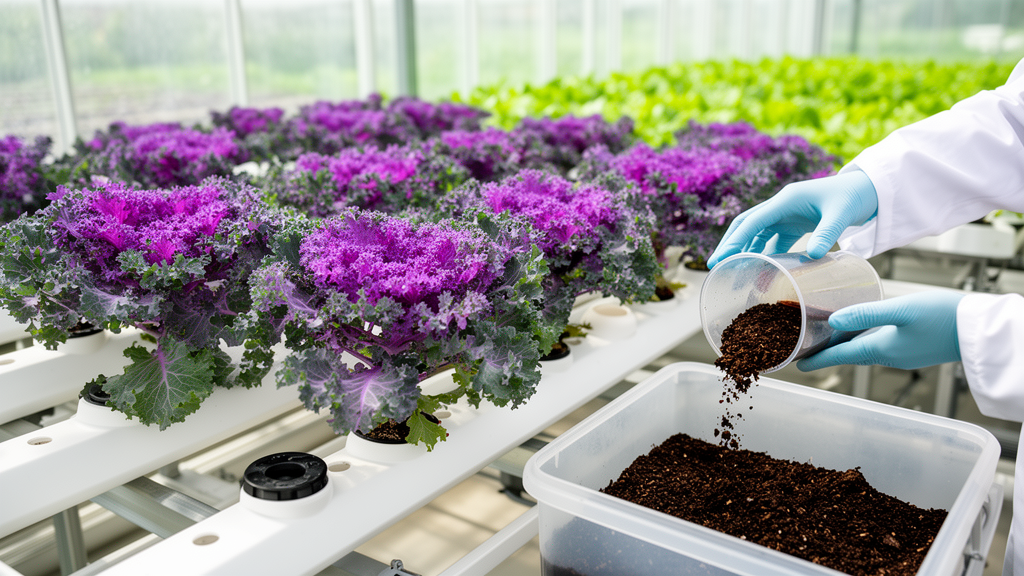
Salt is quietly strangling one of horticulture’s most photogenic crops. Ornamental kale, the ruffled rosette of a plant that anchors autumn and winter displays across parks and balconies, is a Brassica like any other when it comes to salinity: expose its roots to too much sodium chloride and growth stalls, leaves lose their pigment, and the plant’s cellular machinery begins to drown in its own reactive chemistry. A new open-access study published in BMC Plant Biology by Onur Sefa Alkaç and Nurullah Bayram of Tokat Gaziosmanpaşa University and Sefa Gün of Ordu University offers a deceptively simple countermeasure drawn straight from the compost heap. By blending modest amounts of compost into a peat-based soilless growing medium, the researchers kept ‘Kamome White’ ornamental kale growing, photosynthesizing, and defending itself under salt levels that would otherwise compromise the crop.
The experimental design was a full factorial matrix: three compost incorporation rates, zero, twenty, and forty percent by volume, crossed with four sodium chloride concentrations, zero, twenty-five, fifty, and seventy-five millimolar. Every combination was replicated in a controlled soilless culture system, and the plants were measured across an unusually broad biochemical and morphological spectrum. The team tracked plant height, plant diameter, leaf number, leaf length, leaf width, fresh and dry weights of both shoots and roots, root length, and chlorophyll content via SPAD readings. On the biochemical side, they quantified total phenolic content expressed as gallic acid equivalents, total flavonoid content expressed as quercetin equivalents, antioxidant capacity using both DPPH radical scavenging and FRAP ferric reducing assays calibrated against Trolox equivalents, and the activities of three central antioxidant enzymes: superoxide dismutase, catalase, and peroxidase. They also measured malondialdehyde, the classic lipid peroxidation marker, and hydrogen peroxide, the reactive oxygen species that accumulates when cellular defenses falter.
The results paint a clear picture of salinity’s toll. As NaCl concentrations climbed from zero to seventy-five millimolar, plant growth and biomass production declined across the board. Fresh weight, dry weight, leaf dimensions, and root development all contracted under the osmotic and ionic pressure of accumulating sodium. Chlorophyll content dropped as salt disrupted photosynthetic pigment stability. Without any compost amendment, the plants at the highest salinity level showed the steepest losses in every metric the researchers tracked, confirming that even a relatively salt-tolerant ornamental brassica cannot escape the physiological cost of saline root zones in a closed soilless system where there is no soil buffer to dilute the ion load.
Compost changed that trajectory. The twenty percent incorporation rate emerged as the most balanced performer in the entire trial. Plants grown with twenty percent compost maintained growth, chlorophyll content, and antioxidant capacity under saline conditions that would otherwise have suppressed these traits. The mechanism is partly physical and partly chemical: compost improves the water-holding capacity and cation exchange capacity of the growing medium, buffering the root zone against rapid osmotic shifts, while its organic matter and nutrient reserves supply the raw materials plants need to sustain metabolism under stress. The twenty percent rate hit a sweet spot where these benefits outweighed any downsides, allowing the kale to keep building biomass and pigment even as salt concentrations rose around its roots.
The forty percent compost treatment told a more complicated story. On the one hand, it promoted root development and enhanced certain antioxidant responses, suggesting that a richer organic amendment can push the plant’s defensive machinery into higher gear. Root fresh weight and root dry weight benefited from the additional organic matter, and some biochemical indicators of stress tolerance improved. On the other hand, compost carries its own dissolved salts, and at forty percent incorporation the electrical conductivity of the growing medium rose enough to become a liability. Under severe salinity, the higher EC of the forty percent medium compounded rather than relieved the osmotic burden on the roots, limiting plant growth precisely where the twenty percent rate had kept it stable. The lesson is that more compost is not automatically better; the amendment’s own salinity must be accounted for when designing the substrate blend.
Beyond growth, the researchers documented a striking shift in the plants’ phytochemical profile. Compost application increased total phenolic compounds and total flavonoids, the secondary metabolites that serve double duty as antioxidants within the plant and as the compounds that give ornamental kale much of its visual and nutritional character. Antioxidant capacity, measured by both DPPH and FRAP assays, rose in compost-amended plants. The activities of superoxide dismutase, catalase, and peroxidase, the enzymatic front line against reactive oxygen species, were also elevated. Superoxide dismutase converts the superoxide radical into hydrogen peroxide, catalase and peroxidase then break that hydrogen peroxide down into water and oxygen before it can diffuse into cellular compartments and cause damage. Compost-amended plants ran this enzymatic cascade at higher speed, keeping the ROS burden in check.
The oxidative stress markers confirmed the biochemical advantage. Malondialdehyde, which accumulates when salt-stressed membranes undergo lipid peroxidation, and hydrogen peroxide, which builds up when enzymatic scavenging falls behind ROS production, were both reduced in compost-amended plants compared with those grown in unamended peat. Lower MDA means less membrane damage; lower hydrogen peroxide means the enzymatic and non-enzymatic antioxidant systems are keeping pace with the oxidative challenge. Together with the elevated phenolics, flavonoids, and enzyme activities, these reductions indicate that compost does not merely dilute the salt or feed the plant; it actively improves the plant’s oxidative stress tolerance, allowing cells to function closer to normal under conditions that would otherwise push them toward damage and senescence.
The broader context makes these findings more than an academic curiosity. Peat, the dominant substrate in soilless horticulture, is a finite resource whose extraction raises environmental concerns across the industry. Reducing peat dependency is a stated goal of sustainable growing media design, and compost offers a renewable, locally producible alternative that can partially replace peat while simultaneously improving stress resilience. The study’s conclusion that twenty percent compost incorporation represents an effective and sustainable strategy for improving ornamental kale performance under saline conditions while reducing peat dependency ties two threads together: a practical agronomic intervention for salt-affected production and a step toward more circular, less extraction-dependent growing systems. For growers working with saline irrigation water or recycled nutrient solutions, the finding suggests that a modest compost amendment can buy meaningful tolerance without requiring expensive desalination or substrate replacement.
There are, of course, limits to what a single greenhouse trial can establish. The researchers worked with one cultivar, ‘Kamome White’, and one compost source, and the interaction between compost composition and plant response is known to vary with feedstock and processing. The forty percent rate’s elevated electrical conductivity is a reminder that compost quality and salinity must be matched to the crop and the irrigation water. Still, the study’s comprehensive biochemical documentation, spanning growth, pigment, phenolics, flavonoids, antioxidant capacity, enzyme kinetics, and oxidative damage markers, provides a mechanistically grounded case that compost is not just a nutrient supplement but a stress-modulating amendment. For ornamental horticulture, where visual quality is the product and salt stress is an ever-present constraint, that distinction could reshape how growers formulate their substrates.
The research, published open access in BMC Plant Biology on sixteen October 2026, was conducted at the Faculty of Agriculture, Department of Horticulture, Tokat Gaziosmanpaşa University in Türkiye, with Sefa Gün contributing from Ordu University. The authors report no competing interests and no external funding. As soilless cultivation expands and salinity pressures mount in greenhouses and nurseries worldwide, the humble compost heap may prove to be one of the most accessible tools for keeping ornamental crops not just alive but thriving under conditions that would once have been written off as marginal.
Subject of Research: Compost enhances growth, phytochemical characteristics, and antioxidant defense in ornamental kale (Brassica oleracea var. acephala) under salinity stress
Article Title: Compost enhances growth, phytochemical characteristics, and antioxidant defense in ornamental kale (Brassica oleracea var. acephala) under salinity stress
Article References: Alkaç, O. S., Gün, S., & Bayram, N. (2026). Compost enhances growth, phytochemical characteristics, and antioxidant defense in ornamental kale (Brassica oleracea var. acephala) under salinity stress. BMC Plant Biology. https://doi.org/10.1186/s12870-026-10169-6
Image Credits: AI Generated
DOI: 10.1186/s12870-026-10169-6
Keywords: ornamental kale, compost, salinity stress, soilless cultivation, antioxidant defense, phenolic compounds, flavonoids, oxidative stress, Brassica oleracea, horticulture, sustainable substrates, peat reduction
Cite Scienmag News
Alan Morgan. (October 16, 2026). Compost Gives Ornamental Kale a Salt-Stress Shield in Soilless Growing Systems. Scienmag. https://scienmag.com/compost-gives-ornamental-kale-a-salt-stress-shield-in-soilless-growing-systems/
Alan Morgan. "Compost Gives Ornamental Kale a Salt-Stress Shield in Soilless Growing Systems." Scienmag, 16 October 2026, https://scienmag.com/compost-gives-ornamental-kale-a-salt-stress-shield-in-soilless-growing-systems/. Accessed 16 October 2026.
Alan Morgan. "Compost Gives Ornamental Kale a Salt-Stress Shield in Soilless Growing Systems." Scienmag. October 16, 2026. https://scienmag.com/compost-gives-ornamental-kale-a-salt-stress-shield-in-soilless-growing-systems/


