


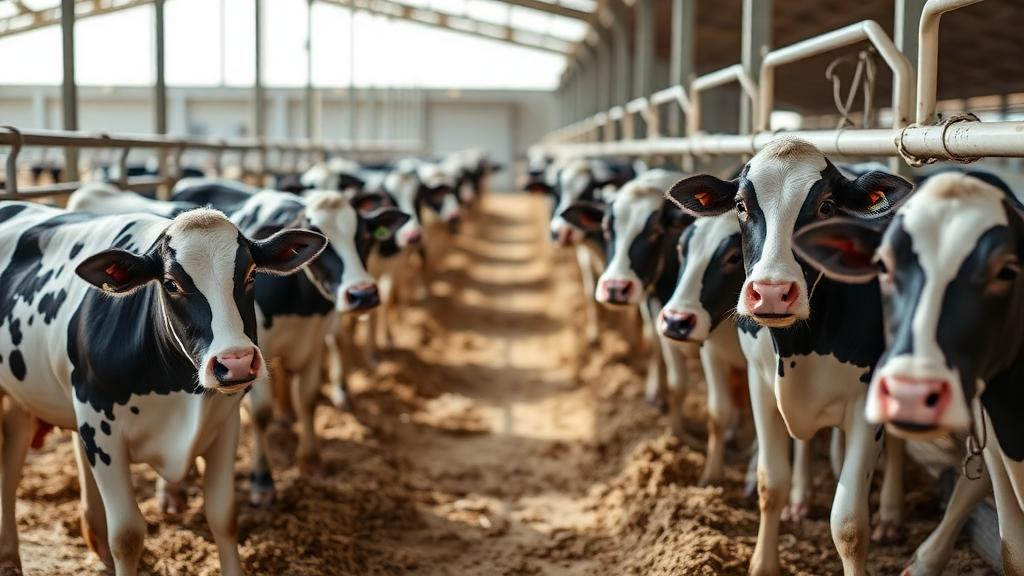
Dairy farms are quietly becoming some of the most data-intensive environments in agriculture. A new review published in Artificial Intelligence in Agriculture argues that the real challenge for animal welfare technology is no longer building clever algorithms, but wiring them into complete systems that survive the messy realities of a working farm. Led by Yi Zhang and colleagues, the review reframes AI- and IoT-enabled welfare assessment as a cyber–physical systems problem, connecting cameras, wearable sensors, environmental probes, edge computers and cloud analytics into a single pipeline that ends not with a prediction but with a defensible management decision.
The authors’ starting point is a familiar frustration. Welfare assessment on most dairy farms still depends on periodic human observation and a short list of visible indicators. Standardized welfare protocols are essential, but their episodic nature makes it hard to catch short-lived stress episodes, early deterioration, or context-dependent behavioral change. Welfare, the review emphasizes, is a multidimensional and time-varying state shaped by interactions among behavior, physiology, environment and management, so it cannot be fully characterized by sparse observational snapshots. Continuous sensing promises to close that gap, but only if the surrounding architecture is designed for it.
Most intelligent dairy platforms now follow a multilayer IoT structure: a perception layer of environmental probes, animal-mounted wearables and vision systems; an edge computing layer that performs latency-sensitive preprocessing and inference on site; a hybrid network layer combining short-range protocols such as Wi-Fi, Zigbee and LoRaWAN with wide-area links like NB-IoT and 4G/5G; and an application layer that fuses multimodal streams into decision-support dashboards. The review stresses that this layering is not just a technical abstraction. It maps welfare-relevant time scales—seconds to minutes for acute events, hours to days for behavioral rhythms, weeks to seasons for drift and longitudinal risk—onto appropriate sensing, inference and decision pathways.
Each layer carries its own failure modes. Vision systems deliver rich behavioral observability but are acutely sensitive to occlusion, lighting variability and barn layout. Wearables—accelerometers, pedometers, rumination collars, bolus temperature sensors—offer stable individualized baselines but face attachment instability, battery limits, calibration drift and data gaps. Environmental sensors can miss pronounced spatial heterogeneity within large barns, where microclimates differ substantially between resting areas, feeding alleys and milking zones. The review argues these modality-specific vulnerabilities must be treated as first-order design considerations, because they directly shape downstream model validity and the interpretability of welfare indicators.
On the analytics side, the review surveys three complementary dimensions. Vision-based pipelines progress from detection and segmentation to multi-object tracking and behavior classification, with CNN-based models widely used for localization and posture recognition and transformer-based architectures increasingly supporting long-range temporal modeling in crowded barns. Wearable time-series analysis draws on support vector machines, random forests, gradient boosting, LSTM networks and, more recently, lightweight temporal convolutional networks and transformer encoders suited to edge deployment. Multimodal fusion combines these streams, with the review contrasting early, intermediate, late and hybrid fusion strategies and their trade-offs between cross-modal richness and robustness when a modality fails.
A recurring theme is that welfare signals are indirect, weakly labeled and strongly confounded by context. Reduced feeding activity may reflect circadian timing, management disturbance, heat-load avoidance or social displacement; without environmental and social context, identical behavioral signatures can carry contradictory welfare meanings. The review therefore calls for context-aware inference that conditions behavioral interpretation on temperature–humidity index, ventilation status and, where available, interaction descriptors. It also maps sensor-derived outputs—reduced rumination, increased lying interruptions, lameness probability, heat-stress risk—onto welfare constructs and intervention logic, insisting that conflicting signals should trigger uncertainty flags rather than automatic responses.
Perhaps the review’s most pointed contribution is its treatment of digital twins. The authors caution that the term is used inconsistently, and that many reported systems are closer to dashboards or digital shadows than true twins. They propose an operational hierarchy: monitoring systems collect and visualize data; digital shadows maintain one-way physical-to-digital updating; digital twins require explicit dynamic state models, bidirectional linkage, uncertainty-aware data assimilation, scenario simulation and prospective validation; autonomous twins would demand closed-loop actuation under validated safety constraints. By these criteria, most current dairy applications sit in the monitoring or shadow categories, with fully realized twins at an early stage and autonomous twins largely aspirational.
Where twins do hold promise, the review argues, is in hybrid modeling that couples AI-derived state estimates with mechanistic submodels of thermoregulation, energy balance or stress physiology. Physics-informed neural networks and constraint-regularized learning can penalize biologically implausible trajectories and improve extrapolation under seasonal variation or distribution shift. But hybridization brings its own challenges: parameter identifiability when mechanistic components are partially observed, and nonstationarity as lactation stage, regrouping and seasons shift the underlying parameters. Sustained twin fidelity requires adaptive calibration, drift monitoring and explicit, auditable update policies.
On deployment, the review is blunt about the translation gap. Models that perform well under controlled conditions often degrade after transfer across farms with different layouts, breeds, climates and management practices. Random within-dataset splits are insufficient when observations from the same animals, cameras or farms appear in both training and test sets; animal-independent, temporally separated, cross-season and cross-farm testing provide progressively stronger evidence. Economic feasibility, too, depends on total cost of ownership—connectivity, computation, power, device replacement, maintenance, retraining and staff training—rather than sensor purchase alone. Barn-based and pasture-based systems face fundamentally different constraints, from bandwidth-rich edge–cloud collaboration to low-power, edge-dominant architectures with opportunistic synchronization.
The review closes with a governance agenda: standardized data schemas and annotation protocols, shared benchmarks that prevent leakage across animals and farms, reproducible pipelines with version-controlled repositories, and privacy-preserving collaboration through federated learning paired with enforceable data governance. Its conclusions are measured. Current evidence is strongest for task-level environmental and behavioral monitoring and selected anomaly detection; it remains less mature for validated latent welfare-state inference, trajectory forecasting and closed-loop control. AI, the authors argue, should augment rather than replace human judgment—prioritizing inspection, triage and proportionate intervention, with low-confidence predictions escalating to people rather than machines. Under those conditions, continuous, individualized, system-aware welfare intelligence becomes not just technically possible but operationally credible.
Subject of Research: AI and IoT architectures for continuous dairy cattle welfare assessment and digital twin decision support
Article Title: AI-IoT architectures for dairy welfare assessment: multimodal monitoring, deployment constraints, and the emerging role of digital twins
Article References: Zhang, Y., Bai, D., Li, Y., Han, G., Xie, X., Gotoh, T., Zhao, K., & Ma, Y. (2026). AI-IoT architectures for dairy welfare assessment: multimodal monitoring, deployment constraints, and the emerging role of digital twins. Artificial Intelligence in Agriculture. https://doi.org/10.1016/j.aiia.2026.09.008
Image Credits: AI Generated
DOI: 10.1016/j.aiia.2026.09.008
Keywords: dairy cattle, animal welfare, precision livestock farming, Internet of Things, artificial intelligence, edge computing, multimodal sensing, digital twin, computer vision, wearable sensors, edge-cloud computing, federated learning
Cite Scienmag News
William Thompson. (October 16, 2026). AI and IoT Turn Dairy Barns Into Welfare Monitoring Networks. Scienmag. https://scienmag.com/ai-and-iot-turn-dairy-barns-into-welfare-monitoring-networks/
William Thompson. "AI and IoT Turn Dairy Barns Into Welfare Monitoring Networks." Scienmag, 16 October 2026, https://scienmag.com/ai-and-iot-turn-dairy-barns-into-welfare-monitoring-networks/. Accessed 16 October 2026.
William Thompson. "AI and IoT Turn Dairy Barns Into Welfare Monitoring Networks." Scienmag. October 16, 2026. https://scienmag.com/ai-and-iot-turn-dairy-barns-into-welfare-monitoring-networks/


