


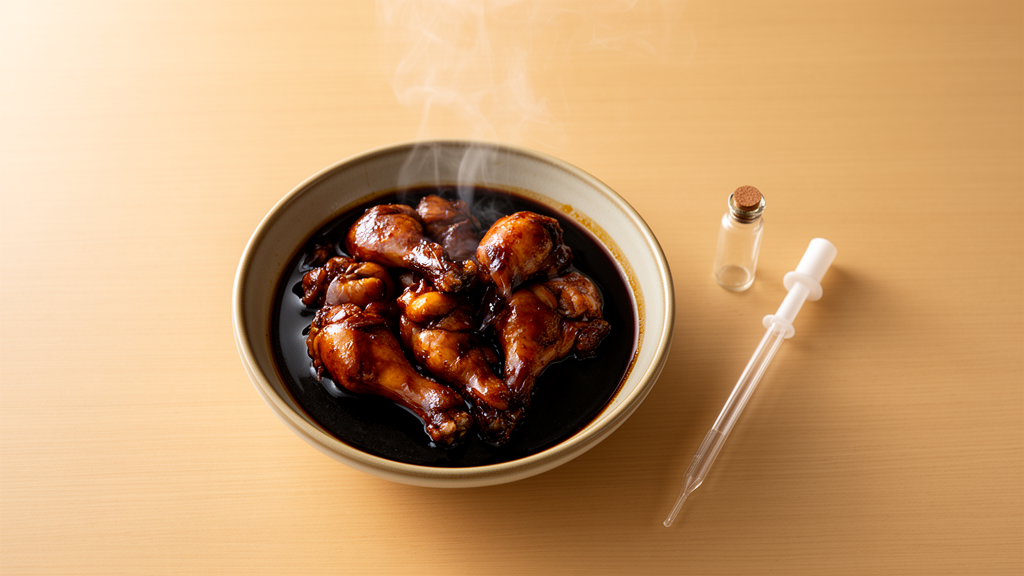
Braised chicken, one of China’s most beloved ready-to-eat meat products, owes its reputation to a flavor built during hours of stewing, when seasonings, spices, and thermal reactions weave together into a profile that consumers recognize instantly. But that flavor is fragile. During prolonged storage, lipid oxidation, protein degradation, and microbial metabolism quietly dismantle the very compounds that make the product appealing, generating rancid aldehydes and ketones, off-tasting amines, and sulfur-containing volatiles. A new study published in Food Chemistry: X has now tracked this flavor evolution month by month over a six-month shelf-life, combining trained sensory panels, electronic tongue and electronic nose systems, and gas chromatography–ion mobility spectrometry to reveal exactly which molecules betray the aging braised chicken.
The research team, led by Liu Jing and colleagues, worked with commercially sterilized Dezhou braised chicken produced by Dezhou Xiangsheng Food Co., Ltd. in Shandong Province. Seven independent production batches, all made from the same standardized 817 broiler chickens at 35 days of age and the same proprietary seasoning formula, were stored at 25 ± 1 °C in the dark. Samples were collected monthly at seven storage durations spanning 0 to 6 months, then analyzed in a unified campaign using sensory evaluation, physicochemical characterization, E-tongue, E-nose, and GC–IMS. This stepwise framework—from macro-scale sensory attributes down to micro-scale chemical compositions—was designed to pinpoint the volatile markers most closely linked to sensory deterioration.
The sensory results were unambiguous. Although every attribute declined during storage, odor deteriorated most dramatically, its score falling from 8.35 to 6.43 over six months and approaching the statistical rejection threshold of 6.0. That 1.92-point reduction was significantly greater than the declines in taste (1.16 points), texture (1.02 points), appearance (0.65 points), and color (0.48 points). Spearman correlation analysis confirmed that odor exhibited the strongest relationship with overall acceptability (r = 0.964, P < 0.001), followed by taste, texture, appearance, and color. In other words, the nose, not the eye or the palate, is the first arbiter of whether a braised chicken still deserves its place on the shelf.
Physicochemical measurements provided the chemical basis for this olfactory collapse. Total volatile basic nitrogen, an index of protein decomposition, rose from 10.45 to 18.48 mg/100 g, though it remained below the consumer-rejectable threshold of 25–28 mg/100 g for poultry meat. Thiobarbituric acid reactive substances, a measure of lipid oxidation, climbed from 0.53 to 2.56 mg malondialdehyde equivalents per kilogram, signaling advanced oxidative degradation and the generation of aldehydes and ketones responsible for greasy, oxidized off-flavors. Meanwhile, pH stayed stable between 6.56 and 6.67, and total viable counts remained below 2.0 log CFU/g throughout storage, indicating that the flavor spoilage was driven primarily by chemical reactions rather than by extensive microbial acidification in this commercially sterilized, vacuum-packaged product.
The E-tongue analysis, using the TS-5000Z system with six taste-specific sensors, objectively quantified the taste shift. Umami declined continuously from 11.57 to 11.09, richness fell from 1.42 to 1.04, and sweetness decreased steadily, while saltiness rose from 2.33 to 3.26 and bitterness and astringency increased during later storage. Principal component analysis showed a clear temporal gradient along the PC1 axis, with umami, richness, and sweetness identified as the core contributors to the initial flavor whose continuous decrease drove flavor evolution. The researchers attribute the umami reduction to the degradation of Maillard reaction products and lipid oxidation, while contrast effects between flavor components can make saltiness more prominent when the overall flavor balance is disrupted.
The E-nose, a PEN3 system with ten metal oxide sensors, revealed the odor counterpart of this taste drift. The W5S and W1W sensors, sensitive to nitrogen oxides and sulfur-containing compounds, showed gradually increasing responses that peaked at six months, suggesting the accumulation of nitrogen- and sulfur-containing volatiles. Conversely, the W1S and W2S sensors, responsive to short-chain alkanes, alcohols, aldehydes, and ketones typically abundant in fresh meat, declined over time. The W2W sensor, which detects aromatic and sulfur compounds, decreased initially before rising significantly in the final two months, consistent with the late-stage buildup of sulfur-containing volatiles associated with off-odors. Principal component analysis separated later-storage samples from earlier ones along PC1, confirming a progressive, time-dependent shift in odor characteristics.
GC–IMS then delivered the molecular detail. The technique detected 75 volatile signals, 67 of which were successfully identified, corresponding to 61 distinct compounds across nine chemical classes: 11 alcohols, 14 aldehydes, 9 ketones, 5 esters, 3 acids, 2 terpenes, 5 organosulfur compounds, 4 heterocyclic compounds, and 8 others. Fingerprint analysis revealed two opposing trends. Area
The molecular story told by the GC–IMS fingerprints mirrors the sensory and instrumental decline in a way that gives the industry a practical diagnostic toolkit. Among the 61 identified compounds, aldehydes deserve particular attention because they sit at the intersection of lipid chemistry and human perception. Saturated aldehydes such as hexanal, heptanal, and octanal are classical secondary oxidation products of omega-6 fatty acids, and their odor thresholds are low enough that even modest increases can shift a product from pleasantly meaty to noticeably rancid. The study’s finding that aldehydes constituted the largest identified class, with fourteen members, is consistent with the TBARS trajectory: as malondialdehyde equivalents more than quadrupled over six months, the pool of carbonyl fragments available for volatile release expanded accordingly. Because GC–IMS requires minimal sample pretreatment and generates visual fingerprints that can be compared across batches, the technique offers a realistic route for routine quality monitoring in production settings where full GC–MS workflows would be impractical.
The organosulfur compounds identified by GC–IMS provide a second, complementary marker family. Sulfur-containing volatiles in braised chicken originate largely from the degradation of sulfur amino acids during thermal processing and from subsequent microbial and oxidative transformations during storage. The E-nose sensors W1W and W2W, which respond strongly to these species, tracked their accumulation with the late-stage surge observed in the final two months of storage. This timing matters for shelf-life management: it suggests that the transition from acceptable to rejectable quality is not linear but accelerates toward the end of storage, meaning that sampling frequency in the final weeks of a product’s labeled shelf-life may be more informative than early monitoring alone. The correlation analysis linking these volatile markers to sensory scores effectively converts analytical chemistry into a predictive tool, allowing manufacturers to flag batches before panelists would formally reject them.
The taste-side findings also carry practical weight. The continuous decline in umami and richness scores reflects the erosion of the savory foundation that braised chicken is prized for, and the researchers’ attribution to Maillard reaction product degradation points to a chemical mechanism rather than simple dilution. Maillard products, formed during the initial stewing, are not permanently stable; they can undergo further reactions during ambient storage that alter or diminish their taste activity. Meanwhile, the rise in perceived saltiness despite unchanged formulation illustrates how flavor perception is relational rather than absolute. When umami and sweetness fade, the same sodium concentration registers as more prominent, a contrast effect well documented in sensory science. For product developers, this implies that reformulation to compensate for storage-induced taste drift is possible but must account for the changing balance rather than any single attribute.
Methodologically, the study demonstrates the value of data fusion across techniques that operate at different scales of resolution. Sensory panels capture holistic human experience but are slow and variable; E-tongue and E-nose provide rapid, objective screening suitable for large sample sets; GC–IMS supplies compound-level specificity with high sensitivity. By layering these approaches and connecting them through correlation and chemometric analysis, the researchers built a chain of evidence from consumer-relevant attributes down to individual molecules. The Spearman correlation coefficient of 0.964 between odor and overall acceptability, the highest among all attributes, justified the decision to prioritize odor-linked volatiles in the marker screening, a sensory-guided strategy that prevented the analysis from being diluted by compounds with no perceptual relevance.
The choice of commercially sterilized, vacuum-packaged product as the model system also shapes the interpretation. With total viable counts remaining below 2.0 log CFU/g throughout, microbial metabolism played a negligible role in the observed deterioration, and the flavor changes can be attributed almost entirely to chemical processes: lipid oxidation, protein degradation, and the slow transformation of thermally generated aroma compounds. This is a meaningful distinction for the meat industry, because ambient-stable sterilized products face different spoilage dynamics than chilled fresh meats, where microbial metabolism dominates. The findings therefore speak directly to the growing segment of shelf-stable ready-to-eat products, for which oxidative stability during long ambient storage is the central quality challenge.
Looking forward, the identified volatile markers and their temporal trajectories could support shelf-life prediction models that integrate chemical thresholds with sensory rejection points. The approach that TVB-N remained below regulatory limits while sensory quality had already declined substantially underscores a broader lesson: microbiological and chemical safety indices alone cannot capture flavor quality, and products can be perfectly safe yet organoleptically past their prime. Multidimensional analytical frameworks of the kind employed here offer a path toward quality standards that reflect what consumers actually experience, bridging the gap between regulatory compliance and market acceptance in the ready-to-eat meat sector.
Subject of Research: Flavor evolution and volatile marker identification in braised chicken during six-month storage
Article Title: Insights into the flavor evolution of braised chicken during six-month storage via sensory evaluation, E -tongue, E -nose, and GC–IMS
Article References: Jing, L., Huanjia, L., Caishuan, Y., Zhiwei, S., Yujin, L., Bingui, W., & Yujie, G. (2026). Insights into the flavor evolution of braised chicken during six-month storage via sensory evaluation, E-tongue, E-nose, and GC–IMS. Food Chemistry: X, Article 104631. https://doi.org/10.1016/j.fochx.2026.104631
Image Credits: AI Generated
DOI: 10.1016/j.fochx.2026.104631
Keywords: braised chicken, flavor deterioration, GC–IMS, electronic nose, electronic tongue, lipid oxidation, protein degradation, volatile compounds, sensory evaluation, shelf-life, ready-to-eat meat, chemometrics
Cite Scienmag News
Bethany Barker. (October 16, 2026). Braised chicken loses its aroma first: scientists trace six months of flavor decay down to four volatile markers. Scienmag. https://scienmag.com/braised-chicken-loses-its-aroma-first-scientists-trace-six-months-of-flavor-decay-down-to-four-volatile-markers/
Bethany Barker. "Braised chicken loses its aroma first: scientists trace six months of flavor decay down to four volatile markers." Scienmag, 16 October 2026, https://scienmag.com/braised-chicken-loses-its-aroma-first-scientists-trace-six-months-of-flavor-decay-down-to-four-volatile-markers/. Accessed 16 October 2026.
Bethany Barker. "Braised chicken loses its aroma first: scientists trace six months of flavor decay down to four volatile markers." Scienmag. October 16, 2026. https://scienmag.com/braised-chicken-loses-its-aroma-first-scientists-trace-six-months-of-flavor-decay-down-to-four-volatile-markers/


