


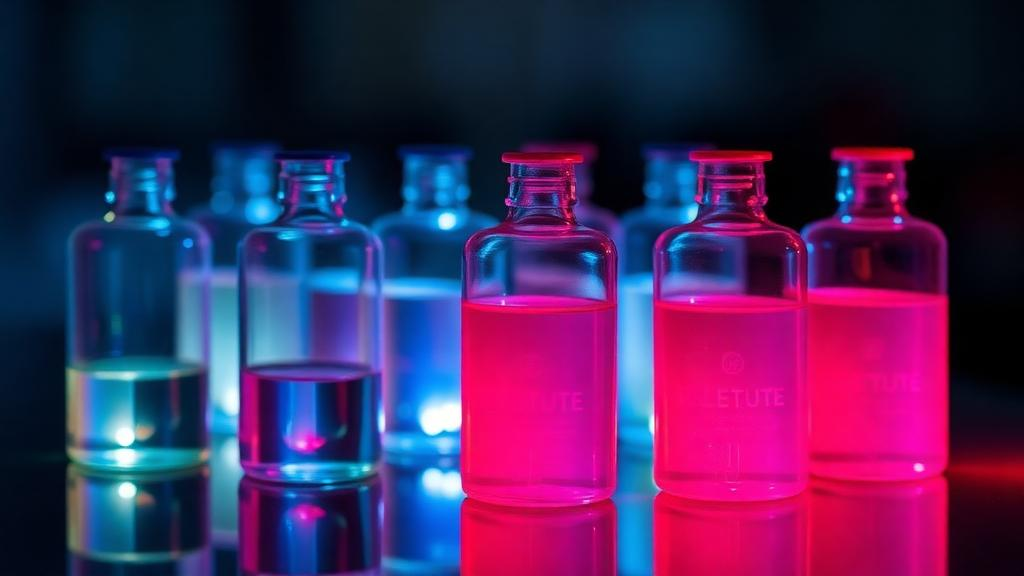
Counterfeit goods cost the global economy hundreds of billions of dollars every year, and the security features designed to stop them—holograms, specialised inks, microprinting—are locked in an escalating arms race with forgers equipped with ever-better reproduction technology. Now researchers at Nottingham Trent University, working with colleagues at the University of Liverpool and the University of Manchester, have developed a new class of glowing liquids that could give manufacturers a flexible and remarkably versatile weapon in that fight. Their materials, described in the Royal Society of Chemistry journal RSC Advances, are room-temperature luminescent ionic liquids built around lanthanide elements, and they can be mixed together like a palette of invisible paints to generate an enormous range of unique optical signatures.
The chemistry at the heart of the work centres on ionic liquids, a family of salts that remain liquid at or near room temperature rather than crystallising into solids. That liquid state is more than a laboratory curiosity. Because the materials flow and blend freely, they can be formulated, applied and processed using many of the printing and coating technologies already deployed on industrial production lines, without the grinding, melting or solvent-heavy processing that solid phosphors and pigments typically demand. Into these liquid hosts the team incorporated lanthanides, a group of fifteen metallic elements that includes familiar names such as europium, terbium and dysprosium, several of which are prized for their striking light-emitting behaviour.
What makes lanthanides so valuable for security applications is the way they emit light. When exposed to ultraviolet illumination, each lanthanide produces its own characteristic pattern of wavelengths—a narrow set of sharp emission lines that acts like a barcode written in photons rather than ink. Two different lanthanide compounds may look superficially similar to the naked eye, yet under the right optical analysis their emission spectra are as distinct as fingerprints. This property has long made lanthanides attractive for optical tagging, but traditional implementations often rely on solid compounds that are difficult to formulate, blend and print at scale.
The Nottingham Trent team, led by senior author Dr Anthony Fitzpatrick of the School of Science and Technology, developed four different glowing liquids, each containing one lanthanide element. The crucial design decision was to make these liquids mutually compatible, so that any of them can be mixed with any other in arbitrary proportions. In demonstrations described in the study, the researchers prepared binary mixtures containing two lanthanides as well as more complex combinations containing three or four. Critically, the mixtures produced increasingly intricate light signatures while retaining the characteristic emission lines of each individual component. The emissions do not blur into an indistinct glow; they stack, allowing the composition of the mixture to be read back from its optical output.
This combinatorial behaviour is what gives the approach its potential power. In conventional anti-counterfeiting systems, creating a new security code usually means synthesising a new material, a slow and expensive process that ties each signature to a specific chemical recipe. With mixable luminescent liquids, the arithmetic changes dramatically. A small set of four base liquids, combined in different proportions, can in principle generate a vast space of distinct optical signatures without any additional chemical synthesis. A manufacturer could tailor a tag for a specific product line, batch or document simply by adjusting the mixing ratios, in much the same way that a printer mixes primary inks to reproduce millions of colours.
Dr Fitzpatrick emphasised this advantage in comments accompanying the research. Creating a more complex security signature, he noted, does not require creating more complicated materials. Instead, different luminescent liquids can be combined to produce new signatures, potentially allowing manufacturers to create tailored optical tags or identification systems without having to synthesise a new material for every application. He suggested the materials could be incorporated into printed security features or other systems where a distinctive optical response is used to verify that an item is genuine, with potential applications spanning optical tagging, secure identification and anti-counterfeiting technologies.
The practical handling of the materials also sets them apart. Annie Prasad, a PhD student at Nottingham Trent University and a co-author of the study, highlighted that the new materials remain liquid at room temperature, making them easier to mix and formulate than materials that must be processed as solid compounds. Their properties, she added, could make them suitable for processing and printing technologies already used to produce security markings. That compatibility matters enormously for real-world adoption: a security ink that demands new equipment or exotic processing conditions faces a steep barrier to industrial uptake, whereas one that drops into existing flexographic, inkjet or screen-printing workflows can move from laboratory to factory far more quickly.
In their experiments, the team demonstrated the materials on paper, showing that different lanthanide liquids and their mixtures produced different optical responses when illuminated with ultraviolet light at different wavelengths. This substrate choice is telling, since paper remains the carrier for some of the world’s most counterfeited and most security-sensitive items, including banknotes, passports, certificates, tickets and pharmaceutical packaging. A security marking made with one of these liquids could look entirely ordinary under normal lighting conditions, revealing its hidden character only when examined under ultraviolet illumination of the appropriate wavelength—an interrogation step that counterfeiters would need to both anticipate and replicate.
The researchers are careful to frame the work as an early-stage demonstration rather than a finished security product. The initial experiments establish the potential of the materials, but further research would be required to fully establish how they might perform in real-world applications. Questions of long-term stability, durability under handling and environmental exposure, resistance to chemical analysis by determined counterfeiters, and the cost and scalability of lanthanide sourcing all remain open. Lanthanides, though not strictly rare in the Earth’s crust, are mined and refined in a concentrated set of locations, and supply-chain considerations could shape any eventual deployment at industrial scale.
Even so, the study offers a compelling glimpse of where anti-counterfeiting technology may be heading. As replication technologies improve, static security features—patterns that look the same every time they are inspected—grow steadily more vulnerable. Materials whose signatures arise from the fundamental physics of lanthanide emission, and whose complexity can be dialled up simply by mixing, push the cost of forgery sharply upward without imposing a corresponding burden on legitimate manufacturers. If subsequent development confirms the durability and printability of these glowing liquids, the invisible barcodes of the future may well be written in rare-earth chemistry, one carefully measured droplet at a time.
Subject of Research: Room-temperature luminescent lanthanide ionic liquids for optical tagging and anti-counterfeiting
Article Title: Glowing liquids could offer new way to protect products from counterfeiters
Article References: Glowing liquids could offer new way to protect products from counterfeiters. (n.d.). Original publication
Image Credits: AI Generated
DOI: Not provided
Keywords: anti-counterfeiting, ionic liquids, lanthanides, luminescence, optical tagging, security inks, Nottingham Trent University, RSC Advances, rare-earth elements, ultraviolet light, photonics, materials science
Cite Scienmag News
Bethany Barker. (October 16, 2026). Glowing ionic liquids could make counterfeits easier to spot. Scienmag. https://scienmag.com/glowing-ionic-liquids-could-make-counterfeits-easier-to-spot/
Bethany Barker. "Glowing ionic liquids could make counterfeits easier to spot." Scienmag, 16 October 2026, https://scienmag.com/glowing-ionic-liquids-could-make-counterfeits-easier-to-spot/. Accessed 16 October 2026.
Bethany Barker. "Glowing ionic liquids could make counterfeits easier to spot." Scienmag. October 16, 2026. https://scienmag.com/glowing-ionic-liquids-could-make-counterfeits-easier-to-spot/


