


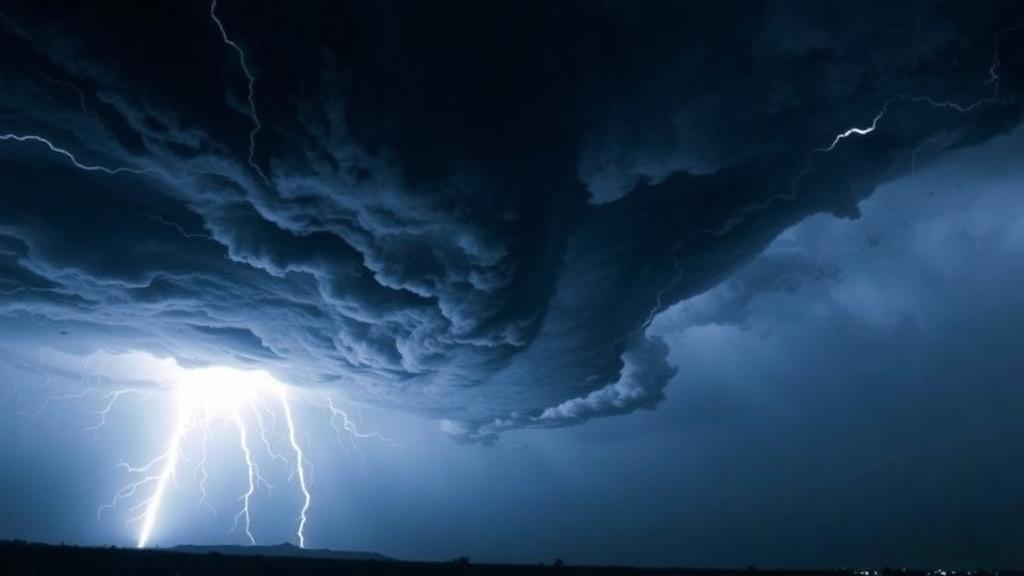
Deep convective storms do not stop at the top of the troposphere. Above the towering clouds that unleash hail, lightning and derechos, the atmosphere carries their imprint hundreds of kilometres upward, into the rarefied plasma of the ionosphere. A new study published in Frontiers in Astronomy and Space Sciences has now captured this hidden connection in unprecedented detail over Western Europe, using a dense web of more than 1,200 ground-based GNSS receivers to track ripples in the ionised layer of the upper atmosphere that were launched by five very different convective storms between 2019 and 2024.
The research, led by Thomas Farges of the French Alternative Energies and Atomic Energy Commission (CEA) together with colleagues at the Université Paris Cité and the Institut de Physique du Globe de Paris, focused on travelling ionospheric disturbances, or TIDs. These are wave-like fluctuations in plasma density that propagate through the ionosphere, the shell of charged particles that begins roughly 60 kilometres above the ground and extends far into space. TIDs come in several flavours: large-scale disturbances race at 300 to 1,000 metres per second with wavelengths of 1,000 to 3,000 kilometres and are usually driven by auroral activity during geomagnetic storms, while medium-scale TIDs move more slowly, at 100 to 300 metres per second, with wavelengths of several hundred kilometres. The latter are typically triggered by events near the Earth’s surface, including volcanic eruptions, earthquakes, tsunamis, rocket launches and, crucially, severe weather.
The physical mechanism linking a thunderstorm to the ionosphere is the atmospheric gravity wave. In the most convective regions of a storm, where updrafts punch through the top of the cloud in what meteorologists call an overshooting plume, air is violently displaced. This generates gravity waves that emerge from the cloud tops and propagate upward, generally at an oblique angle, through the stratosphere and mesosphere before reaching the thermosphere and modulating the plasma there. Because the waves travel obliquely rather than straight up, the ionospheric signature appears hundreds of kilometres away from the storm itself, spreading outward in near-circular ripples, much like the rings around a stone thrown into a pond.
To catch these ripples, the team exploited total electron content, or TEC, a measure of the number of electrons along the line of sight between a GNSS satellite and a ground receiver. By combining signals at two carrier frequencies, the researchers computed TEC for each satellite-receiver pair, discarded low-elevation measurements to avoid tropospheric contamination, and then subtracted a slow polynomial trend and applied a band-pass filter covering periods between roughly 6 and 45 minutes, the window where gravity-wave signatures live. The geographic position of each measurement was mapped to the so-called ionospheric piercing point, the intersection of the signal path with a thin shell at 250 kilometres altitude, allowing thousands of individual time series to be stitched into two-dimensional maps of the perturbed ionosphere.
The five storms analysed were deliberately diverse. They included a derecho that swept from the Mediterranean across northern Italy on 18 August 2022, a stationary Mediterranean storm that stalled over the Cevennes in southern France on 19 September 2020, a sprite-producing mesoscale convective system over the Mediterranean on 21 September 2019, the remnants of ex-tropical storm Kirk that crossed France on 8 October 2024, and the devastating cold-drop storm that flooded the Valencia region of southeastern Spain on 29 October 2024, killing more than 200 people. Storm candidates were preselected using meteorological reports and then filtered with criteria established in earlier work: the storm’s radar reflectivity above 30 dBZ had to cover more than 25,000 square kilometres, and lightning activity, measured by the World-Wide Lightning Location Network, had to exceed three flashes per ten minutes within half-degree grid cells inside the convective zone.
In every case, the ionosphere responded. Quasi-periodic TIDs propagated nearly circularly away from the storm centres, remaining visible in TEC for many hours and reaching horizontal distances of up to 1,000 kilometres. The apparent horizontal phase speeds fell between 100 and 160 metres per second, and the wave periods ranged from 13 to 39 minutes, values fully consistent with earlier observations in the Americas and Asia and with theoretical dispersion relations for gravity waves. For three of the five storms, the temporal evolution of the wave trains could be mapped clearly enough to measure wavelengths of roughly 200 to 300 kilometres, and the radiation pattern proved distinctly non-isotropic: waves were stronger and better defined in some directions than in others, exactly as atmospheric models predict.
The derecho case illustrates the power of the technique. As the storm formed north of the Balearic Islands around 04 UTC, climbed the Gulf of Genoa and slammed into northern Italy, its convective area swelled to about 70,000 square kilometres. Hodochrones, time-distance diagrams built from roughly 130 receivers, showed wavefronts marching away from the source at an average phase speed of 152 metres per second, with local values ranging from 120 to 230 metres per second. Two-dimensional TEC maps revealed circular ripples detectable from 600 to 1,000 kilometres from the storm, with amplitudes of about 0.3 TECU. A two-dimensional Fourier transform of an averaged TEC map yielded a wavelength of 193 kilometres and a preferred propagation azimuth toward the northeast, matching the 180 kilometres measured by eye between successive ripples. Intriguingly, waves travelling southeast carried amplitudes near 0.15 TECU and periods near 30 minutes, while those heading northeast were stronger, around 0.35 TECU, with shorter periods near 20 minutes, a directional asymmetry that mirrors the storm’s own motion.
The asymmetry itself carries scientific weight. Stratospheric and thermospheric winds act as filters, suppressing gravity-wave propagation in the direction the wind blows from, and the direction of the prevailing stratospheric wind reverses with the seasons. Four of the five storms occurred after the autumnal equinox, when the winds at around 65 kilometres altitude turn easterly, and their TIDs propagated preferentially westward. The derecho, the sole summer event, broke the pattern. The researchers argue that this seasonal dependence, long predicted by numerical simulations, is now confirmed observationally over Europe, and that it provides an independent fingerprint tying the ionospheric waves to their tropospheric sources.
By overlaying circles fitted to the observed wavefronts onto radar reflectivity maps, the team also pinned down the waves’ birthplace. The best agreement between the circular patterns and the most convective storm cores, defined by reflectivity above 45 dBZ, occurred when the radar data were taken roughly two to two and a half hours before the ionospheric measurement, a lag consistent with the oblique propagation speed of gravity waves. Because no disturbances were detected directly above the storms, only beyond about 600 kilometres, the observations imply a minimum propagation angle of about 20 degrees from the vertical, a hallmark of atmospheric gravity waves. For the sprite-producing storm and the Cevennes event, only a small arc of the wavefront was visible to the southwest, an asymmetry the authors attribute partly to wind filtering and partly to the geomagnetic field, which impedes the motion of ions and electrons perpendicular to field lines.
The study also sounds a note of caution for anyone hoping to use the ionosphere as a storm detector. During the Valencia flood, background TIDs of unrelated origin obscured the storm’s signature during the first peak of lightning activity, and the signal only became clear during the second peak. Geomagnetic storms, such as the one in its recovery phase when ex-Kirk arrived, can generate TIDs of their own that must be carefully separated from thunderstorm waves by analysing both speed and direction. The solar terminator, the moving boundary between day and night, launches wave packets that can mimic storm-generated disturbances; during the Cevennes event, terminator-driven waves showed amplitudes and speeds uncomfortably similar to gravity waves, and the authors note that distinguishing the two requires checking whether the propagation direction deviates by more than about 30 degrees from the terminator line or whether the speed falls below 200 metres per second. Solar flares, by contrast, produce an almost instantaneous, dayside-wide TEC jump that is easy to tell apart. The researchers conclude that, at this stage, the type of thunderstorm cannot be identified from TID characteristics alone, and they warn that intense storm activity could even complicate the ionospheric detection of tsunamis, which generate gravity waves with strikingly similar parameters. Still, with Europe’s GNSS networks now dense enough to image these ripples in real time, thunderstorms have been added to the growing list of surface events, from earthquakes to rocket launches, whose fingerprints can be read in the electrically charged sky above.
Subject of Research: Thunderstorm-generated travelling ionospheric disturbances observed with dense GNSS networks over Western Europe
Article Title: Characterization of thunderstorm-generated travelling ionospheric disturbances by dense GNSS sensors network over Western Europe
Article References: Farges, T., Princelle, E., & Astafyeva, E. (2026). Characterization of thunderstorm-generated travelling ionospheric disturbances by dense GNSS sensors network over Western Europe. Frontiers in Astronomy and Space Sciences, 13, Article 1893553. https://doi.org/10.3389/fspas.2026.1893553
Image Credits: AI Generated
DOI: 10.3389/fspas.2026.1893553
Keywords: travelling ionospheric disturbances, thunderstorms, atmospheric gravity waves, GNSS, total electron content, ionosphere, derecho, sprites, lightning, Western Europe, space weather, solar terminator
Cite Scienmag News
Russell Cooper. (October 16, 2026). Thunderstorms Leave Giant Ripples in the Ionosphere That European GPS Networks Can Now Track. Scienmag. https://scienmag.com/thunderstorms-leave-giant-ripples-in-the-ionosphere-that-european-gps-networks-can-now-track/
Russell Cooper. "Thunderstorms Leave Giant Ripples in the Ionosphere That European GPS Networks Can Now Track." Scienmag, 16 October 2026, https://scienmag.com/thunderstorms-leave-giant-ripples-in-the-ionosphere-that-european-gps-networks-can-now-track/. Accessed 16 October 2026.
Russell Cooper. "Thunderstorms Leave Giant Ripples in the Ionosphere That European GPS Networks Can Now Track." Scienmag. October 16, 2026. https://scienmag.com/thunderstorms-leave-giant-ripples-in-the-ionosphere-that-european-gps-networks-can-now-track/


