


Alzheimer’s disease is a thief that works slowly. The neuropathological changes that eventually erase memory and independence can begin years, even decades, before a family notices anything wrong, and by the time cognitive impairment is obvious, substantial and largely irreversible neuronal loss has already occurred. Structural MRI is one of the few widely available windows into that hidden interval, sensitive to the ventricular enlargement and hippocampal atrophy that track disease progression. Yet reading those scans remains stubbornly human: stage boundaries are fuzzy, scanners and sites introduce nuisance variation, and radiologists frequently disagree with one another, especially for very mild or borderline presentations. A new study from researchers at Vellore Institute of Technology in India, published in Frontiers in Artificial Intelligence, argues that a carefully engineered hybrid neural network can shoulder much of that burden, classifying brain MRI slices into four clinically meaningful Alzheimer’s stages with 95.94% slice-level accuracy, while also quantifying, with unusual candor, exactly why that headline number should be treated as an upper bound rather than a promise.
The team, led by T. Deenadayalan, S. P. Shantharajah, and Swarna Priya Ramu, built an end-to-end framework that fuses two kinds of reasoning that are usually kept apart. A convolutional neural network, the workhorse of modern medical image analysis, extracts local texture and shape cues from each grayscale MRI slice. But Alzheimer’s staging is not purely a local-pattern problem: the clinically relevant evidence is spatially distributed and often expressed as gradual structural change across neighboring regions. To capture that continuity, the researchers serialize the final convolutional feature map, an 8-by-8 grid of 256-channel descriptors, into an ordered sequence of 64 spatial tokens, each corresponding to a 16-by-16-pixel region of the input. A bidirectional long short-term memory network, or BiLSTM, then sweeps across this sequence in both directions, modeling the contextual dependencies between tokens without requiring a computationally heavy three-dimensional network.
The third ingredient is attention. An additive, Bahdanau-style attention block scores each of the 64 contextualized tokens, and a softmax over the token axis converts those scores into normalized weights. The weighted sum produces a compact 256-dimensional context vector that a dense head, comprising 128 ReLU units with L2 regularization, batch normalization, and dropout, maps to four class probabilities. The design choice that makes the whole thing interpretable is subtle but decisive: because the full two-dimensional grid is preserved rather than collapsed into eight row-aggregated vectors, each attention weight folds back onto a specific grid cell, yielding an 8-by-8 spatial map that can be overlaid on the original slice. The researchers also fixed a training detail with outsized consequences, moving the tanh nonlinearity from the scalar score into the hidden projection, which removed a mathematical constraint that had previously capped the ratio between the largest and smallest attention weights at roughly 7.4 and forced a near-uniform distribution.
The ablation results are striking. A CNN-only baseline, using global average pooling over the same 64 tokens, reached just 63.33% accuracy with a Matthews correlation coefficient of 0.4891. Adding the BiLSTM alone, without attention, actually performed slightly worse at 61.46% accuracy, and the exact McNemar test on paired predictions showed the difference was not statistically significant. Attention alone, without recurrence, fared even worse at 51.88% accuracy. Only the complete CNN-BiLSTM-Attention configuration, with 1,619,237 trainable parameters, achieved the headline performance, and the McNemar test against the CNN-only baseline yielded a p-value of 2.128 times ten to the power of negative 76. The improvement is not explained by parameter count alone: the BiLSTM variant carries roughly 32.6% more parameters than the baseline yet delivers no corresponding gain, while the complete architecture adds only about 34% more parameters and transforms the task.
Class imbalance posed a second, equally serious challenge. The publicly available Kaggle four-class corpus contains 6,400 axial MRI slices, but the distribution is brutally skewed: 3,200 slices from persons with no dementia, 2,240 from persons with very mild dementia, 896 from persons with mild dementia, and just 64 from persons with moderate dementia. Training without any imbalance correction produced a balanced accuracy of only 37.91%, with zero recall for the moderate stage. The researchers deliberately rejected pixel-space SMOTE, the synthetic minority over-sampling technique that interpolates between flattened images, on the grounds that linearly blending two unregistered MRI slices produces patterns with no anatomical referent. Instead, they oversampled real minority slices toward the majority-class count with a maximum duplication factor of ten, combined with tempered cost-sensitive class weights ranging from 0.765 to 1.706, applied strictly to the training fold. This strategy lifted balanced accuracy to 96.08% and moderate-stage recall to 1.0000, outperforming SMOTE, which reached only 75.24% balanced accuracy despite generating a larger effective training set.
The evaluation protocol is where the study departs most sharply from much of the prior literature. Before any partitioning, exact duplicates were screened using MD5 hashing of the resized images, and the stratified 70/15/15 split was performed before any balancing, so no resampled or reweighted instance could reach the validation or test folds. The researchers then went further, conducting a quantitative near-duplicate audit on the fixed folds. Each of the 960 test slices was downscaled to 32 by 32 pixels, L2-normalized, and compared against all 4,480 training slices using cosine similarity. No byte-level duplicate was found at a threshold of 0.999, but 874 test slices, 91.0% of the fold, had a training counterpart with similarity of at least 0.99, and every single test slice had a counterpart at 0.95 or above. This is the signature of slice-level partitioning, where adjacent axial slices from the same brain can land in different folds, and it is precisely the effect that prior benchmark studies by Wen and colleagues and Yagis and colleagues showed can inflate reported accuracy by tens of percentage points.
Because the redistributed dataset carries no subject identifiers, patient-grouped partitioning is simply not possible, and the authors state explicitly that the reported accuracies should be interpreted as an upper bound attainable under a slice-level split, not as evidence of how the model would perform on unseen patients. The validation-versus-test gap is small, below one percentage point for accuracy, balanced accuracy, macro-F1, MCC, and Cohen’s kappa, which the authors read as consistency between the two held-out folds rather than as proof of subject-level generalization. A multi-seed experiment using three independent random seeds revealed substantial variability, with accuracy ranging from 28.96% to 53.02% across nominally identical configurations, a discrepancy the authors have not yet fully reconciled with the headline run and which they flag as bearing on the validity of every other result in the paper.
On the untouched test fold, the complete model achieved 95.94% accuracy, 96.08% balanced accuracy, an MCC of 0.9334, a Cohen’s kappa of 0.9325, and a macro-averaged one-versus-rest AUC of 0.9954, with narrow bootstrap confidence intervals over 2,000 resamples. Per-class analysis showed strong sensitivity and specificity for the three better-represented stages, while the extremely rare moderate dementia class, with just nine test images, showed a favorable point estimate that the authors explicitly decline to claim as robust detection on its own. The error structure is clinically favorable: of the 39 test-set misclassifications, 82.1% were adjacent-stage confusions, no error spanned three stages, and no confusion occurred directly between persons with no dementia and persons with moderate dementia, indicating the network learned the severity ordering rather than an arbitrary partition. The dominant residual failure, staging very mild dementia as no dementia in 23 cases, remains the clinically most costly error and the priority target for future work.
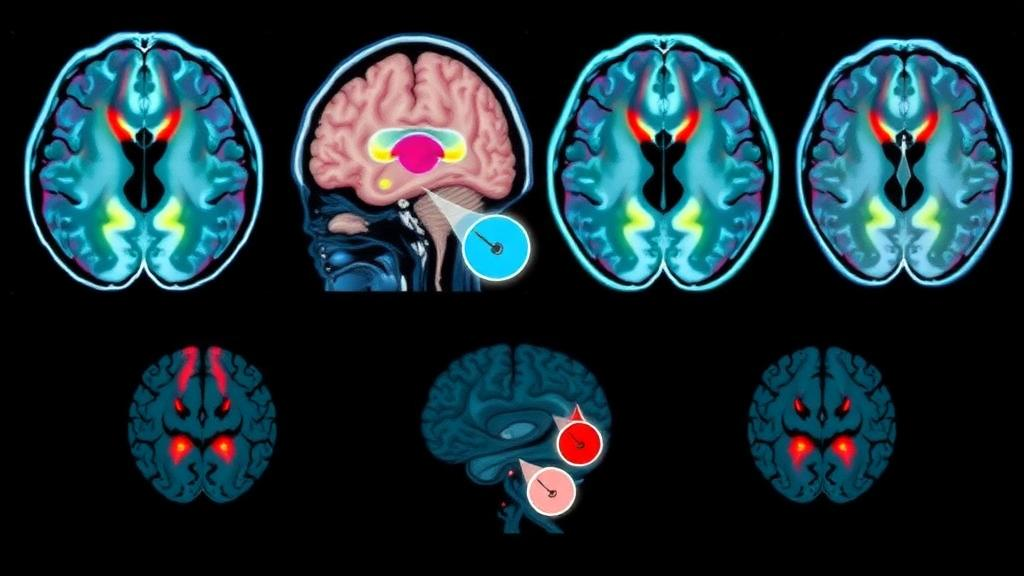
Interpretability comes through two complementary channels. The network’s own additive attention distribution is a forward-pass quantity the model actually uses to decide, not a post-hoc reconstruction, and the observed entropy of 3.410 nats against a uniform baseline of 4.159 nats confirms the distribution is measurably selective. The two more advanced stages draw the most concentrated attention, consistent with focal gross structural change, while very mild dementia attracts the most diffuse attention, consistent with distributed subtle evidence, and the class-mean maps concentrate on the periventricular and inferior-medial bands where ventricular enlargement and medial temporal atrophy are expressed. Grad-CAM overlays, which weight the last convolutional layer’s channels by the mean gradient of the predicted class score, agree on the broad localization, providing a useful cross-check. The authors are careful about scope: the maps have 16-by-16-pixel resolution and are regional rather than anatomical, indicating attention to periventricular structure but not segmenting a hippocampus or quantifying its volume.
External validation on the independent OASIS cohort, without any retraining or fine-tuning, showed the model retaining useful discriminative capability under cross-dataset domain shift, with 71.24% accuracy, 69.48% balanced accuracy, an MCC of 0.6214, and a macro ROC-AUC of 0.8619, confirming a substantial domain-shift effect while demonstrating that the learned representations carry meaningful information about unseen MRI data. The authors outline a future agenda in order of priority: auditing the checkpoint-selection discrepancy between the headline run and the multi-seed sweep, extending validation to strict participant-level partitioning on OASIS and additional cohorts such as ADNI, volumetric modeling evaluated within that same protocol, a parameter-matched architectural control to isolate the capacity confound, richer real data for the advanced stages, and quantitative evaluation of the attention and Grad-CAM explanations against expert-annotated regions of interest. The study’s lasting contribution may be less the architecture itself than the protocol surrounding it, a demonstration that coupling convolutional feature extraction with bidirectional sequence modeling and additive attention under a leakage-aware, imbalance-aware evaluation can produce competitive four-stage Alzheimer’s classification while quantifying, rather than hiding, the limits of what the numbers mean.
Subject of Research: Alzheimer's disease
Article Title: A hybrid CNN–BiLSTM network with additive attention for automated four-stage classification of Alzheimer's disease from brain MRI
Article References: Deenadayalan, T., Shantharajah, S. P., & Ramu, S. P. (2026). A hybrid CNN–BiLSTM network with additive attention for automated four-stage classification of Alzheimer's disease from brain MRI. Frontiers in Artificial Intelligence, 9, Article 1948601. https://doi.org/10.3389/frai.2026.1948601
Image Credits: AI Generated
DOI: 10.3389/frai.2026.1948601
Keywords: Alzheimer's disease, brain MRI, deep learning, CNN, BiLSTM, attention mechanism, class imbalance, data leakage, Grad-CAM, explainable AI, OASIS, dementia staging
Cite Scienmag News
Cassandra Pierce. (October 16, 2026). Hybrid AI reads brain scans to stage Alzheimer’s disease in four steps. Scienmag. https://scienmag.com/hybrid-ai-reads-brain-scans-to-stage-alzheimers-disease-in-four-steps/
Cassandra Pierce. "Hybrid AI reads brain scans to stage Alzheimer’s disease in four steps." Scienmag, 16 October 2026, https://scienmag.com/hybrid-ai-reads-brain-scans-to-stage-alzheimers-disease-in-four-steps/. Accessed 16 October 2026.
Cassandra Pierce. "Hybrid AI reads brain scans to stage Alzheimer’s disease in four steps." Scienmag. October 16, 2026. https://scienmag.com/hybrid-ai-reads-brain-scans-to-stage-alzheimers-disease-in-four-steps/


