


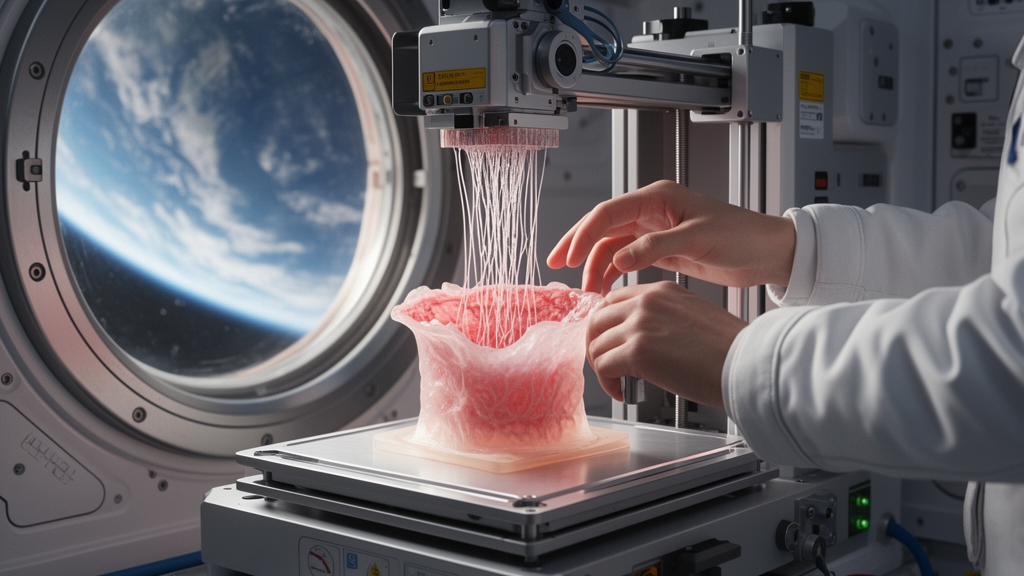
Space is often described as a hostile environment, but a new review from researchers at Cedars-Sinai Medical Center argues that it may also be one of the most powerful tools biomedicine has ever had. Writing in Frontiers in Bioengineering and Biotechnology, Jasmine Gupta, Maedeh Mozneb, Jemima Moses, and Arun Sharma survey the bioengineering technologies that are turning the International Space Station and future orbital platforms into laboratories capable of tissue fabrication, disease modeling, and real-time molecular monitoring. Their conclusion is striking: microgravity is not merely a hazard to be endured, but a physical regime that can be exploited to build human tissues that are difficult or impossible to construct on Earth.
The urgency behind this work comes from what spaceflight does to the human body. Beyond Earth’s protective atmosphere, astronauts face microgravity, galactic cosmic rays, solar proton events, isolation, and confinement, all of which disrupt physiological homeostasis and can accelerate cellular and systemic aging. Microgravity shifts fluid distribution in ways that produce Spaceflight-Associated Neuro-ocular Syndrome, marked by optic disc edema and vision changes. The heart, relieved of some of its workload, atrophies, and orthostatic tolerance and blood volume decline. Most dramatic are the musculoskeletal effects: astronauts can lose up to one percent of bone mass per month as osteoblast activity is suppressed and osteoclast-mediated resorption increases, while skeletal muscle atrophy follows from impaired myogenesis and upregulated proteolytic pathways. These changes mirror terrestrial aging but unfold over weeks to months, effectively turning astronauts into an accelerated model of degenerative disease.
Deep space adds a threat with no terrestrial equivalent. Outside Earth’s magnetic field and solid shielding, missions to the Moon and Mars will expose crews to high-energy heavy ions and high-linear energy transfer radiation that cannot be reproduced comparably on Earth, raising risks of carcinogenesis and degenerative disease. Radiation damages DNA and elevates cancer susceptibility, isolation impairs neurobehavioral health, and even microbes change behavior in orbit, with bacteria showing reduced susceptibility to antibiotics. Understanding these mechanisms, the review argues, is essential both for safeguarding astronaut health and for advancing medicine on Earth, particularly for aging and disuse-related conditions. But conducting biology in orbit has historically been constrained by high costs, operational complexity, limited launch opportunities, and severe limits on mass, volume, and crew time. The authors organize the emerging solution into four converging technology areas: tissue engineering, 3D bioprinting, tissue chips, and biosensors.
Tissue engineering, which combines cell biology, materials science, and biomedical engineering to build functional tissues, is the foundation of this effort. Engineered human tissues and organoids derived from human stem cells offer human-relevant alternatives to animal models, which are expensive to fly and fail to recapitulate human physiology and immune responses. As the review notes, organoids act essentially as small avatars of an individual, allowing researchers to study authentic human tissue without causing harm. Microgravity itself is an asset here: the absence of sedimentation and buoyancy-driven convection promotes uniform cell distribution within developing constructs, encouraging the formation of large, complex, well-organized multicellular structures. A commercial company, Lambdavision, is already exploiting this to build artificial retinas from layers of bacteriorhodopsin, flowing homogeneous layers over a scaffold in orbit because on Earth sedimentation and convective turbulence create uneven layers that must be discarded.
The historical proof of concept came from a landmark experiment in which researchers cultivated bovine articular chondrocytes on biodegradable polyglycolic acid scaffolds, growing them for three months on Earth before sending them to the Mir Space Station for four more months. Space-grown cartilage constructs were more spherical than their terrestrial counterparts and showed superior three-dimensional extracellular matrix synthesis, but they contained less glycosaminoglycan and were mechanically inferior, a reminder that gravity-driven mechanical cues shape tissue function. The review also highlights more recent work: engineered heart tissues built from induced pluripotent stem cell-derived cardiomyocytes in fibrin hydrogels, conditioned electromechanically until they aligned, striated, and responded to adrenergic stimulation, and decellularized bone matrices seeded with stem cell-derived osteoblasts, endothelial cells, and hematopoietic progenitors to build functional bone marrow tissue for radiation studies. Microgravity-cultured 3D cancer models, including patient-derived colorectal cancer organoids that showed increased viability and enhanced sensitivity to 5-fluorouracil, are opening the door to drug screening with far greater physiological relevance than flat cultures.
Where tissue engineering builds structures, 3D bioprinting builds them on demand, depositing cells, biomaterials, and biomolecules layer by layer into tissue-like architectures. Microgravity addresses two of the biggest problems of bioprinting on Earth: it reduces cell sedimentation and the gravity-driven collapse of soft or complex constructs, and it relaxes the requirement that printed material be viscous enough to support the weight of layers above it. Inkjet-style bioink printing, first demonstrated with an Epson 800 printer aboard the ISS, benefits from lower bioink viscosity, which reduces shear stress on cells and nozzle clogging. The flagship platform today is the ISS BioFabrication Facility developed by Redwire Corporation, which has successfully printed meniscus tissue in orbit. When the collagen and chondroitin-based hydrogel tended to run up the needle, the team used the printer’s multi-ink capability to first print a well and dispense an agarose support bath, then print into it. The result showed good shape fidelity and cell distribution, but a weakness remains: the space-printed meniscus had a Young’s modulus of about 9.8 kilopascals against roughly 38.7 kilopascals for ground controls, so the print was biologically and structurally successful but not yet mechanically equivalent to native tissue.
Alternative printing technologies carry different trade-offs. Photopolymerization methods such as digital light processing and stereolithography solidify geometry with light, avoid nozzles that can damage fragile cells, and offer higher speed and resolution, but they require photopolymerizable bioinks, limit cell loading, and demand a full bath of liquid material that is difficult to contain and power-hungry in microgravity, sustaining live cells throughout a large volume. Laser-assisted printing is least affected by the space environment since laser function does not change in orbit, and magnetic levitation can scaffold-free printing, though the gadolinium used for levitation is toxic to cells. Meanwhile, work on printed polylactic acid scaffolds mimicking physiological and osteoporotic bone architectures, seeded with osteoblast-like cells in rotating bioreactors, showed roughly threefold increased cell colonization under dynamic simulated microgravity with no detectable inflammatory response, validating integrated scaffold-bioreactor systems for bone research.
Tissue chips, or organ-on-chip microfluidic devices, represent the most mission-friendly format of all. These small-footprint systems control fluid flow precisely and culture cells in tissue-like geometries, requiring minimal space and resources, capable of automation, and fully contained, making them safer in orbit than open fluid handling. Under the Tissue Chips in Space initiative launched by NCATS and the ISS National Laboratory, chips modeling the brain, gut, heart, liver, lungs, kidney, bone, cartilage, bone marrow, and the blood-brain barrier have been developed for flight. Skeletal muscle chips flown on multiple payloads revealed downregulated myoblast proliferation, reduced muscle-metabolism pathways, and shifts in fiber type, reinforcing space as a model for sarcopenia-like phenotypes. In radiation research, engineered cardiac tissues and bone marrow exposed to simulated cosmic radiation at doses of one to six gray showed tissue-specific damage patterns, and proof-of-concept countermeasure testing succeeded: amifostine pre-treatment protected the cardiac tissues, and granulocyte colony-stimulating factor partially restored hematopoietic stem and progenitor populations in irradiated bone marrow chips, results that aligned with live mouse models.
The fourth pillar, biosensors, tackles the data bottleneck that limits every orbital experiment. With crew time scarce and sample return delayed, real-time in-situ measurement of contraction forces, electrical activity, metabolites, proteins, and cell viability is transformative. Wearable devices are already in development, including an electromagnetic resonant skin patch sensor that detects microgravity-induced cranial fluid shifts to warn of Spaceflight-Associated Neuro-ocular Syndrome risk, verified against ultrasound images of the optic nerve sheath. Superwettable microchips with alternating superhydrophilic and superhydrophobic patterns create controlled individual droplets for colorimetric detection of glucose, calcium, and proteins without complex hardware. Researchers have also proposed organoids engineered as biological sentinels that report cytotoxicity or radiation exposure through fluorescent signals, while compact modular microscopes such as the 3D-printed EuniceScope and nanoelectronic meshes grown into cyborg organoids are expanding what can be measured autonomously mid-experiment.
The review’s authors are candid about the hurdles: vascularization of thick engineered tissues, long-term functional stability after return to Earth’s gravity, mechanical equivalence of printed constructs, methodological standardization across simulated microgravity platforms, and regulatory questions ranging from Outer Space Treaty jurisdiction to Good Manufacturing Practice standards for space-grown stem cells, which NASA and the FDA have begun aligning. But the trajectory is clear. Tissue engineering, 3D bioprinting, tissue chips, and biosensors are converging toward unified, autonomous platforms that could fabricate, culture, and monitor human tissue in orbit with minimal crew intervention. Such systems would let researchers test countermeasures faster, probe the mechanisms of accelerated aging and radiation injury with unprecedented fidelity, and, in a twist few predicted, use the absence of gravity as a manufacturing advantage, delivering insights that flow back to patients on Earth as surely as they protect the next generation of explorers bound for Mars.
Subject of Research: Bioengineering technologies for conducting biomedical research, including tissue engineering, 3D bioprinting, tissue chips, and biosensors, in the microgravity environment of space
Article Title: Bioengineering technologies for enabling biomedical research in space
Article References: Bioengineering technologies for enabling biomedical research in space. (n.d.). https://doi.org/10.3389/fbioe.2026.1915463
Image Credits: AI Generated
DOI: 10.3389/fbioe.2026.1915463
Keywords: space biology, microgravity, tissue engineering, 3D bioprinting, tissue chips, organ-on-a-chip, biosensors, organoids, astronaut health, cosmic radiation, International Space Station, regenerative medicine
Cite Scienmag News
Gregory Coleman. (October 16, 2026). Printing Tissue in Orbit: How Space Is Becoming the Next Biomedical Lab. Scienmag. https://scienmag.com/printing-tissue-in-orbit-how-space-is-becoming-the-next-biomedical-lab/
Gregory Coleman. "Printing Tissue in Orbit: How Space Is Becoming the Next Biomedical Lab." Scienmag, 16 October 2026, https://scienmag.com/printing-tissue-in-orbit-how-space-is-becoming-the-next-biomedical-lab/. Accessed 16 October 2026.
Gregory Coleman. "Printing Tissue in Orbit: How Space Is Becoming the Next Biomedical Lab." Scienmag. October 16, 2026. https://scienmag.com/printing-tissue-in-orbit-how-space-is-becoming-the-next-biomedical-lab/


