


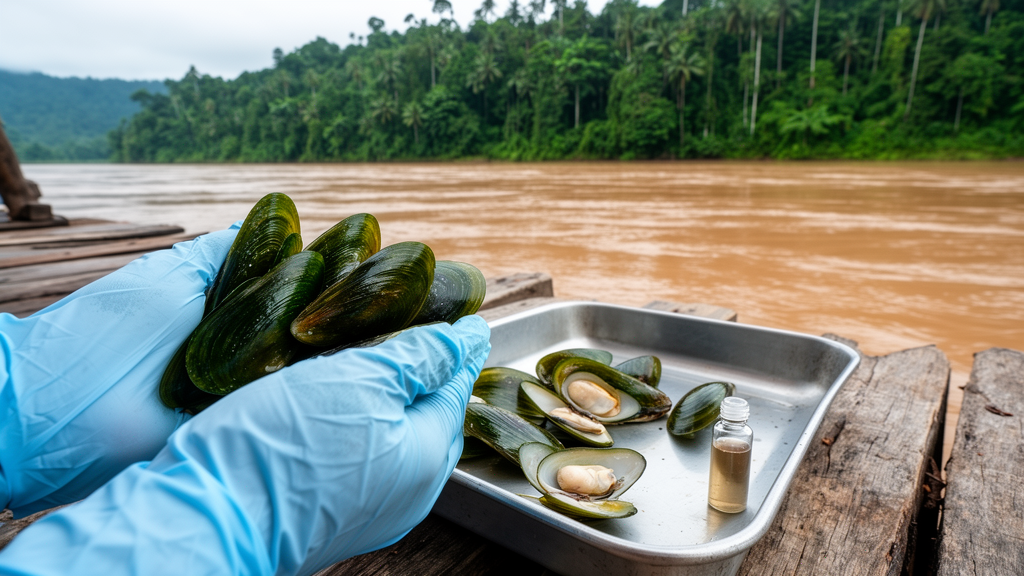
Every single Asian green mussel pulled from the Santubong River estuary in Sarawak, Malaysia, contained microplastics. That 100 percent occurrence rate, documented in a new baseline study published in Environmental Monitoring and Assessment, is the kind of finding that stops researchers mid-sentence. The mussels carried a mean abundance of 5.51 microplastic items per individual, and the polymers identified inside them were not random debris. Polyamide, polypropylene, and polystyrene dominated the particle inventory, and when the researchers ran those polymers through a standardized polymer hazard index, the result was 3143.3, a Level IV high-hazard score. In one of the world’s most biodiverse regions, the region’s most iconic bivalve is quietly cataloging the plastic fingerprint of human activity along its riverbanks.
The study, conducted by Hawa Moussa Ba and Farah Akmal Idrus at Universiti Malaysia Sarawak, focused on the Asian green mussel, Perna viridis, a species widely used across Southeast Asia as a sentinel for marine contamination. Green mussels are filter feeders, pumping enormous volumes of water through their gills each day and sieving out particles as small as a few micrometers. That biology makes them ideal biomonitors: whatever is suspended in the water column tends to end up in their soft tissues. The Santubong River, flowing into the South China Sea near Kuching, carries runoff from fishing communities, aquaculture operations, and growing settlements, yet until this study, no data existed on microplastic contamination or polymer hazards in mussels from this estuary. The researchers set out to fill that gap with a rigorous, quantitatively grounded assessment.
Laboratory analysis of the mussel tissues revealed a clear morphological signature. Fibers accounted for 54.7 percent of all recovered particles, fragments for 30.9 percent, with films and spheres making up the remainder. Fibers are the classic marker of textile shedding, fishing gear degradation, and rope weathering, while fragments typically signal the mechanical breakdown of larger plastic items. Color analysis added another layer of forensic detail: transparent particles made up 40.9 percent of the inventory, white 26.1 percent, and blue 23.8 percent. The blue fraction is particularly telling, since blue is a common color for nylon ropes, nets, and aquaculture gear used throughout Southeast Asian coastal waters. Size distribution showed that 83.6 percent of particles were smaller than 1000 micrometers, meaning most were well within the range that bivalves can readily ingest and retain.
One of the most consequential statistical findings of the study was a moderate negative correlation between microplastic abundance and soft tissue weight, with a correlation coefficient of r = -0.40 and a p-value below 0.05. In plain terms, mussels carrying more microplastics tended to have lighter soft tissues relative to their body size. Soft tissue weight is a proxy for physiological condition in bivalves, reflecting energy reserves, reproductive investment, and overall health. A negative correlation does not prove causation, but it raises the possibility that microplastic ingestion is imposing a measurable cost on the mussels’ energy budget, either by interfering with feeding efficiency, damaging digestive tissues, or triggering inflammatory responses that divert resources away from growth. Similar patterns have been reported in other bivalve studies worldwide, and the consistency of that signal across species and regions strengthens the argument that microplastics are not biologically inert.
To identify the specific polymers inside the mussels, the researchers turned to attenuated total reflectance Fourier-transform infrared spectroscopy, or ATR-FTIR. This technique works by directing infrared light onto a particle and measuring which wavelengths are absorbed, producing a molecular fingerprint unique to each polymer type. The results were unambiguous: polyamide made up 60 percent of the identified polymers, polypropylene 23.3 percent, and polystyrene 10 percent. Polyamide, better known commercially as nylon, is the workhorse polymer of fishing gear, ropes, nets, and aquaculture equipment. Its overwhelming dominance in the Santubong mussels points directly to local fishing and aquaculture operations as the primary source of microplastic contamination in this estuary. Polypropylene, meanwhile, is one of the most widely produced plastics globally and appears in packaging, containers, and household items, while polystyrene is common in food packaging and disposable products.
Scanning electron microscopy added a sobering dimension to the polymer analysis. SEM imaging revealed extensive surface weathering on the recovered particles, including cracks, pits, and fractures. This is not cosmetic damage. Surface weathering increases the effective surface area of a particle, making it more reactive and more likely to adsorb persistent organic pollutants, heavy metals, and pathogenic microorganisms from the surrounding water. Weathered particles also fragment more readily, generating smaller particles and eventually nanoplastics, which can cross biological membranes that larger particles cannot. The combination of polyamide dominance and extensive weathering suggests that the particles inside these mussels have been in the environment for a considerable time, cycling through UV exposure, mechanical abrasion, and biological degradation before being ingested.
The polymer hazard index, or PHI, is a composite metric that weighs the relative toxicity of each polymer type by its abundance. Polymers are assigned hazard scores based on their chemical composition, monomer toxicity, and known environmental impacts, with polyamide and polystyrene carrying higher scores than polypropylene due to their monomer toxicity and additive content. When the Santubong polymer inventory was run through this framework, the resulting PHI of 3143.3 placed the estuary firmly in Level IV, the high-hazard category. This is not a trivial classification. Level IV hazard status implies that the polymer mix inside these mussels carries a meaningful toxicological burden, both for the organisms themselves and potentially for humans who consume them. Green mussels are a widely harvested and commercially important food species in Malaysia, and the presence of high-hazard polymers in their tissues raises direct questions about seafood safety in the region.
The implications extend well beyond the Santubong River. Perna viridis is harvested and cultured throughout Southeast Asia, from the Gulf of Thailand to the Java Sea to the coastal waters of the Philippines and Vietnam, and studies from those regions consistently report microplastic contamination in the same species. The Santubong findings add Malaysian Borneo to that growing map, establishing a critical baseline against which future changes in contamination can be measured. Baselines matter because they allow researchers and regulators to distinguish between a stable, chronic contamination level and a worsening trend. Without this kind of quantitative starting point, it is impossible to evaluate whether pollution management measures are working or whether contamination is escalating. The researchers frame their study as exactly that: a foundational dataset for microplastic pollution management in Perna viridis and for broader environmental health assessments in Malaysian Borneo.
What makes this study resonate is the way it transforms a humble bivalve into a forensic instrument. Each mussel is, in effect, a biological archive of the water it filtered, recording the polymers, shapes, colors, and degradation states of the particles suspended in the Santubong estuary. The dominance of polyamide tells a story about fishing gear and aquaculture ropes. The prevalence of fibers and fragments tells a story about textile shedding and plastic breakdown. The weathered surfaces tell a story about prolonged environmental exposure. And the high-hazard polymer score tells a story about the toxicological weight of the plastic mix entering the food chain. Taken together, these threads weave a picture of an estuary where plastic is not an occasional intruder but a persistent, structurally embedded component of the aquatic environment.
The road ahead will require more than documentation. Reducing polyamide inputs means addressing fishing gear loss and degradation, improving gear recovery programs, and exploring biodegradable alternatives for ropes and nets. Reducing polypropylene and polystyrene inputs means tackling packaging waste and improving solid waste management in coastal communities. Monitoring programs built around sentinel species like Perna viridis can track whether such interventions produce measurable changes in contamination levels over time. The Santubong baseline provides the quantitative anchor for that effort, and its message is clear: in the rivers and estuaries of Malaysian Borneo, the plastic era is not approaching. It has already arrived, and the mussels are keeping count.
Subject of Research: Biomonitoring microplastic pollution and polymer hazards using the Asian green mussel (Perna viridis): a baseline assessment from Santubong River, Sarawak, Malaysia
Article Title: Biomonitoring microplastic pollution and polymer hazards using the Asian green mussel (Perna viridis): a baseline assessment from Santubong River, Sarawak, Malaysia
Article References: Biomonitoring microplastic pollution and polymer hazards using the Asian green mussel (Perna viridis): a baseline assessment from Santubong River, Sarawak, Malaysia. (n.d.). https://doi.org/10.1007/s10661-026-16053-y
Image Credits: AI Generated
DOI: 10.1007/s10661-026-16053-y
Keywords: Biomonitoring, microplastic, pollution, polymer, hazards, Asian, green, mussel, Perna, viridis, baseline, assessment
Cite Scienmag News
Violet Maxwell. (October 16, 2026). Green Mussels Reveal High-Hazard Microplastic Load in Malaysian Borneo River. Scienmag. https://scienmag.com/green-mussels-reveal-high-hazard-microplastic-load-in-malaysian-borneo-river/
Violet Maxwell. "Green Mussels Reveal High-Hazard Microplastic Load in Malaysian Borneo River." Scienmag, 16 October 2026, https://scienmag.com/green-mussels-reveal-high-hazard-microplastic-load-in-malaysian-borneo-river/. Accessed 16 October 2026.
Violet Maxwell. "Green Mussels Reveal High-Hazard Microplastic Load in Malaysian Borneo River." Scienmag. October 16, 2026. https://scienmag.com/green-mussels-reveal-high-hazard-microplastic-load-in-malaysian-borneo-river/


