


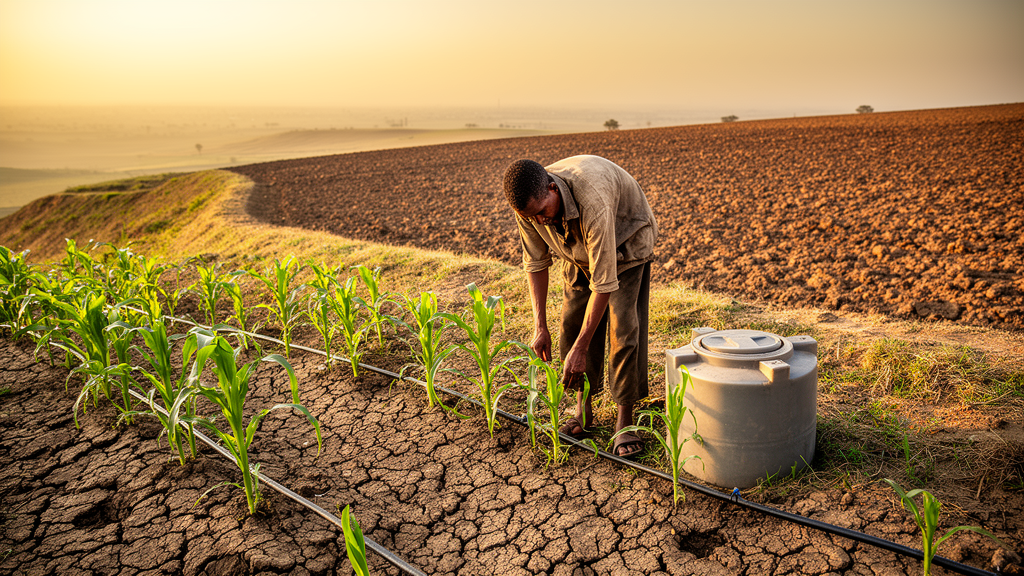
Deep in the highlands of northwestern Ethiopia, in a district called Gonji Kolela, smallholder farmers are watching their climate shift in real time. The rains that once arrived with predictable rhythm have become erratic, the growing seasons have shortened, and the heat has crept steadily upward. For the families who depend entirely on rain-fed agriculture to feed themselves and earn a living, these are not abstract statistics — they are the difference between a harvest and a hungry year. A new study published in Theoretical and Applied Climatology has now put hard numbers behind what these farmers already know, and its findings carry a warning that reaches far beyond one Ethiopian district.
The research, conducted by Kiros Getachew Belachew and Berhanu Tadesse Beyene of Debre Markos University, combined household surveys with meteorological records spanning three decades. The team randomly selected 181 farming households across the district and supplemented the quantitative data with key informant interviews and focus group discussions. What emerged was a picture of a community living on the front line of climate change in sub-Saharan Africa, where adaptive capacity remains limited and livelihoods hang on the timing of rainfall.
The meteorological data told an unambiguous story. Between 1991 and 2020, temperatures in the district rose in a statistically significant trend, while rainfall declined and grew increasingly variable. These are precisely the conditions that climate scientists have projected for the Horn of Africa, and they match what the farmers themselves reported perceiving. The convergence between lived experience and instrumented measurement is important — it means the community’s concerns are grounded in measurable reality, not in rumor or speculation.
The consequences have been tangible. Farmers described declining crop productivity, worsening livestock performance, and increased exposure to climate-related risks such as drought and flooding. In a district where most families practice mixed crop–livestock farming, a bad season hits both the grain store and the herd simultaneously. The study’s qualitative interviews revealed how these losses ripple through household food security, school attendance, and the ability to invest in the next planting cycle.
Yet the farmers of Gonji Kolela have not simply surrendered to the changing climate. The study documented a range of adaptation strategies already in use across the district. Some households have switched to early-maturing and drought-tolerant crop varieties that can complete their life cycle before the rains fail. Others have deepened crop–livestock integration, using manure to fertilize fields and crop residues to feed animals during dry spells. Soil and water conservation practices — terracing, bunding, and water harvesting — have spread across the landscape, and some farmers have invested in small-scale irrigation to buffer against rainfall failure.
But the study’s most striking finding concerns who adapts and who does not. Using binary logistic regression, the researchers identified the socio-economic and institutional factors that determine whether a household adopts adaptation measures. On-farm income, livestock holdings, the age of the household head, and access to climate information all significantly increased the likelihood of adaptation. These are the classic markers of a household with resources, experience, and awareness — families who can afford to experiment and who know what the seasonal forecast says.
The negative associations, however, are what make this study genuinely important for policy. Access to formal credit was negatively associated with adaptation, and so were larger landholdings. This is counterintuitive at first glance — one might expect that wealthier families with more land would be the first to invest in resilience. But the pattern suggests something deeper about how adaptation works in resource-poor settings: it is not simply a function of wealth, but of information, incentives, and institutional support. Families with large landholdings may feel less pressure to change, while those without access to credit may be unable to finance the transition even when they want to.
The implications reach well beyond Gonji Kolela. Across sub-Saharan Africa, hundreds of millions of people depend on rain-fed agriculture, and climate projections consistently indicate that rainfall will become more variable while temperatures continue to rise. The study’s authors argue that strengthening climate information services, improving access to climate-resilient technologies, and enhancing institutional support systems are essential if smallholder farmers are to adapt effectively. Without these interventions, the gap between those who can adapt and those who cannot will widen — and the most vulnerable families will be left furthest behind.
There is also a warning embedded in the findings about the risk of maladaptation. Adaptation measures that work in one context can fail or even backfire in another, and the study’s emphasis on the negative role of formal credit suggests that well-intentioned interventions can sometimes miss their target. The researchers point to the need for flexibility, participation, and integration of approaches — adaptation designed with farmers rather than for them, informed by local knowledge as well as meteorological data.
What makes this study resonate is its specificity. It does not offer a grand theory of climate adaptation; it offers a detailed, evidence-based portrait of one community’s response to a changing climate, with all the nuance and contradiction that entails. The farmers of Gonji Kolela are not waiting for global negotiations to conclude — they are switching crop varieties, building terraces, and integrating livestock into their fields right now. The question the study poses is whether the institutions around them will catch up in time to help.
Subject of Research: Climate change and smallholder agriculture: investigating adaptation strategies and determinants in Gonji Kolela District, Northwestern Ethiopia
Article Title: Climate change and smallholder agriculture: investigating adaptation strategies and determinants in Gonji Kolela District, Northwestern Ethiopia
Article References: Belachew, K. G., & Beyene, B. T. (2026). Climate change and smallholder agriculture: investigating adaptation strategies and determinants in Gonji Kolela District, Northwestern Ethiopia. Theoretical and Applied Climatology, 157(11), Article 725. https://doi.org/10.1007/s00704-026-06645-6
Image Credits: AI Generated
DOI: 10.1007/s00704-026-06645-6
Keywords: climate change, adaptation, smallholder agriculture, Ethiopia, rain-fed farming, food security, Climate, change, smallholder, agriculture, investigating, strategies
Cite Scienmag News
Sloane Callahan. (October 16, 2026). Ethiopian farmers are adapting to a hotter, drier climate — but not all can afford to. Scienmag. https://scienmag.com/ethiopian-farmers-are-adapting-to-a-hotter-drier-climate-but-not-all-can-afford-to/
Sloane Callahan. "Ethiopian farmers are adapting to a hotter, drier climate — but not all can afford to." Scienmag, 16 October 2026, https://scienmag.com/ethiopian-farmers-are-adapting-to-a-hotter-drier-climate-but-not-all-can-afford-to/. Accessed 16 October 2026.
Sloane Callahan. "Ethiopian farmers are adapting to a hotter, drier climate — but not all can afford to." Scienmag. October 16, 2026. https://scienmag.com/ethiopian-farmers-are-adapting-to-a-hotter-drier-climate-but-not-all-can-afford-to/


