


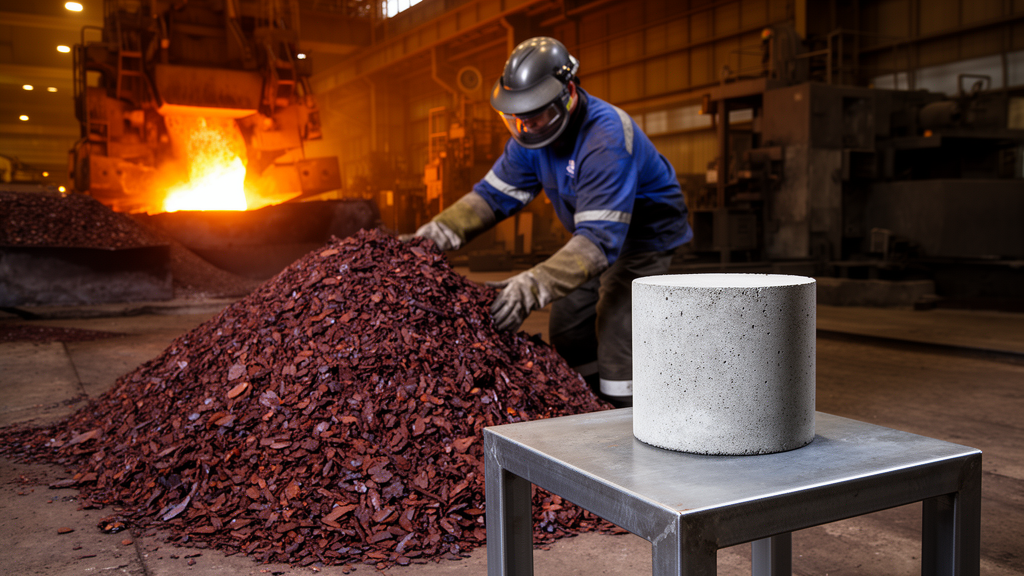
Every year, the world’s steel mills peel off roughly 38 million tonnes of a flaky, iron-oxide-rich waste called mill scale — the layered oxide film that forms on hot steel surfaces during rolling and is spalled away in the descaling process. Most of it is landfilled or downcycled. Now a critical review published in Frontiers in Built Environment argues that this dense, iron-laden by-product could find a second life inside concrete and mortar, but the field’s own evidence base is too poorly reported to say exactly how well it works — and the review lays out a detailed roadmap for fixing that.
Mill scale is generated at roughly 1 to 3 percent of the mass of steel rolled, equivalent to about 22 to 40 kilograms per tonne. Applied to global crude steel production of 1,882.6 million tonnes in 2024, that implies something on the order of 19 to 56 million tonnes per year, consistent with two independent published estimates of approximately 37 and 39 million tonnes. Because concrete is produced at an even larger scale, even marginal substitutions of natural sand with mill scale could be consequential — and the material has attracted interest on three distinct grounds: as a partial replacement for fine aggregate, as a dense additive for heavyweight and radiation-shielding concretes, and, more speculatively, as a source of limited chemical reactivity in alkaline pore solution.
One of the review’s most striking technical contributions is resolving a confusion that has plagued the construction-materials literature for years. Studies reporting mill scale as “93 to 99 percent Fe2O3” and studies reporting it as roughly half wüstite (FeO) and half magnetite (Fe3O4) are not in conflict at all — they are simply using different measurement conventions. X-ray fluorescence returns elemental concentrations that are conventionally normalised and reported as oxides, with all iron reported arithmetically as Fe2O3 regardless of its actual oxidation state. X-ray diffraction with quantitative phase analysis, by contrast, resolves the actual crystalline phases present. The single quantitative phase analysis of as-received mill scale the authors located reports FeO at 47.81 percent, Fe3O4 at 51.34 percent and metallic Fe at 0.85 percent — magnetite marginally exceeding wüstite, with hematite not present as a major phase.
The review also documents that mill scale is a genuinely variable material with identifiable causes of variability. Steel grade and alloy content govern the trace-metal inventory; the process route — basic oxygen furnace versus electric arc furnace, hot rolling versus wire drawing — sets the thermal and mechanical history; coiling temperature and cooling rate control the eutectoid decomposition of wüstite below approximately 570 degrees Celsius and therefore the final phase assemblage; descaling method and water contact determine particle size distribution and surface hydroxide formation; and handling, storage and oil contamination introduce rolling oils and greases that can impair the paste-particle bond. Stockpile weathering causes progressive oxidation and hydration, arguing for per-batch characterisation.
When the authors mapped what the primary literature actually reports about mechanical, durability and environmental performance, they found the reported optimum replacement level is not consistent across the corpus. Eighteen primary studies met the eligibility criteria, spanning mortars, conventional and high-performance concretes, self-compacting concrete, geopolymer concrete and precast paving blocks at replacement levels from 5 to 100 percent. Four independent studies converge on approximately 15 percent by mass or volume as a strength optimum in mortar and self-compacting concrete — the strongest single pattern in the corpus. But several conventional concrete studies report optima at 50 to 60 percent, and at least two report monotonic strength loss. The review treats this discrepancy as a genuine open question, most likely reflecting the interaction between the fineness of the mill scale and the gradation of the sand it replaces.
Workability decreases with increasing mill-scale content, consistently across studies — the most reliably reported effect. One study quantifies a 74 percent slump reduction at 60 percent replacement. The mechanism combines the flake morphology and rough surface texture of mill scale, which increase internal friction, with surface hydroxide layers and any entrained rolling oil, which alter water demand and the paste-particle interface. Because workability was managed differently across studies — some held water constant, some held slump constant, some added superplasticiser — the strength results across the corpus are not comparable without accounting for this, which the review treats as a first-order confounder.
Durability evidence is thin and unevenly distributed. Post-fire residual performance, thermal behaviour and acid resistance are reported as favourable by more than one group. Chloride evidence exists but rests substantially on the rapid chloride permeability test, whose interpretation is questionable for a matrix containing an electrically conductive, iron-bearing phase — the test measures total charge passed, which is a function of pore-solution conductivity as well as pore structure. Carbonation depth and freeze-thaw performance are unreported in the entire corpus. Most consequentially, no electrochemical study of reinforcement corrosion in mill-scale concrete was located anywhere — an iron-bearing admixture in reinforced concrete raises a corrosion question that has not been asked, let alone answered, and the review places it first among research priorities.
Quantitative pooling across the literature is currently obstructed by six specific and documentable deficiencies: heterogeneous replacement bases (mass versus volume; aggregate versus binder), inconsistent curing ages and outcome definitions, uncharacterised variation in mill-scale provenance, near-universal absence of dispersion statistics and replicate counts, confounding of mill scale with co-additives such as graphite nano/microplatelets or steel fibres, and probable non-independence among studies from single research groups. Of the eighteen studies, only two companion papers from one campaign report replicate counts, error bars and inferential statistics. A random-effects meta-analysis cannot be estimated from a corpus in which the variance components are unrecoverable.
To make future synthesis possible, the review specifies a pre-registered meta-analytic protocol — effect-size definition using Hedges’ g or raw mean difference, dose-response meta-regression, random-effects estimation with restricted maximum likelihood, heterogeneity quantification, pre-specified subgroup analysis, distributional diagnostics, sensitivity analysis and small-study-effect assessment — to be executed once the reporting deficiencies are remedied. It also proposes a minimum reporting standard for primary studies, requiring plant and process provenance, composition with the measurement technique named and the phase versus elemental basis stated explicitly, full particle size distribution, specific gravity, water absorption, chloride content, oil and grease content, complete mix proportions, and — for every outcome at every age — mean, standard deviation and number of specimens. Not mean alone. Not a bar chart without error bars.
What the evidence currently supports is cautious use of mill scale in non-structural and specialty applications. Four independent studies report shielding benefits attributable to mill scale’s density and iron content, including a linear attenuation coefficient of 0.085 per centimetre in a geopolymer composite and electromagnetic-interference shielding of 26.37 decibels at 11.82 gigahertz at 30 percent replacement in mortar. Notably, the shielding optimum lies at high replacement while the mechanical optimum in mortar lies near 15 percent — the two do not coincide, so a shielding mix must be designed against a strength requirement rather than assumed adequate. Radiation and EMI shielding, heavyweight and ballast concretes, mortars and renders at moderate replacement, and non-structural elements including paving blocks are the most defensible near-term applications. Structural reinforced concrete is not supported at any replacement level. The economics favour ready-mixed or precast operations near integrated steel plants, because the material is dense and transport cost scales with mass — the viable market is geographically bounded by its own density. The qualitative industrial-symbiosis case is strong; the quantitative case has not yet been made. But the reporting problem is solvable, and solving it is a precondition for the field to know what it collectively knows.
Subject of Research: Materials Science
Article Title: Steel mill scale in concrete and mortar: a critical review of the evidence base and a proposed framework for future quantitative synthesis
Article References: Loganathan, G., Senthil Pandian, M., & Deepa Nivethika, S. (2026). Steel mill scale in concrete and mortar: a critical review of the evidence base and a proposed framework for future quantitative synthesis. Frontiers in Built Environment, 12, Article 1932304. https://doi.org/10.3389/fbuil.2026.1932304
Image Credits: AI Generated
DOI: 10.3389/fbuil.2026.1932304
Keywords: steel mill scale, concrete, mortar, circular economy, construction materials, evidence synthesis, waste valorisation, durability, Steel, mill, scale, critical
Cite Scienmag News
Violet Maxwell. (October 16, 2026). Steel Mill Scale Could Turn Concrete Into a Shielding Supermaterial — But the Evidence Isn’t Ready. Scienmag. https://scienmag.com/steel-mill-scale-could-turn-concrete-into-a-shielding-supermaterial-but-the-evidence-isnt-ready/
Violet Maxwell. "Steel Mill Scale Could Turn Concrete Into a Shielding Supermaterial — But the Evidence Isn’t Ready." Scienmag, 16 October 2026, https://scienmag.com/steel-mill-scale-could-turn-concrete-into-a-shielding-supermaterial-but-the-evidence-isnt-ready/. Accessed 16 October 2026.
Violet Maxwell. "Steel Mill Scale Could Turn Concrete Into a Shielding Supermaterial — But the Evidence Isn’t Ready." Scienmag. October 16, 2026. https://scienmag.com/steel-mill-scale-could-turn-concrete-into-a-shielding-supermaterial-but-the-evidence-isnt-ready/


