


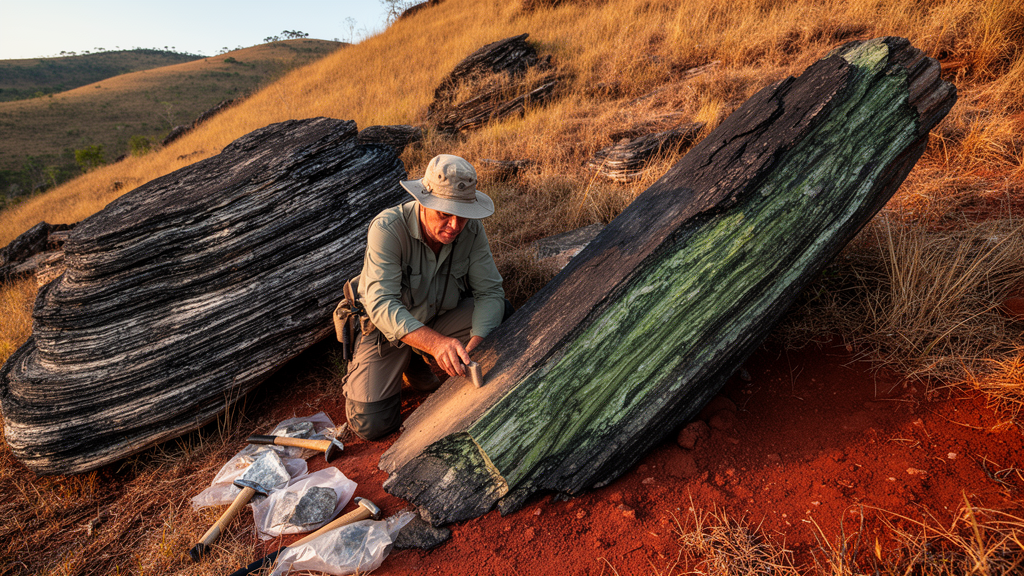
Deep beneath the rolling savannas of southwestern Brazil, chunks of billion-year-old mantle rock are quietly keeping one of Earth’s oldest secrets. A team of geochemists analyzing rare gases trapped inside these rocks has found chemical fingerprints suggesting that oceanic crust was being dragged deep into the mantle and recycled there as early as the Archean eon, more than 2.5 billion years ago. The finding, published in Nature Communications, offers some of the most direct evidence yet that plate tectonic-style subduction was operating on the early Earth, and that its byproducts still linger in the continental roots beneath ancient cratons today.
The rocks in question are xenoliths, fragments of mantle peridotite, pyroxenite, and eclogite carried up to the surface by kimberlite eruptions along the margin of the São Francisco Craton, a vast block of ancient continental crust in eastern Brazil. Because xenoliths are ripped from depths of tens to over a hundred kilometers during their violent ascent, they preserve a snapshot of the mantle’s composition at depths corresponding to pressures between roughly 2.0 and 5.5 gigapascals. By measuring the isotopic ratios of helium, neon, argon, krypton, and xenon trapped within minerals in these rocks, the researchers could reconstruct the history of the fluids and materials that percolated through the cratonic mantle over billions of years.
Noble gases are ideal tracers for this kind of detective work because they are chemically inert. Once produced or trapped in a rock, they do not react with their surroundings, so their isotopic ratios act like unalterable fingerprints of their origin. Helium-3, for instance, is primordial, inherited from the solar nebula that formed the planet, while helium-4 is continuously produced by the radioactive decay of uranium and thorium. A high helium-3 to helium-4 ratio signals a mantle source that has retained its primordial gas, whereas a low ratio points to extensive radiogenic ingrowth, often associated with crustal materials rich in uranium and thorium that have been subducted and stored in the mantle.
In the Brazilian xenoliths, the helium isotopes revealed a strongly radiogenic signature, indicating that the rocks had been infiltrated by fluids or materials carrying a heavy load of uranium and thorium-derived helium-4. Neon isotopes, by contrast, told a more nuanced story, showing a mixture of signatures typical of the mid-ocean ridge basalt source, the well-mixed upper mantle that feeds seafloor spreading centers, and nucleogenic neon produced by nuclear reactions within the rock itself. This divergence between helium and neon is the key clue: it suggests that subducted materials, likely ancient hydrated oceanic crust and the sediments that blanketed it, were recycled into the stratified cratonic mantle and have remained there, variably mixed with the ambient mantle source.
Xenon isotopes added further detail. Xenon in these rocks reflects a cratonic lithospheric mantle where atmospheric xenon, introduced by surface-derived fluids, and fissiogenic xenon, produced by the spontaneous fission of uranium-238 in crustal materials, mix in varying proportions with xenon from the MORB-like mantle source. The pattern is consistent with the long-term storage of recycled crustal components in the mantle wedge above an ancient subduction zone, where fluids released from the descending slab carried dissolved noble gases and other elements into the overlying lithosphere.
The researchers propose that a complex and long-lived subduction system operated along the southwestern margin of the São Francisco Craton since the Archean. During this time, slabs of oceanic crust and their overlying sediment layers, both characterized by high ratios of uranium and thorium relative to primordial helium-3, neon-22, and xenon-132, were carried into the mantle. Over billions of years, these materials accumulated in the lithospheric mantle beneath the craton, creating a stratified reservoir whose noble gas inventory reflects repeated episodes of subduction, metamorphic dehydration, and metasomatic infiltration.
What makes this finding remarkable is that while mid-ocean ridge basalts and ocean island basalts have been extensively characterized for their noble gas isotopes, the continental lithosphere, particularly cratonic domains and subduction-related settings, has remained poorly constrained. Cratons are the oldest and most stable parts of the continents, underlain by thick lithospheric roots that have resisted recycling into the deeper mantle for billions of years. Because of this stability, they act as archives, preserving evidence of mantle processes that operated when the planet was far younger and its tectonic regime may have differed from today’s.
The presence of subduction-derived noble gases in the cratonic mantle suggests that the São Francisco Craton’s lithospheric root was not an isolated, pristine block of primordial mantle, but rather a composite reservoir built up over time by the addition of recycled materials. This challenges the notion that cratonic roots are chemically inert and unchanging, instead portraying them as dynamic systems that have interacted with subducting slabs throughout their history. The stratification observed, with different noble gas signatures at different depths, reflects this layered accretion of recycled components over geological time.
From a broader perspective, the study contributes to ongoing debates about when plate tectonics began on Earth. Some researchers argue that modern-style subduction was operating by the Mesoarchean, around 3 billion years ago, while others contend that early Earth’s tectonics was dominated by vertical processes such as delamination and sagduction, with horizontal subduction emerging only later. The noble gas evidence from the São Francisco Craton lends support to the view that subduction-like processes, involving the transport of hydrated oceanic crust and sediments into the mantle, were established along craton margins by the Archean, even if the tectonic style differed in detail from modern plate boundaries.
The work also highlights the value of xenoliths as probes of the deep continental mantle. Because kimberlite eruptions sample material from a range of depths within the lithosphere, they provide a vertical cross-section that surface volcanism cannot. Combined with modern noble gas mass spectrometry, capable of measuring isotopic ratios at unprecedented precision on tiny gas quantities, xenoliths are opening a window onto the deep mantle’s history that complements studies of oceanic basalts. As more cratonic xenolith suites are analyzed in this way, researchers hope to build a global picture of how subduction has shaped the continental mantle over Earth’s entire history, from the Archean to the present.
Subject of Research: Archean subduction-derived noble gases in the lithospheric mantle beneath the São Francisco Craton
Article Title: Archean subduction-derived noble gases in the lithospheric mantle beneath the São Francisco Craton
Article References: Braga, L. G., Jalowitzki, T., Sumino, H., Fuck, R. A., Balbinot, E., Gervasoni, F., Dalla Costa, M. M., & Santos, R. V. (2026). Archean subduction-derived noble gases in the lithospheric mantle beneath the São Francisco Craton. Nature Communications. https://doi.org/10.1038/s41467-026-78667-7
Image Credits: AI Generated
DOI: 10.1038/s41467-026-78667-7
Keywords: noble gases, São Francisco Craton, lithospheric mantle, subduction, Archean, xenoliths, helium isotopes, neon isotopes, xenon isotopes, craton recycling, Brazil, geodynamics
Cite Scienmag News
Violet Maxwell. (October 16, 2026). Ancient Slabs Trapped Beneath Brazil Preserve Earth’s Earliest Subduction Recipe. Scienmag. https://scienmag.com/ancient-slabs-trapped-beneath-brazil-preserve-earths-earliest-subduction-recipe/
Violet Maxwell. "Ancient Slabs Trapped Beneath Brazil Preserve Earth’s Earliest Subduction Recipe." Scienmag, 16 October 2026, https://scienmag.com/ancient-slabs-trapped-beneath-brazil-preserve-earths-earliest-subduction-recipe/. Accessed 16 October 2026.
Violet Maxwell. "Ancient Slabs Trapped Beneath Brazil Preserve Earth’s Earliest Subduction Recipe." Scienmag. October 16, 2026. https://scienmag.com/ancient-slabs-trapped-beneath-brazil-preserve-earths-earliest-subduction-recipe/


