


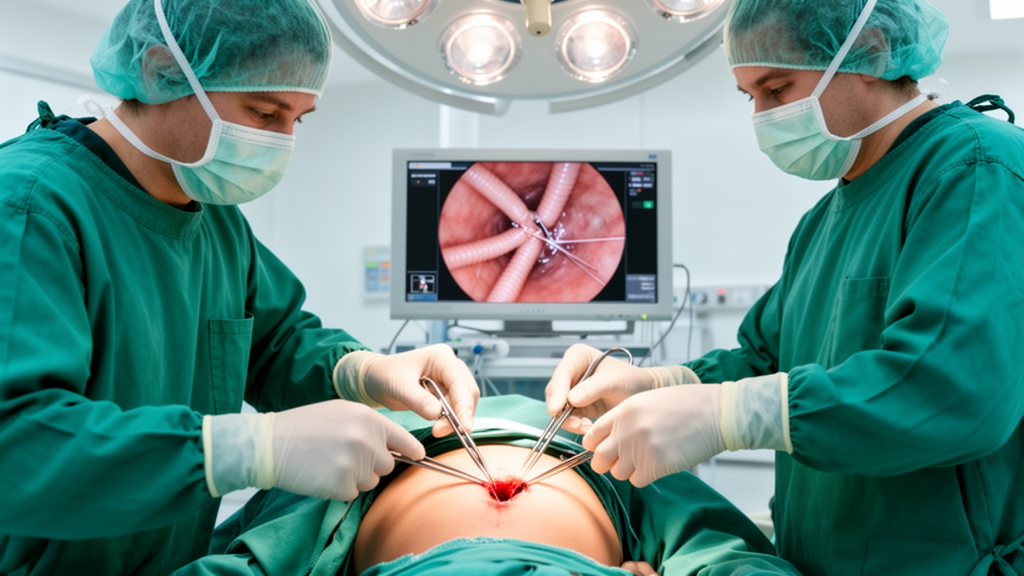
Surgeons in China have reported that they can remove a congenital bile duct cyst from a child and rebuild the entire digestive plumbing through one small incision hidden inside the belly button, without ever pulling the intestine out of the body. The operation, described in a study published in Frontiers in Pediatrics, is called totally single-incision laparoscopic choledochal cyst excision with intracorporeal hand-sewn Roux-en-Y reconstruction, and its results offer one of the clearest looks yet at both the promise and the steep learning curve of pushing minimally invasive pediatric surgery to its limits.
Choledochal cysts are congenital swellings of the bile duct, the tube that carries bile from the liver to the intestine. Left untreated, they can cause recurrent inflammation, pancreatitis, and an elevated long-term risk of bile duct cancer, so the standard of care is complete removal of the cyst followed by reconstruction: surgeons reroute a segment of intestine, the Roux limb, up to the liver so bile can flow into the gut again. Laparoscopic surgery has largely replaced open operations in children, and single-incision techniques, in which everything passes through the umbilicus, have become increasingly popular because they leave essentially no visible scar.
But conventional single-incision surgery has a hidden compromise. To build the Roux-en-Y connection, surgeons typically enlarge the umbilical incision, pull the jejunum out of the abdomen, stitch the bowel loops together on the abdominal wall, and then tuck everything back inside before resuming the laparoscopic view. That workflow is familiar and fast, but it stretches the incision, tugs on the bowel and its blood supply, and repeatedly disturbs the sterile operative field. The new approach keeps every stitch inside the body, where the surgeon can watch bowel orientation and the closure of the mesenteric defect directly on the laparoscopic screen.
The trade-off is technical difficulty. Working through a single umbilical channel means the instruments and camera travel along nearly the same axis, eliminating the triangulation that makes laparoscopic suturing manageable. The team at Shanghai Children’s Medical Center Guizhou Hospital performed both anastomoses, the jejunojejunostomy joining the bowel loops and the hepaticojejunostomy joining the Roux limb to the hepatic duct, entirely by hand with continuous single-layer 5-0 PDS suture, dividing the jejunum, measuring the limb, and closing the mesenteric defect all under laparoscopic vision.
To find out whether that extra difficulty was worth it, the researchers reviewed 75 children operated on between January 2018 and December 2024. Thirty-five underwent the fully intracorporeal technique, all performed by the same senior pediatric laparoscopic surgeon with a stable assistant team, while 40 underwent the conventional single-incision-assisted approach with extracorporeal stapled reconstruction. Because the fully intracorporeal method was deliberately offered first to older and heavier children, whose larger abdominal working space makes internal suturing easier, the groups differed at baseline: the intracorporeal patients averaged nearly 30 months of age and almost 15 kilograms, compared with roughly 20 months and 9 kilograms in the assisted group.
Those imbalances matter, and the team addressed them with multivariable linear regression using HC3 robust standard errors, adjusting for age, weight, sex, cyst type, cyst diameter, and preoperative inflammation. After adjustment, total operative time was statistically indistinguishable between the two techniques, averaging about 228 minutes for the fully intracorporeal operations versus 221 minutes for the assisted ones. The internal bowel join did take roughly 12 minutes longer, a difference the authors attribute to the sheer difficulty of hand-sewing through a single coaxial port with crowded instruments and limited angles.
Where the fully intracorporeal technique clearly won was in everything surrounding the incision itself. Blood loss was lower, averaging about 7 milliliters versus nearly 11, and the incision measured 1.68 centimeters on average compared with 3.59 centimeters when the umbilicus had to be stretched for exteriorization. Children who received the fully internal reconstruction also passed gas and stool earlier after surgery, by roughly seven hours in each case, signals of less bowel handling and faster return of intestinal function. Time to first oral feeding, drain removal, and hospital stay did not differ meaningfully once the baseline differences were accounted for.
Safety numbers were reassuring but limited. Early complications such as bile leak, wound infection, or intestinal obstruction occurred in 3 of 35 fully intracorporeal patients and 5 of 40 assisted patients, and late complications during follow-up, which extended to a median of 40 and 46.5 months respectively, were similarly rare. Thirty-three of the 35 fully intracorporeal procedures were completed without adding a port or converting to open surgery; one case required an extra port and one required conversion, reminders that secure exposure and a safe anastomosis must always outrank the cosmetic goal of a single incision.
Perhaps the most striking result is the learning curve. Using cumulative sum analysis of jejunojejunostomy time, a statistical tool that tracks whether performance is improving or deteriorating relative to the overall average, the curve peaked at case 17 and then declined steadily, indicating relative stabilization after case 18. Across four chronological phases, mean jejunojejunostomy time fell from nearly 72 minutes in the first eight cases to about 34 minutes in the last nine, and total operative time dropped from more than 254 minutes to under 198. The authors stress these phases describe one experienced surgeon’s trajectory and are not universal proficiency thresholds.
The study’s authors conclude that the fully intracorporeal single-incision operation is feasible in selected children and may offer real perioperative advantages for older, larger patients, while remaining a selective option rather than a routine replacement for the assisted technique. As a single-center retrospective analysis with deliberate patient selection, small numbers of adverse events, and no validated cosmetic scoring, it cannot settle questions of safety equivalence or generalizability to lower-volume centers. But for families weighing scar-conscious surgery for a child with a choledochal cyst, the message is that the entire operation can now be done through an incision small enough to disappear inside the belly button, provided the surgical team has climbed the learning curve.
Subject of Research: Totally single-incision laparoscopic choledochal cyst excision with intracorporeal hand-sewn Roux-en-Y reconstruction in children: clinical outcomes and learning curve
Article Title: Totally single-incision laparoscopic choledochal cyst excision with intracorporeal hand-sewn Roux-en-Y reconstruction in children: clinical outcomes and learning curve
Article References: Luo, M., Qin, Z., Tang, Y., & Zhuang, Y. (2026). Totally single-incision laparoscopic choledochal cyst excision with intracorporeal hand-sewn Roux-en-Y reconstruction in children: clinical outcomes and learning curve. Frontiers in Pediatrics, 14, Article 1951655. https://doi.org/10.3389/fped.2026.1951655
Image Credits: AI Generated
DOI: 10.3389/fped.2026.1951655
Keywords: Totally, single-incision, laparoscopic, choledochal, cyst, excision, intracorporeal, hand-sewn, Roux-en-Y, reconstruction, children, clinical
Cite Scienmag News
Ophelia Keating. (October 16, 2026). Surgeons stitch a child’s bile duct back together through a single belly-button incision. Scienmag. https://scienmag.com/surgeons-stitch-a-childs-bile-duct-back-together-through-a-single-belly-button-incision/
Ophelia Keating. "Surgeons stitch a child’s bile duct back together through a single belly-button incision." Scienmag, 16 October 2026, https://scienmag.com/surgeons-stitch-a-childs-bile-duct-back-together-through-a-single-belly-button-incision/. Accessed 16 October 2026.
Ophelia Keating. "Surgeons stitch a child’s bile duct back together through a single belly-button incision." Scienmag. October 16, 2026. https://scienmag.com/surgeons-stitch-a-childs-bile-duct-back-together-through-a-single-belly-button-incision/


