


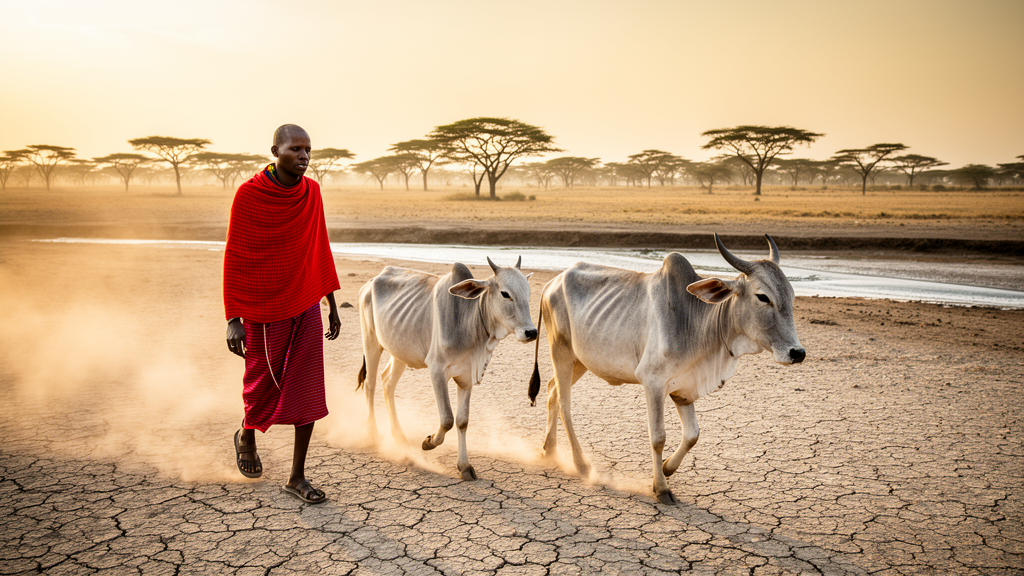
In the semi-arid rangelands of Simanjiro District in northern Tanzania, drought is not an occasional emergency but a structural feature of the climate. A new three-decade analysis published in Theoretical and Applied Climatology has now quantified precisely how that hazard has behaved between 1994 and 2024, using two complementary drought indices computed at multiple time scales. The study, led by Upendo E. Lyimo of the Institute of Resource Assessment at the University of Dar es Salaam, together with Edmund B. Mabhuye and Noah M. Pauline, offers one of the most methodologically rigorous drought characterisations yet attempted for a Tanzanian pastoral district, and its findings carry implications far beyond the Maasai steppe where Tarangire’s elephants migrate across community lands.
The researchers computed the Standardized Precipitation Index (SPI) and the Standardized Precipitation Evapotranspiration Index (SPEI) at 3-, 6-, 9- and 12-month accumulation periods across the full 31-year record. The SPI, introduced by McKee and colleagues in 1993, measures how much precipitation in a given window deviates from the long-term norm, expressed in units of standard deviation. The SPEI, developed by Vicente-Serrano and colleagues, goes a step further by subtracting potential evapotranspiration from precipitation before standardisation, effectively capturing the atmospheric demand for water that accelerates drying when temperatures rise. Running both indices side by side allowed the team to separate the purely rainfall-driven component of drought from the temperature-amplified component that climate change increasingly contributes.
The headline finding is deceptively simple but consequential: moderate drought dominated the drought record across every accumulation period, while severe and extreme events were rarer yet stubbornly recurrent. More revealing was the behaviour of the indices at different time scales. Short-term indices at the 3-month scale captured rapid soil-moisture stress that hits grazing lands within a single season, whereas the 9- and 12-month indices revealed droughts that persisted across wet seasons, the kind of multi-year water deficits that decimate livestock herds and force pastoral families to sell animals at collapsed prices. Longer accumulation periods showed greater drought persistence, confirming that the hydrological memory of the landscape extends well beyond any single rainy season.
The comparison between SPI and SPEI produced one of the study’s most striking quantitative results. The two indices correlated strongly, with Pearson coefficients between 0.89 and 0.93, indicating that rainfall deficiency remains the primary driver of drought in Simanjiro. Yet the residual difference between them, the portion of drought severity attributable to atmospheric evaporative demand rather than rainfall alone, grew systematically with time scale, from 2.31 percent at the 3-month scale to 7.51 percent at the 12-month scale. This gradient is the fingerprint of a warming atmosphere. As air temperatures climb, the vapour pressure deficit between saturated leaf surfaces and the surrounding air widens, pulling moisture from soils and vegetation even when rainfall is merely average. The longer the accumulation window, the more this evaporative stress compounds, and the more SPEI diverges from a precipitation-only view of drought.
To ensure the trends they detected were real rather than artefacts of serial correlation, the team applied the Trend-Free Pre-Whitening Mann-Kendall test, a nonparametric approach that removes the red-noise structure inherent in autocorrelated climate series before testing for monotonic change. They further corrected significance levels using the Benjamini-Hochberg False Discovery Rate procedure, which controls the expected proportion of false positives across multiple simultaneous tests, a safeguard that is increasingly standard in climate trend analysis but still too often omitted. The result was unambiguous: all SPI series showed significant positive monotonic trends, and SPEI did so at the 6-, 9- and 12-month scales. In the standardised framework of these indices, a positive trend means values are climbing back toward or above the climatological median, a signal the authors interpret in the context of shifting rainfall regimes and changing drought dynamics over the study period.
Recognising that potential evapotranspiration can be estimated in different ways, each with its own biases, the researchers conducted a sensitivity analysis of the PET formulations underlying SPEI. They compared simpler temperature-based approaches, such as the Thornthwaite and Hargreaves-Samani methods, against more physically complete formulations. The verdict was reassuring for practitioners: drought classification and trend interpretation proved robust to the choice of evapotranspiration estimation method. This matters enormously for drought monitoring in data-sparse regions, where full Penman-Monteith calculations demanding radiation, humidity and wind data are often impossible, and where temperature-based approximations must suffice. The Simanjiro results suggest that even simplified PET inputs can support defensible drought characterisation, provided the analysis acknowledges the growing evaporative component.
Why does a statistical analysis of a single Tanzanian district deserve global attention? Because semi-arid pastoral systems are among the most drought-sensitive social-ecological systems on Earth, and Simanjiro sits at the intersection of several converging pressures. The district’s Maasai and agro-pastoral communities depend on rain-fed rangelands where rainfall variability is extreme and livestock are simultaneously their bank account, their food security and their cultural identity. Previous research in Maasailand has documented catastrophic livestock mortality during the 2005-2006 drought, and the economic burden of drought and disease in northern Tanzania runs into millions of dollars annually. When drought indices shift, even by fractions of a standard deviation, the consequences cascade through herd sizes, household income, child nutrition and the delicate negotiation between pastoral land use and wildlife conservation around Tarangire National Park.
The study’s methodological architecture also carries a message for the wider drought-monitoring community. By demonstrating that SPI and SPEI agree strongly yet diverge in quantifiable, scale-dependent ways, the authors provide empirical support for the argument that precipitation-only indices systematically underestimate drought severity in a warming world. This echoes findings from Europe, where increasing divergence between observed drought indices has been documented, and from global analyses showing that warming accelerates drought severity through enhanced evaporative demand. The residual drought quantified in Simanjiro, growing from roughly 2 to 7.5 percent across time scales, is a local manifestation of a planetary process: the atmosphere’s increasing thirst is quietly converting moderate rainfall deficits into more severe water stress than precipitation statistics alone would suggest.
Perhaps the most forward-looking element of the research lies in its explicit framing for climate-related Loss and Damage assessment, the policy framework under the United Nations Framework Convention on Climate Change that addresses harms beyond what adaptation can avert. Quantifying drought frequency, persistence and severity with standardised, reproducible indices provides exactly the kind of evidence base that Loss and Damage negotiations and national adaptation planning require. The authors make their entire analytical pipeline publicly available through the Zenodo repository, including the original monthly climate dataset, the derived SPI and SPEI time series, the R scripts for every stage of computation, and the audit files documenting missing-data handling. This level of transparency is rare and valuable, allowing any researcher or government analyst to reproduce, verify or extend the analysis for other districts.
For the pastoralists of Simanjiro, the numbers translate into a familiar reality rendered newly precise: droughts here are predominantly moderate but persistent, their severity increasingly inflated by a warming atmosphere, and their multi-year character demands planning horizons that extend beyond seasonal forecasts. For scientists and policymakers, the study demonstrates that pairing precipitation-based and water-balance-based indices, tested with rigorous trend statistics and sensitivity checks, offers a robust and transferable framework for drought monitoring in the world’s semi-arid margins. As global temperatures continue to rise and evaporative demand intensifies across the tropics, the quiet divergence between what the rain gauges record and what the landscape actually endures will only widen. Simanjiro’s three-decade record shows exactly how that gap opens, one accumulation period at a time.
Subject of Research: Temporal drought characteristics in semi-arid northern Tanzania based on multi-scale SPI and SPEI (1994–2024)
Article Title: Temporal drought characteristics in semi-arid northern Tanzania based on multi-scale SPI and SPEI (1994–2024)
Article References: Lyimo, U. E., Mabhuye, E. B., & Pauline, N. M. (2026). Temporal drought characteristics in semi-arid northern Tanzania based on multi-scale SPI and SPEI (1994–2024). Theoretical and Applied Climatology, 157(11), Article 724. https://doi.org/10.1007/s00704-026-06661-6
Image Credits: AI Generated
DOI: 10.1007/s00704-026-06661-6
Keywords: Temporal, drought, characteristics, semi-arid, northern, Tanzania, based, multi-scale, SPEI, scientific research
Cite Scienmag News
Sloane Callahan. (October 16, 2026). Rising Evaporative Demand Is Reshaping Drought in Northern Tanzania’s Pastoral Heartland. Scienmag. https://scienmag.com/rising-evaporative-demand-is-reshaping-drought-in-northern-tanzanias-pastoral-heartland/
Sloane Callahan. "Rising Evaporative Demand Is Reshaping Drought in Northern Tanzania’s Pastoral Heartland." Scienmag, 16 October 2026, https://scienmag.com/rising-evaporative-demand-is-reshaping-drought-in-northern-tanzanias-pastoral-heartland/. Accessed 16 October 2026.
Sloane Callahan. "Rising Evaporative Demand Is Reshaping Drought in Northern Tanzania’s Pastoral Heartland." Scienmag. October 16, 2026. https://scienmag.com/rising-evaporative-demand-is-reshaping-drought-in-northern-tanzanias-pastoral-heartland/


