


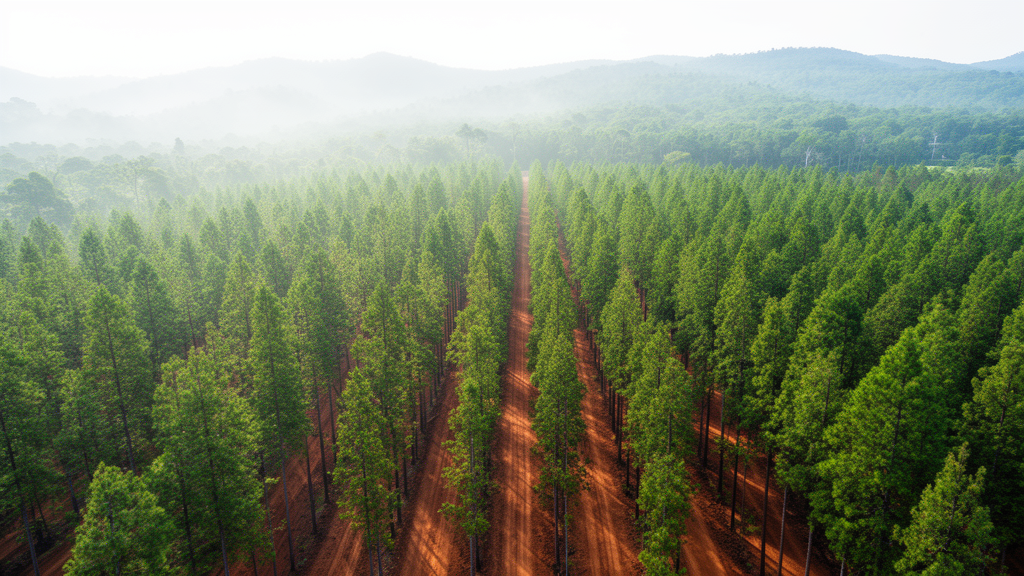
Deep in the hilly terrain of China’s Sichuan Basin, an unassuming forestry experiment has been quietly running for more than three and a half years, and its results could reshape how managers of low-yield plantations think about carbon. Researchers led by Jiaping Yang and Qing Dong of Mianyang Normal University tracked the decomposition and humification of leaf litter across cypress (Cupressus funebris) plantations subjected to different management regimes, deploying thousands of litterbags and monitoring them for 1,277 days. Their conclusion, published in Frontiers in Soil Science, is striking in its simplicity: of the management options tested, strip thinning and filling did the best job of slowing the loss of humus carbon from decomposing litter, the critical precursor pool from which stable soil organic matter is ultimately built.
The stakes are larger than they might first appear. Litter humification is the biogeochemical bridge between what happens above ground and what happens below. When leaves, twigs and herbaceous material fall to the forest floor, microbes and fungi break them down, and a fraction of that material is transformed into alkaline-extractable humus carbon. This pool feeds the formation of soil organic matter, one of the planet’s largest terrestrial carbon reservoirs. In plantations where management decisions alter canopy cover, temperature, moisture and the mix of plant species, the fate of this humus carbon can swing dramatically. Yet, until now, few systematic studies had examined how different forestry practices in subtropical cypress stands actually influence this hidden process.
The experiment was anchored in real-world forestry. Between 2005 and 2008, the Sichuan Academy of Forestry implemented three management practices in local cypress plantations: artificial forest gap creation, in which logging opened gaps of 50 to 200 square meters; strip thinning and filling, which produced logging strips 4 to 10 meters wide; and density-based ecological thinning, a selective removal of 10 to 25 percent of the original stand. The researchers selected one representative stand for each practice, plus an unmanaged pure plantation as a control, focusing on the conditions previously validated as optimal: gaps of 90 to 100 square meters, strips 6 meters wide, and 20 percent thinning intensity. Within each stand, five spatially independent 20 by 20 meter plots served as subsample units.
In November 2020, the team collected fresh leaf litter from the dominant tree species, from understory shrubs such as Coriaria nepalensis and Vitex negundo, and from four common herb species. After air-drying, the litter was sorted into four categories: tree, shrub, herb, and a mixed sample blended in the natural field mass ratio of one part tree to one part shrub to two parts herb. Each type was sealed into nylon litterbags holding 20 grams of dry material, with fine mesh on the soil-contacting side and coarser mesh above. In total, 4,400 litterbags were laid out on cleared soil surfaces on 30 December 2020, then retrieved at eleven intervals stretching from 90 days to 1,277 days after deployment, with the final collection in June 2024.
In the laboratory, the researchers extracted humus carbon using a hot alkaline solution of sodium hydroxide and sodium pyrophosphate, then measured it with a total organic carbon analyzer. Alongside humus carbon content, they calculated the net relative change in humus carbon, the humification degree, and the cumulative intensity of humification. They also characterized the litter’s chemistry, including total organic carbon, nitrogen, phosphorus, cellulose and lignin, quantified microbial biomass carbon, nitrogen and phosphorus via chloroform fumigation-extraction, and logged litter temperature every two hours with iButton recorders. Statistical analysis leaned on generalized additive mixed models to handle the non-linear, autocorrelated nature of decomposition time series, supplemented by hierarchical partitioning and partial least squares path modeling to disentangle the drivers of humification.
The headline finding concerns strip thinning and filling. In exploratory pairwise contrasts, this treatment showed relatively higher humus carbon content and humification degree, together with a less negative net change in humus carbon, compared with the artificial gap treatment, differences that reached statistical significance. Strip-thinned stands averaged 17.46 percent humus carbon content against 15.95 percent in gap-created stands, and a humification degree of 48.27 percent versus 41.89 percent. No significant differences separated strip thinning from the unmanaged control or from ecological thinning. Notably, every stand lost humus carbon overall, with net changes ranging from roughly minus 44 to minus 50 percent, meaning that no management practice achieved absolute net humus accumulation. Strip thinning’s advantage lay in suppressing losses rather than in building humus outright.
Litter type mattered enormously. Shrub litter consistently outperformed the rest, exhibiting the highest humus carbon content at 18.52 percent and the greatest humification degree at 49.23 percent, significantly above tree, herb and mixed litter. Herb litter, by contrast, showed the smallest net loss of humus carbon. The researchers attribute the shrub advantage to its distinctive substrate chemistry, with lower lignin content and more favorable lignin-to-nitrogen and carbon-to-nitrogen ratios than tree or herb litter, which creates a different nutrient supply regime for the decomposer community. They caution, however, that comparing mixed litter directly with shrub litter cannot prove antagonistic mixing effects without mass-weighted predicted indices, a limitation they flag for future work.
The mechanistic analysis revealed a layered picture of causation. Hierarchical partitioning identified litter substrate as the dominant driver of humification variation in every stand, explaining between roughly 43 and 71 percent of the variance depending on treatment, with cellulose, total organic carbon and total phosphorus among the leading contributors. Yet partial least squares path modeling told a complementary story: climatic conditions exerted strong, statistically significant direct negative effects on humification in all four stands, even though climate accounted for a moderate share of explained variance overall. This apparent paradox dissolves once one recognizes that the two methods measure different things, with partitioning capturing total explanatory importance and path modeling isolating direct causal pathways. In the strip-thinned stand, monthly temperature emerged as a key climatic predictor, and neither the microbial nor the substrate direct path reached statistical significance, whereas the unmanaged control showed a significant positive microbial effect on humification.
Temporally, the experiment exposed stage-dependent dynamics. In the first year, climatic conditions dominated, driving humus loss through leaching and microbial activation of labile substrates, with lignin and cellulose exerting stronger control than in later stages. During the middle period, from roughly 455 to 729 days, humus retention continued to decline under the influence of residual carbon and nutrients. But in the final stretch, from 729 to 1,277 days, humus retention trended upward, likely because unstable humus fractions had already been depleted and new humus began forming under the regulation of residual nutrients and humus-promoting microorganisms. The advantages of strip thinning and ecological thinning emerged gradually after the mid-decomposition stage, while the warm, humid microhabitats of the gap-created stands accelerated both litter breakdown and humus degradation, producing severe net depletion.
The authors are careful about scope. Because each management practice was represented by a single stand, with plots serving as nested subsamples rather than independent replicates, the pairwise contrasts are exploratory and cannot be generalized to all cypress plantations without replicated multi-stand trials. They also note that humus quantification relied solely on alkaline extraction and recommend future integration of solid-state carbon-13 nuclear magnetic resonance spectroscopy and mineral-associated organic matter fractionation, along with high-throughput sequencing to resolve which fungal and bacterial taxa drive the observed stand-level differences. Still, the practical implication is clear: for the low-efficiency cypress plantations that dominate the hilly Sichuan Basin and form a critical part of the upper Yangtze River ecological shelterbelt, strip thinning and filling offers a promising, evidence-based route to conserving litter humus carbon, and encouraging natural understory shrub recruitment could amplify that benefit even further.
Subject of Research: Effects of forest management practices on litter humification and humus carbon retention in subtropical cypress plantations
Article Title: Strip thinning and filling reduces litter humus carbon loss in Cupressus funebris plantations: relative contributions of microclimate, litter substrate and microbial biomass
Article References: Strip thinning and filling reduces litter humus carbon loss in Cupressus funebris plantations: relative contributions of microclimate, litter substrate and microbial biomass. (n.d.). https://doi.org/10.3389/fsoil.2026.1929672
Image Credits: AI Generated
DOI: 10.3389/fsoil.2026.1929672
Keywords: litter decomposition, humification, soil organic matter, cypress plantation, forest management, carbon sequestration, strip thinning, microbial biomass, litter substrate, microclimate, subtropical forest, humus carbon
Cite Scienmag News
Violet Maxwell. (October 16, 2026). Strip Thinning Preserves Forest Carbon in Subtropical Cypress Plantations, Study Finds. Scienmag. https://scienmag.com/strip-thinning-preserves-forest-carbon-in-subtropical-cypress-plantations-study-finds/
Violet Maxwell. "Strip Thinning Preserves Forest Carbon in Subtropical Cypress Plantations, Study Finds." Scienmag, 16 October 2026, https://scienmag.com/strip-thinning-preserves-forest-carbon-in-subtropical-cypress-plantations-study-finds/. Accessed 16 October 2026.
Violet Maxwell. "Strip Thinning Preserves Forest Carbon in Subtropical Cypress Plantations, Study Finds." Scienmag. October 16, 2026. https://scienmag.com/strip-thinning-preserves-forest-carbon-in-subtropical-cypress-plantations-study-finds/


