


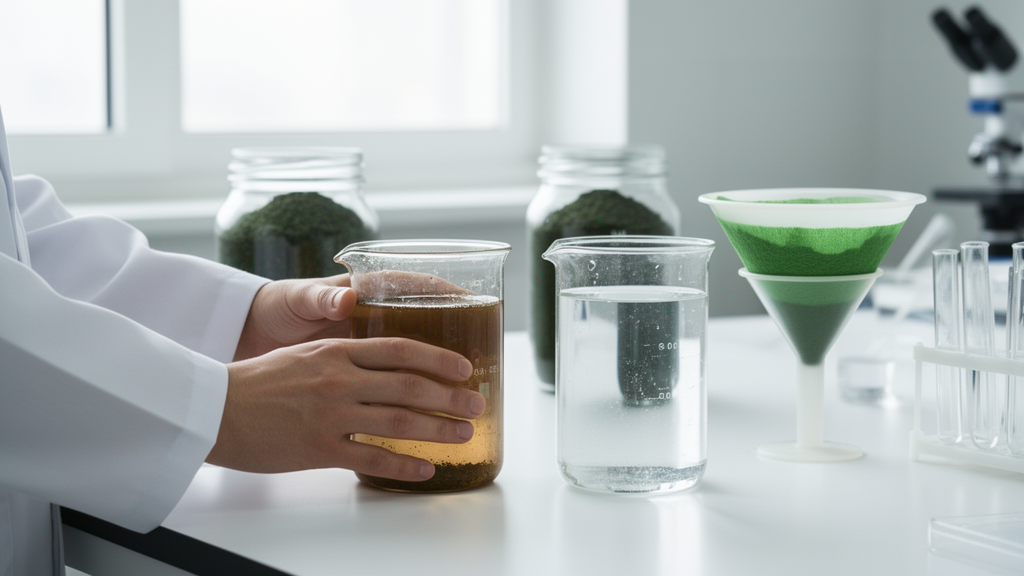
Water scarcity is forcing regions around the world to rethink how they treat and recycle wastewater, and a new critical review published in Frontiers in Environmental Chemistry argues that one of the most hyped solutions of the past decade—green sorbents made from renewable biomass—remains trapped in the laboratory. The review, led by Sidra Iftekhar of the University of Eastern Finland and Muhammad Bilal Asif of Sologenix Engineering, synthesizes ten years of research on sorbents derived from lignocellulosic materials, animal waste, and marine biomass, and delivers a sobering verdict: despite thousands of publications reporting impressive contaminant removal, almost none of these materials have made the leap from beaker to treatment plant.
The appeal of green sorbents is easy to understand. Activated carbon, the workhorse adsorbent of the water industry, is expensive, its cost is rising, and its regeneration poses persistent challenges alongside a significant environmental footprint. Green sorbents, by contrast, are derived from locally available, renewable sources such as peach wood branches, date pits, orange peels, eggshells, coconut fibers, chicken feathers, blue-green algae, seaweed, and fish scales. They are biodegradable, align with circular economy principles, and have shown promising results in removing organic dyes, heavy metals, and organic micropollutants including antibiotics, pesticides, and bisphenol A. Publication trends in the field have risen sharply over the last decade, reflecting the influx of significant research output.
Preparation of these materials typically follows a sequence of washing and sorting, crushing and grinding to increase surface area, pyrolysis or torrefaction, and physicochemical pre- or post-synthesis modifications. Reported adsorption capacities span an extraordinary range, from 0.16 milligrams per gram for trimethoprim removal by oak wood chippings to 1,095 milligrams per gram for methylene blue removal by ultrasound-modified seaweed (Kappaphycus alvarezii). Between those extremes lie grape waste functionalized with 3-aminopropyl triethoxysilane, which achieved 362 milligrams per gram for methyl orange—outperforming grape seed biochar at 111 milligrams per gram and porous carbon from waste cellulose fibers at 337 milligrams per gram—along with amine-grafted blue-green algae reaching 687 milligrams per gram for Reactive Red 120 dye and surfactant-modified orange peels achieving 667 milligrams per gram for Congo red.
The mechanisms behind these performances are increasingly well characterized. Lignocellulosic materials carry organic moieties on their surfaces that facilitate contaminant sorption, and electrostatic interactions remain the dominant mechanism reported for organic dye removal across studies of the hopbush plant, seed powders, apricot seed shells, and olive waste. Heavy metals, being charged species, are removed mainly through electrostatic interaction and ion exchange, with chelation possible when sorbents are modified with acetamide, carboxyl, phenolic, or ester functional groups. Organic micropollutants are captured through a broader toolkit including electrostatic interactions, hydrogen bonding, dipole-dipole interactions, complexation, and hydrophobic interactions. Characterization techniques such as FTIR, XPS, BET, SEM, zeta potential, and thermogravimetric analysis are routinely deployed before and after adsorption to identify active sites, confirm binding, and evaluate structural stability.
Yet the review identifies a fundamental flaw in how this evidence is generated and reported. The experimental outcomes depend heavily on operating parameters such as initial pH, contact time, sorbent dosage, initial concentration, and temperature—higher initial concentrations generally yield inflated maximum capacity values due to increased driving force. Inconsistencies in experimental protocols and reporting standards hinder meaningful comparison across studies, and high adsorption capacities alone should not be considered definitive indicators of superior performance without considering testing conditions and mechanistic evidence. The authors also caution that mechanistic conclusions are frequently oversimplified: high correlation coefficients are often the sole criterion for model selection, pseudo-second-order kinetics is often incorrectly interpreted as evidence of chemisorption despite lacking direct mechanistic validation, and linearization of isotherm equations can introduce statistical bias.
Perhaps the most damning critique concerns the gap between synthetic and real wastewater. Most studies have evaluated green sorbents using a single model contaminant in idealized laboratory conditions, whereas real wastewater contains multiple competing ions such as calcium, magnesium, and sodium, natural organic matter, suspended solids, and fluctuating pH and salinity. These factors can significantly reduce sorption efficiency through site competition, pore blockage, and electrostatic screening. Natural organic matter can form surface coatings on sorbents, reducing accessible active sites, while high ionic strength suppresses electrostatic interactions. Consequently, results obtained under simplified laboratory conditions may overestimate actual performance, and pilot-scale demonstrations under real wastewater matrices remain extremely scarce.
Regeneration presents another persistent challenge. Biomass-based green sorbents have predominantly been regenerated chemically, using agents such as 0.1 molar EDTA, hydrochloric acid with 50 percent ethanol, nitric acid, acetic or citric acid, sodium hydroxide with sodium chloride, or plain ethanol. Sorption capacity declines by 5 to 40 percent with each reuse cycle compared to pristine sorbents, because saturated sorbents cannot be fully recovered or cannot completely desorb the captured pollutant. Structural degradation of biobased sorbents is a common issue under repeated regeneration, and the strong acids, bases, or chelating agents involved increase operating costs and generate secondary waste streams. Metals recovered during regeneration can be reused in industrial applications, but the safe disposal and breakdown of desorbed organic contaminants remains an open question.
Environmental safety adds a further layer of concern. Biomass-derived sorbents are inherently heterogeneous and contain soluble organic fractions that may leach into treated water, releasing secondary contaminants. Leaching and surface degradation have been reported for various bionanocomposites, including cellulose-based and xanthan gum-layered double hydroxide systems. Chemical modification strategies commonly employed to enhance sorption—amine grafting, surfactant loading, or metal impregnation—may introduce new risks associated with the release of residual reagents or toxic by-products during operation. Stability is further compromised under the variable pH, ionic strength, and oxidative conditions encountered in real wastewater, which can induce structural degradation or loss of active functional groups. Systematic assessments of long-term reusability and ecotoxicological impacts remain scarce.
Scale-up efforts, though rare, offer instructive lessons. Vilardi and colleagues investigated a pilot-scale fixed-bed column of 30 to 70 liters containing an iron-modified olive stone sorbent for chromium(VI) removal, achieving 64 percent removal and developing models to predict breakthrough curve shapes and sorption kinetics. More recently, upscaling of a sugarcane bagasse-based sorbent was successfully achieved, with mechanistic models developed for both lab-scale (10.5 liters) and pilot-scale (105 liters) columns accurately predicting breakthrough shape and time. Importantly, the breakthrough time at pilot scale was longer than at lab scale—a finding that implies observations from lab-scale sorption systems may not be directly applicable to pilot-scale systems, underscoring the need for future studies to assess and report breakthrough curves.
Assessed through the Technology Readiness Level framework, the field’s maturity gap becomes stark. A large number of publications fall under TRL 1 to 3, focused on laboratory-scale batch experiments using synthetic wastewater and single-contaminant systems, moving from material synthesis to optimization of pH, dose, contact time, and temperature. Only a limited number of studies have reached TRL 4 to 5, involving continuous-flow fixed-bed or packed-bed columns where breakthrough curves, mass-transfer limitations, and hydrodynamics become critical. Studies at TRL 6 to 7—demonstration under real wastewater conditions in pilot-scale systems or operational treatment plants—remain extremely limited, and TRL 8 to 9, corresponding to full-scale commercialization and integration into water treatment infrastructure, remains largely unachieved for most green sorbents.
The economics tell a similar story. Raw biomass may be inexpensive, but converting waste into sorbents involves energy-intensive steps such as drying, grinding, chemical activation, pyrolysis, or functionalization, which increase capital and operational costs along with the carbon footprint. In some cases, the cost of producing bio-based sorbents can be comparable to or even exceed that of conventional adsorbents. Life-cycle assessment offers a more comprehensive framework: compared with conventional activated carbon, biochar produced from agricultural waste exhibits lower cumulative energy demand and global warming potential, but high-temperature treatments and chemical activation erode those advantages. Regulatory and market barriers—including the lack of standardized testing protocols, limited long-term performance data, and uncertainties surrounding environmental safety and disposal—further hinder commercialization.
The review’s outlook is clear-eyed rather than dismissive. Green sorbents derived from lignocellulosic waste, animal waste, and marine biomass genuinely offer circular economy benefits, low cost potential, and local availability, and their physicochemical properties can be tuned by introducing functional groups that improve sorption capacity through both electrostatic and non-electrostatic interactions. But bridging the gap between laboratory research and industrial implementation requires standardized testing under environmentally relevant conditions, mechanistic validation through combined spectroscopic and surface analyses, sustainable regeneration techniques, comprehensive stability and ecotoxicological evaluations, and pilot-scale demonstrations supported by integrated techno-economic and life-cycle frameworks. Until those boxes are ticked, the review concludes, green sorbents will remain promising laboratory materials rather than viable industrial solutions for sustainable water treatment.
Subject of Research: Environmental Chemistry
Article Title: Future of green sorbents for water and wastewater treatment
Article References: Future of green sorbents for water and wastewater treatment. (n.d.). https://doi.org/10.3389/fenvc.2026.1854369
Image Credits: AI Generated
DOI: 10.3389/fenvc.2026.1854369
Keywords: green sorbents, water treatment, wastewater treatment, adsorption, biomass, heavy metals, organic micropollutants, scale-up, technology readiness levels, life-cycle assessment, Future, green
Cite Scienmag News
Violet Maxwell. (October 16, 2026). Green Sorbents Promise Cleaner Water, But Lab Success Hasn’t Reached the Real World. Scienmag. https://scienmag.com/green-sorbents-promise-cleaner-water-but-lab-success-hasnt-reached-the-real-world/
Violet Maxwell. "Green Sorbents Promise Cleaner Water, But Lab Success Hasn’t Reached the Real World." Scienmag, 16 October 2026, https://scienmag.com/green-sorbents-promise-cleaner-water-but-lab-success-hasnt-reached-the-real-world/. Accessed 16 October 2026.
Violet Maxwell. "Green Sorbents Promise Cleaner Water, But Lab Success Hasn’t Reached the Real World." Scienmag. October 16, 2026. https://scienmag.com/green-sorbents-promise-cleaner-water-but-lab-success-hasnt-reached-the-real-world/


