


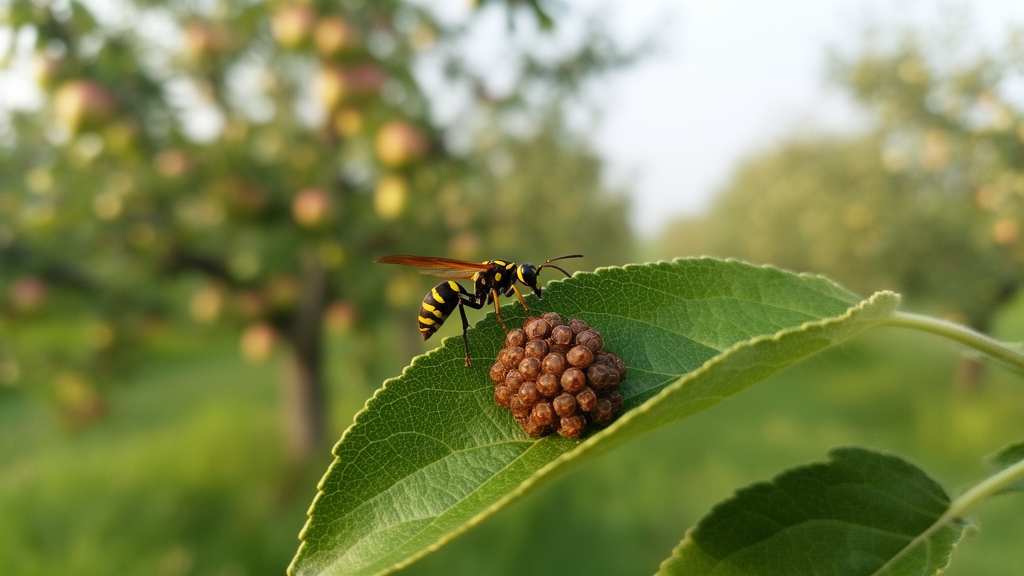
In the orchards and vineyards of western Slovenia, a tiny parasitic wasp has quietly made history. Researchers conducting a five-year survey of stink bug egg parasitoids have recorded, for the first time in the country, the presence of Trissolcus japonicus, a minute scelionid wasp often called the samurai wasp and widely regarded as the most formidable natural enemy of the brown marmorated stink bug, Halyomorpha halys. The discovery, documented in the Journal of Hymenoptera Research, confirms that the wasp has not merely arrived but has overwintered, reproduced and begun to spread, a milestone that could reshape how one of Europe’s most damaging agricultural pests is managed.
The brown marmorated stink bug is no ordinary nuisance. Native to East Asia, it has become one of the most consequential invasive crop pests in the world, piercing fruits, vegetables, soybeans, corn and nuts with its needle-like mouthparts and leaving behind shrivelled, unmarketable produce. In Europe, the damage has been staggering: northern Italy, the first European region to report serious economic losses in fruit crops, saw production losses estimated at nearly 740 million euros in 2019 alone. Since the pest was first detected in Slovenia in 2017, it has inflicted significant harm on the country’s stone and pome fruit production, prompting growers to escalate their reliance on broad-spectrum insecticides.
Chemical control, however, is a holding action rather than a solution. Repeated spraying disrupts ecological balance, triggers outbreaks of secondary pests and exposes farmworkers and consumers to pesticide residues, all while failing to deliver durable suppression. This is why scientists have invested so heavily in classical biological control, the deliberate use of co-evolved natural enemies from a pest’s native range. For H. halys, the leading candidate is Trissolcus japonicus, a multivoltine egg parasitoid whose attacks in its native China can eliminate up to 90 percent of stink bug eggs. The wasp deposits its own eggs inside the stink bug’s barrel-shaped eggs, and its developing larvae consume the host embryo from within.
The species’ journey to Europe has been characteristically unpredictable. First reported outside Asia in the United States in 2014, it has since been detected in Canada, Switzerland, Italy, Germany, France and Serbia, sometimes through accidental introductions and sometimes through deliberate augmentative releases. Slovenia sat within the predicted spread zone of climate models, yet repeated monitoring from 2019 onward failed to detect it. That changed in late August 2024, when surveyors examining a parasitised H. halys egg mass laid on a Ginkgo biloba tree in Šempeter pri Gorici, in the Goriška region near the Italian border, noticed exit holes characteristic of two different parasitoid species.
Three female wasps eventually emerged from the unhatched eggs in the laboratory, and their morphology matched the diagnostic description of T. japonicus, including the hyperoccipital carina and other fine sculptural characters of the head and mesosoma. To rule out error, the team turned to molecular tools: they extracted DNA, amplified the 5-prime fragment of the mitochondrial COX I gene using standard barcoding protocols, and sequenced it in both directions. The resulting sequences were identical across all three specimens and matched, at 100 percent, a reference isolate of T. japonicus from Beijing held in public NCBI databases. Morphology and molecules agreed: the samurai wasp had arrived in Slovenia.
The finding was not a one-off. In 2025, the species turned up at four additional sites, all within roughly five kilometres of the original discovery point, indicating an early phase of regional spread most likely driven by natural dispersal from neighbouring Friuli Venezia Giulia in Italy, where the wasp is now established following both accidental arrivals and organised releases. The pattern mirrors the earlier expansion of another Asian parasitoid, Trissolcus mitsukurii, which crossed from northern Italy into Slovenia within a few years of its first detection there. Crucially, the 2025 records demonstrate that the wasps survived the winter and reproduced successfully, evidence of genuine establishment rather than a transient incursion.
The wider survey that produced these findings was itself a considerable logistical effort. Between 2021 and 2025, researchers patrolled 40 field sites across roughly 3,500 square kilometres of western Slovenia, from the cooler Soča Valley in the northwest to sub-Mediterranean Slovenian Istria in the southwest. Every week from late May to mid-October, they scoured the undersides of leaves in orchards, vineyards, hedgerows and urban greenery, collecting stink bug egg masses into Petri dishes for laboratory rearing at carefully controlled temperature, humidity and photoperiod. In total, 474 egg masses of the brown marmorated stink bug were gathered, containing 12,578 eggs, alongside 76 masses of native and other invasive pentatomids including the southern green stink bug, Nezara viridula.
The parasitoid community they uncovered proved remarkably rich: seven species from three families of Hymenoptera. The native Anastatus bifasciatus dominated, accounting for 47 percent of all parasitoids reared from H. halys eggs and contributing 9.2 percent to overall egg parasitism. The non-native T. mitsukurii followed at 31 percent of the parasitoid complex and 6.1 percent of total parasitism, while T. japonicus, despite appearing only in the final two years, already ranked third with 21 percent of the complex and 4 percent of total parasitism. Most strikingly, in 2025 T. japonicus became the single most important parasitoid in the samples, representing 54 percent of all individuals reared, and the mean parasitism rate within attacked egg masses surged to 76 percent, well above the 37 to 53 percent recorded in earlier years. Overall egg parasitism across the study averaged 19.6 percent, ranging from 8.5 percent in 2022 to nearly 34 percent in 2025.
Climate appears to be a decisive factor in how this parasitoid cast performs. The anomalously low parasitism of 2022 coincided with the hottest summer of the five-year period in western Slovenia, warmer even than the record European summer of 2024. Laboratory work by other researchers suggests why: A. bifasciatus performs best between 20 and 30 degrees Celsius and suffers elevated mortality above 32 degrees, while T. mitsukurii has a lower thermal optimum than T. japonicus, leaving it disadvantaged during heatwaves. T. japonicus, by contrast, maintains relatively high performance at elevated temperatures and tolerates colder conditions than its host, a combination well suited to the sub-Mediterranean climate that already favours H. halys overwintering and reproduction in the region.
For Slovenian growers, the establishment of the samurai wasp represents more than an academic curiosity. Because T. japonicus is highly host-specific and devastatingly efficient against H. halys, its self-spreading presence could underpin future classical biological control programmes, complementing physical approaches such as exclusion nets, trap cropping and tractor-mounted bug vacuums that Slovenian researchers have been trialling. Yet the authors caution against premature celebration. The relationship between the wasp and pest populations must be monitored over coming years, the potential for competition with resident parasitoids such as A. bifasciatus remains unresolved, and the effectiveness of any biological control strategy will be tested by the extreme temperatures that a changing climate increasingly delivers. What is certain is that a new player has entered one of Europe’s most consequential crop battles, and it arrived on its own wings.
Subject of Research: First record and establishment of the egg parasitoid wasp Trissolcus japonicus in western Slovenia as a biological control agent against the invasive brown marmorated stink bug
Article Title: First record of Trissolcus japonicus (Ashmead) ( Hymenoptera , Scelionidae ) in western Slovenia: Evidence from a multi-year survey of stink bug egg parasitoids
Article References: First record of Trissolcus japonicus (Ashmead) ( Hymenoptera , Scelionidae ) in western Slovenia: Evidence from a multi-year survey of stink bug egg parasitoids. (n.d.). https://doi.org/10.3897/jhr.99.198300
Image Credits: AI Generated
Keywords: Trissolcus japonicus, Halyomorpha halys, brown marmorated stink bug, biological control, egg parasitoids, Slovenia, invasive species, Hymenoptera, Scelionidae, pest management, agriculture, climate
Cite Scienmag News
Alan Morgan. (October 16, 2026). Invasive Samurai Wasp Turns Up in Slovenia, Offering New Hope Against a Devastating Stink Bug. Scienmag. https://scienmag.com/invasive-samurai-wasp-turns-up-in-slovenia-offering-new-hope-against-a-devastating-stink-bug/
Alan Morgan. "Invasive Samurai Wasp Turns Up in Slovenia, Offering New Hope Against a Devastating Stink Bug." Scienmag, 16 October 2026, https://scienmag.com/invasive-samurai-wasp-turns-up-in-slovenia-offering-new-hope-against-a-devastating-stink-bug/. Accessed 16 October 2026.
Alan Morgan. "Invasive Samurai Wasp Turns Up in Slovenia, Offering New Hope Against a Devastating Stink Bug." Scienmag. October 16, 2026. https://scienmag.com/invasive-samurai-wasp-turns-up-in-slovenia-offering-new-hope-against-a-devastating-stink-bug/


