


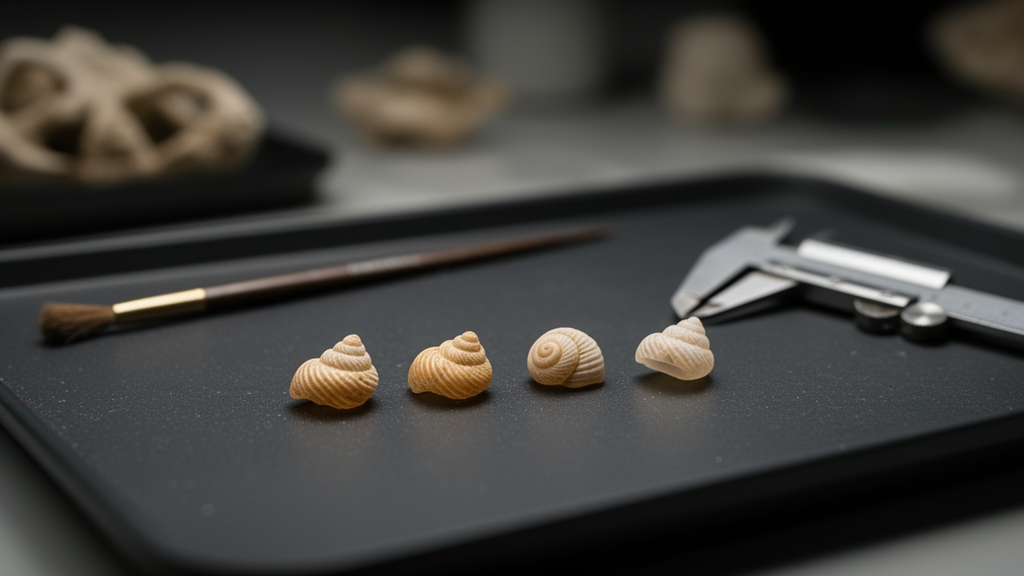
Deep in the drawers of the Natural History Museum Vienna, a handful of seashells no larger than a grain of rice have been waiting for more than a century to tell their story. Misidentified and tucked away among an unrelated group of gastropods, these minute fossils have now been recognized as five entirely new species of sea snails that lived roughly 15 million years ago in the Central Paratethys Sea, a vast shallow sea that once stretched across what is now Central and Eastern Europe. The discovery, published in the Annals of the Natural History Museum Vienna, raises the known diversity of Middle Miocene Bittiinae, a subfamily of small cerithiid snails, to thirteen species, nearly double the number that inhabits the Mediterranean Sea today.
The new species, named Bittium biskupici, Bittium castori, Bittium pallgergelyi, Bittium parvapyramis and Bittium polluxi, were recovered from Badenian-stage deposits in Austria, Romania and Ukraine. Four of them come from middle Badenian strata corresponding to the Langhian age, while one, the Ukrainian species Bittium parvapyramis, derives from upper Badenian layers of the Serravallian age. According to the research, all five species are abundant at their respective type localities but have so far never been recorded anywhere else, a pattern that speaks to the highly regional character of the ancient sea’s ecosystems.
The specimens had been stored in the paleontological collection of the Natural History Museum Vienna, where they were misidentified as members of the genus Cerithiopsis and filed among the Triphoroidea, a different group of minute marine snails. They came to light during an ongoing revision of Miocene Paratethyan gastropod families, building on a recent comprehensive revision of the region’s Bittiinae published by Harzhauser and colleagues in 2025, which had already described eight Bittium species from the Middle Miocene of the Central Paratethys. The rediscovery underscores how museum collections can serve as unexpected archives of past biodiversity, holding species that no field campaign might ever rediscover in the same form.
Technically, the new species were distinguished through detailed analysis of shell morphology, including the number and shape of whorls, the structure of the larval protoconch, the arrangement of spiral cords and axial ribs, the positioning of tubercles at the intersections of these elements, and the presence or absence of denticles inside the outer lip. Bittium biskupici, for example, is a small, slender conical to slightly pagodiform shell reaching about five to seven millimeters in height, with a protoconch of roughly two and a half whorls bearing two spiral cords, and an outer lip armed with two prominent denticles, a feature rarely reported among Badenian Bittiinae. Its name honors Radoslav Biskupič of Poprad, Slovakia, in recognition of his contributions to the paleontology of the Vienna Basin.
Bittium castori and Bittium polluxi, both from the silt and clay of the Dej Formation at Lăpugiu de Sus in Romania’s Făget Basin, were named after the twin brothers Castor and Pollux of Greek mythology, a nod to how easily their shells were confused. The two species co-occurred at the same locality and their shells had even been mixed together in the Vienna museum’s collection. Bittium castori is distinctly larger, reaching about seven to eight millimeters, with more pointed tubercles and peribasal cords that are often slightly coalescent, whereas Bittium polluxi, at around five millimeters, has well-separated peribasal cords and shells that are brownish rather than whitish. The subtle but consistent differences in sculpture, growth stage at which additional spiral cords appear, and even shell color allowed the researchers to separate the twins.
Bittium pallgergelyi, also from Gainfarn in the Vienna Basin, is a medium-sized, slender species of up to eleven teleoconch whorls, attaining eight to eleven millimeters, characterized by three narrow spiral cords bearing rows of small, widely spaced, pointed tubercles and one to two prominent varices per whorl. It was named in honor of Barna Páll-Gergely of the Centre for Agricultural Research in Hungary, recognizing his contributions to malacology. The species shares its type locality with Bittium biskupici, both living in what the researchers interpret as a shallow marine, inner neritic environment with seagrass cover, based on earlier paleoenvironmental work at the site.
The most enigmatic of the five is Bittium parvapyramis, a minute, relatively broad conical shell of barely four millimeters, described from 120 specimens collected at Golubytsya, historically known as Hołubica, in the Voronyaky Hills of Ukraine. Its name derives from the Latin words parva, meaning small, and pyramis, meaning pyramid, referring to its shape. Despite the immature appearance of its outer lip, none of the 120 available specimens shows a greater number of whorls, and the researchers could not match them to juveniles of any other Paratethyan Bittium species, supporting its status as a distinct, fully grown species. It lived during the late Badenian, around the Serravallian, in the Polish-Ukrainian Fore-Carpathian Basin, and may represent one of the endemic species that flourished there as the sea became semi-isolated.
The paleogeographic setting is central to understanding why so many species coexisted. The Central Paratethys Sea came into existence around the Eocene-Oligocene boundary, when the mountain-building events of the Alpidic orogeny divided the former Tethys Ocean into a series of increasingly isolated epicontinental seas. During the Langhian, the biota of this sea was strongly influenced by the global Middle Miocene Climatic Optimum, a warm interval that produced a peak of marine biodiversity. Maximum diversity of the late Langhian developed in the Vienna and Făget basins, the very regions that yielded four of the five new species. The archipelago-like landscape of the Central Paratethys probably provided numerous different and possibly partially or intermittently isolated habitats, fueling speciation in the central and southern basins of the sea.
The numbers are striking. With thirteen species now known from the Middle Miocene of the Central Paratethys, the region’s Bittiinae diversity was nearly twice that of the modern Mediterranean Sea, which hosts seven species, and more than twice that of the modern tropical eastern Atlantic, which has five. Middle Miocene Paratethyan diversity even exceeded that of the present-day Indo-West Pacific region, where only two species are described from the Red Sea and only six from the Coral Triangle, one of the world’s acknowledged marine biodiversity hotspots. Comparison with the coeval Middle Miocene Proto-Mediterranean fauna remains difficult, however, because no comparable gastropod revisions have been published for that region so far.
The diversity peak did not last. It ended with the onset of cooling during the Middle Miocene Climate Transition, which triggered a general decline of marine diversity during the late Badenian. As sea level fell, the Polish-Ukrainian Fore-Carpathian Basin became semi-isolated, and many endemic species evolved there, Bittium parvapyramis possibly among them. Ultimately, only one Bittiinae species survived the tectonically induced Badenian-Sarmatian extinction event, and the subfamily disappeared entirely from the region during the middle Sarmatian. The story of these five tiny snails is thus not merely a taxonomic exercise; it is a window into how a warm, fragmented sea briefly became one of the richest marine ecosystems on Earth, and how quickly that richness collapsed when climate and geography turned against it. It is also a reminder that the final word on past biodiversity has not yet been spoken, even after thorough revisions of well-studied groups, and that museum drawers may still hold surprises waiting to be counted.
Subject of Research: Taxonomic description of five new Middle Miocene Bittiinae gastropod species from the Central Paratethys Sea
Article Title: New Bittiinae ( Gastropoda , Cerithiidae ) from the Middle Miocene of the Central Paratethys Sea
Article References: New Bittiinae ( Gastropoda , Cerithiidae ) from the Middle Miocene of the Central Paratethys Sea. (n.d.). https://doi.org/10.3897/anhmw.170289
Image Credits: AI Generated
DOI: 10.3897/anhmw.170289
Keywords: Bittium, Bittiinae, Cerithiidae, Central Paratethys, Middle Miocene, Badenian, gastropods, paleontology, Vienna Basin, Făget Basin, Miocene Climatic Optimum, museum collections
Cite Scienmag News
Margaret Porter. (October 16, 2026). Five Tiny Fossil Sea Snails From Miocene Europe Rewrite the Story of a Lost Marine Biodiversity Hotspot. Scienmag. https://scienmag.com/five-tiny-fossil-sea-snails-from-miocene-europe-rewrite-the-story-of-a-lost-marine-biodiversity-hotspot/
Margaret Porter. "Five Tiny Fossil Sea Snails From Miocene Europe Rewrite the Story of a Lost Marine Biodiversity Hotspot." Scienmag, 16 October 2026, https://scienmag.com/five-tiny-fossil-sea-snails-from-miocene-europe-rewrite-the-story-of-a-lost-marine-biodiversity-hotspot/. Accessed 16 October 2026.
Margaret Porter. "Five Tiny Fossil Sea Snails From Miocene Europe Rewrite the Story of a Lost Marine Biodiversity Hotspot." Scienmag. October 16, 2026. https://scienmag.com/five-tiny-fossil-sea-snails-from-miocene-europe-rewrite-the-story-of-a-lost-marine-biodiversity-hotspot/


