


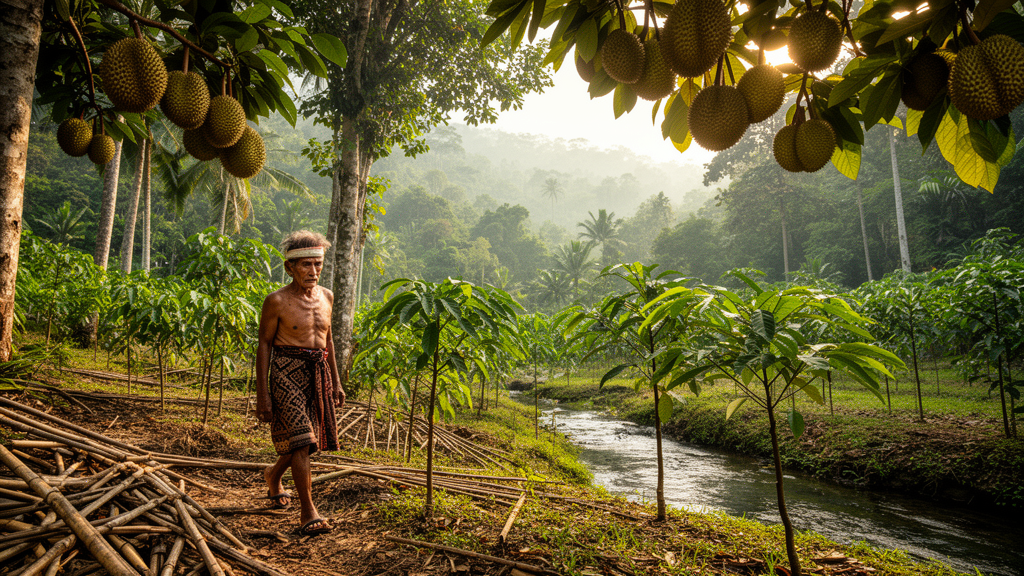
Deep in the upstream reaches of Indonesian Borneo, where the Sepauk River feeds the mighty Kapuas watershed, scientists have found that a centuries-old farming tradition may hold the key to restoring some of the country’s most damaged land. A new study published in One Ecosystem examined the vegetation of tembawang, the traditional forest gardens of the Dayak people of West Kalimantan, and concluded that these culturally treasured landscapes could serve as a locally adapted model for rehabilitating critically degraded catchments.
The research focused on the Peninsung Catchment, an 8,111.36-hectare area within the Sepauk Sub-Watershed that functions as a recharge zone for the Kapuas watershed. The catchment is under serious strain: roughly 71.15 percent of its land, about 5,771.57 hectares, is classified as moderately critical, meaning it has lost much of its ecological function. The wider Sepauk Sub-Watershed spans 122,025 hectares and is itself considered 53.54 percent critical, placing it among Indonesia’s 108 priority recovery watersheds. With hydrometeorological disasters increasingly linked to watershed degradation across the country, finding rehabilitation strategies that local communities will actually embrace has become an urgent scientific and policy challenge.
Tembawang is no ordinary farmland. These forest gardens, often established around former settlement sites and traditional Dayak longhouses or field huts, are managed across generations under customary law and are now formally recognized in Sintang Regency Regulation No. 122 of 2021. Structurally, they mimic natural forests, integrating the iconic tengkawang trees of the Shorea genus with fruit and timber species. Previous research has credited tembawang with absorbing carbon dioxide, conserving tree species, reducing erosion through litter dynamics, and supplying food, medicine and building materials to local households. Yet quantitative ecological assessments of tembawang vegetation, particularly across all growth stages, have remained scarce.
To fill this gap, the research team conducted vegetation surveys in February 2024 across four tembawang sites, designated T1 through T4, ranging from 0.5 to 0.7 hectares each. The sites represented three tenure types: Communal Tembawang, Young Heritage Tembawang and Old Heritage Tembawang, estimated at more than 80 years, 50 to 60 years and 60 to 70 years old respectively. Using a line-nested plot method with a 30 percent sampling intensity, the team established 16 plots in total, with nested quadrats of 20 by 20 meters for trees, 10 by 10 meters for poles, 5 by 5 meters for saplings and 2 by 2 meters for seedlings. Species were identified in the field using local vernacular names provided by the landowners themselves.
The analysis, performed with PAST software version 4.04, yielded a rich picture of ecological dynamics. Across the four sites, the surveys recorded 55 species from 30 families, distributed as 14 species at the seedling stage, 34 at the sapling stage, eight at the pole stage and 24 at the tree stage. The Importance Value Index, a composite measure of relative density, frequency and dominance, revealed a striking successional story. At the seedling stage, locally managed fruit species dominated, with Lansium domesticum reaching an IVI of 117.36 at site T3, rubber (Hevea brasiliensis) at 100.31 at T4, and durian (Durio zibethinus) at 93.27 at T2.
As the vegetation matured into the sapling stage, dominance became more dispersed, with maximum IVI values dropping to between roughly 31 and 55, a sign of intense competition and resource sharing in the lower canopy. Then came the most dramatic shift of the study: the pole stage. At three of the four sites, rubber trees seized near-absolute control of the mid-canopy, with IVI values of 140.98, 160.02 and 161.38 at sites T2, T3 and T4 respectively. Only site T1 resisted, dominated instead by the native woody species Aporosa arborea at 78.44. The researchers describe this as a Rubber Phase, an economically driven intensification period that temporarily simplifies the ecosystem’s mid-story.
Crucially, the story does not end there. At the mature tree stage, native fruit trees reclaimed the canopy. Artocarpus integer and Durio zibethinus dominated site T1 with IVIs of 106.4 and 93.78, while Lansium domesticum and Mangifera laurina anchored the overstorey at T3. Even at T4, where rubber remained dominant, its IVI fell to just 75.08, heavily diluted compared to its pole-stage grip. This recovery demonstrates that as tembawang matures, the system naturally limits monoculture-like dominance and allows diverse, large-stature fruit trees to establish a stable permanent canopy.
The diversity indices told a complementary tale. Shannon Index values across the sites ranged from 0.69 to 2.53, mostly in the moderate category, with the pole stages at T3 and T4 dipping into low diversity because of rubber dominance. Evenness, however, remained consistently high throughout, exceeding 0.6 at every stage and even reaching a perfect 1.00 at the pole stage in T3 and T4, indicating that the few species present were distributed with remarkable uniformity. Hierarchical cluster analysis using the UPGMA algorithm and Bray-Curtis similarity confirmed these patterns with strong statistical reliability, with cophenetic correlation coefficients reaching 0.9549 at the tree stage. The clustering showed that rubber-dominated sites T3 and T4 became nearly identical at the pole stage, while sites managed for mixed fruit trees, T1, T2 and T3, converged into a species-rich traditional orchard configuration at maturity.
Why does this matter for rehabilitation? The answer lies in structure. The continuous presence of seedlings, saplings, poles and mature trees creates a multilayered canopy that intercepts rainfall, reduces the kinetic energy of raindrops, slows surface runoff, prevents nutrient loss and enhances water infiltration. Dense understorey layers, such as the 14 sapling species recorded at T3, act as biological buffers against erosion. Accumulating litter biomass further reduces runoff and sedimentation. These are precisely the hydrological functions that critically degraded land has lost, and the study argues that tembawang’s stratified architecture can restore them while simultaneously producing food and income.
Perhaps most importantly, the researchers emphasize that ecological effectiveness alone is not enough. Successful rehabilitation requires community acceptance, and tembawang is deeply woven into Dayak cultural identity and livelihoods. By integrating this indigenous ecological knowledge into restoration strategies, rather than imposing external planting schemes, watershed managers in West Kalimantan and beyond may find a proven, locally adaptive path forward. The study concludes that tembawang, with its stable successional dynamics, balanced species distribution and multilayered structure, offers a scientifically validated model for healing Indonesia’s degraded watersheds, one forest garden at a time.
Subject of Research: Ecological assessment of traditional Dayak tembawang agroforestry vegetation for critical land rehabilitation in an Indonesian watershed
Article Title: Vegetation diversity of tembawang in relation to critical land rehabilitation efforts in the Peninsung Catchment, Sepauk Sub-Watershed, West Kalimantan
Article References: Hutagaol, R. R., Kusumandari, A., Suryatmojo, H., & Permadi, D. B. (2026). Vegetation diversity of tembawang in relation to critical land rehabilitation efforts in the Peninsung Catchment, Sepauk Sub-Watershed, West Kalimantan. One Ecosystem, 11, Article e177863. https://doi.org/10.3897/oneeco.11.e177863
Image Credits: AI Generated
DOI: 10.3897/oneeco.11.e177863
Keywords: tembawang, agroforestry, Dayak, West Kalimantan, watershed rehabilitation, critical land, species diversity, Important Value Index, Shannon index, rubber cultivation, soil and water conservation, Kapuas watershed
Cite Scienmag News
Margaret Porter. (October 16, 2026). Ancient Dayak forest gardens offer blueprint for healing Indonesia’s degraded watersheds. Scienmag. https://scienmag.com/ancient-dayak-forest-gardens-offer-blueprint-for-healing-indonesias-degraded-watersheds/
Margaret Porter. "Ancient Dayak forest gardens offer blueprint for healing Indonesia’s degraded watersheds." Scienmag, 16 October 2026, https://scienmag.com/ancient-dayak-forest-gardens-offer-blueprint-for-healing-indonesias-degraded-watersheds/. Accessed 16 October 2026.
Margaret Porter. "Ancient Dayak forest gardens offer blueprint for healing Indonesia’s degraded watersheds." Scienmag. October 16, 2026. https://scienmag.com/ancient-dayak-forest-gardens-offer-blueprint-for-healing-indonesias-degraded-watersheds/


