


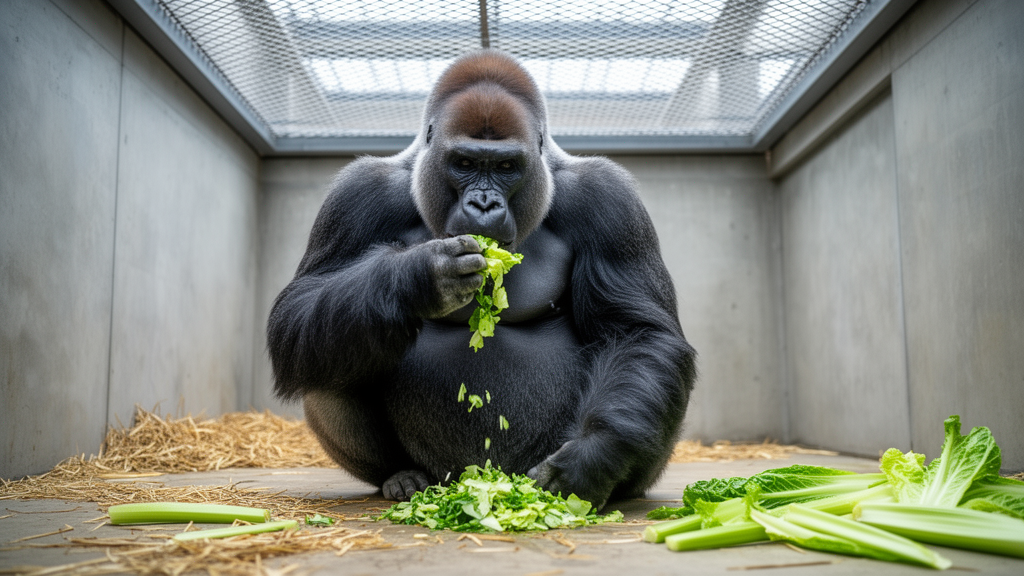
In zoos across North America, a strange behavior ripples through gorilla enclosures with such regularity that many caretakers consider it almost routine. The animals deliberately bring up food from their stomachs, sometimes into their hands or onto the floor, and then eat it all over again. Scientists call this regurgitation and reingestion, or R&R, and it is virtually unheard of in wild gorillas. Yet it is so common in captivity that roughly 60 to 65 percent of the North American zoo population is thought to display it. A new study published in Frontiers in Ethology offers the most detailed look yet at when, why, and on which foods captive gorillas perform this puzzling act, and its findings challenge long-held assumptions among zoo staff about what drives it.
Researchers Rhiannon Schultz of Animal Welfare Expertise and the University of Georgia, Isabella Clegg of Animal Welfare Expertise, and Roberta Salmi of the University of Georgia observed 21 male western lowland gorillas at five Association of Zoos and Aquariums-accredited institutions in the United States. The subjects ranged from five to forty years old and fell into four groups: adolescents, pubescents, healthy adults, and adults diagnosed with cardiovascular disease, a condition that disproportionately affects male gorillas in zoos and was included because reduced activity levels in heart-diseased animals might influence abnormal behavior. Over the period from May 2023 to January 2025, the team logged 1,034 hours of direct behavioral observation, using focal animal sampling and instantaneous scans at five-minute intervals to build detailed daily activity budgets for each individual.
The scale of observation matters, because previous studies of R&R often relied on small samples or on surveys of caretaker recollections rather than direct recording. By watching the animals themselves, the researchers could capture what happened immediately before each regurgitation event, what the animal had eaten beforehand, and how the behavior clustered in time. They also went beyond behavior into chemistry, analyzing the nutrient composition of the foods most often brought back up, using USDA databases and laboratory proximate analysis of dehydrated samples that measured crude protein, neutral detergent fiber, gross energy, and mineral content.
The results revealed a striking temporal pattern. R&R was overwhelmingly an afternoon affair. The statistical models showed the probability of the behavior at its lowest during the early morning hours of six to nine a.m., creeping upward through midday and peaking between three and six p.m. Even more telling was the relationship with feeding: the more time a gorilla spent feeding on a given day, the less likely it was to engage in R&R at all. This inverse correlation fits a hypothesis the researchers had set out to test, that the behavior may function as a way of extending feeding time when captive diets fail to satisfy the drives that wild feeding patterns normally fulfill.
That mismatch between wild and captive feeding is dramatic. Wild gorillas spend forty to fifty percent of their waking hours feeding and foraging on fibrous plant material, while zoo-housed gorillas dedicate at most twenty to twenty-five percent of their time to eating. Captive diets are nutrient-dense and low in fiber, meaning animals can consume their entire daily ration in a fraction of the time it would take to meet equivalent needs in a forest. The new study adds nuance to this picture: gorillas who structured their eating into longer, consolidated bouts followed by long gaps of inactivity showed higher R&R frequencies, while those with more fragmented feeding opportunities showed less. The behavior, in other words, appears tied not just to how much an animal eats, but to the rhythm of eating across the day.
The food chemistry results were perhaps the most surprising. Caretakers have long blamed fruit, with its sugar content and palatability, as the main trigger for R&R, and reduced-fruit diets have sometimes appeared to help. But this study found that commercial primate chow topped the list of foods disproportionately associated with the behavior, followed by fruit juice, grapes, cabbage, mixed nuts, and carrots. Only sycamore among the browse items was significant. Meanwhile, banana, broccoli, kale, and popcorn showed no association at all. Permutation-based nutrient comparisons showed that regurgitated foods tended to be richer in phosphorus, potassium, calcium, and magnesium, while fiber’s role proved more complicated than expected: some of the most regurgitated items, like chow and sycamore browse, were actually high in fiber.
The category-level analysis sharpened the contrast. Root vegetables carried more than a sixfold increase in the likelihood of being regurgitated relative to the baseline, chow and biscuits more than tripled the risk, and nuts, enrichment foods, and fruit each roughly doubled it. Browse, by contrast, was dramatically underrepresented: gorillas were about ninety-seven percent less likely to regurgitate browse than the reference category. Because browse items like leaves and stems demand long processing and chewing time, this finding suggests that foods requiring extended handling may protect against the behavior, while foods that can be gulped down quickly may leave the feeding drive unsatisfied. The researchers note that individual variation was considerable, with one gorilla regurgitating disproportionately after cabbage and another after oatmeal, suggesting diet design should work at the level of specific items rather than broad categories.
The behavioral sequence analysis revealed something equally important: R&R is not one uniform behavior but appears to come in at least two distinct forms. Isolated single events tended to follow periods of rest and inactivity, especially after sequences of resting followed by feeding, consistent with the old hypothesis that boredom or unmet foraging motivation triggers the behavior. Clustered bouts, in which animals repeated the cycle many times, were instead closely tied to feeding episodes, and only feeding occurred in the thirty-minute window preceding R&R episodes. A logistic decision-tree model identified high-risk sequences such as feeding transitioning into prolonged inactivity, and found that R&R itself predicted future R&R, hinting that in some individuals the behavior becomes self-reinforcing and potentially stereotypic.
Demographic patterns added another layer of intrigue, even if they were not statistically conclusive. Adults with heart disease showed the highest average time spent in R&R at about eighty minutes, and pubescents also showed elevated rates, though the study found no significant effect of demographic group overall and individual variability was high. The authors speculate that R&R may relate to metabolic or energetic demands that standard zoo diets, typically calculated from body weight, do not capture, particularly during growth or physiological change. They connect this to a broader metabolic picture: captive gorillas share risk factors with humans diagnosed with metabolic syndrome, including energy-dense, low-fiber diets, and these factors have been implicated in fibrosing cardiomyopathy, the leading heart disease of male zoo gorillas.
The practical implications are concrete. The authors suggest that breaking the day into more frequent, smaller feeding opportunities, ideally accompanied by low-sodium browse such as pear, American beech, or hackberry, could disrupt the long-bout-then-long-gap pattern that breeds clustered R&R. Predictive behavioral monitoring could flag risk windows in real time, allowing keepers to deploy enrichment or social opportunities before abnormal behavior emerges. The researchers caution that their study was observational and cannot establish causation, that physiological measures of hunger and satiety were not assessed, and that the sample, though larger than most previous work, was limited to males. Still, by dissecting R&R at the level of events, bouts, and episodes, and pairing behavior with nutrient chemistry, the study reframes this peculiar habit not as a meaningless quirk of captive life, but as a window into how environment and diet reshape the inner signals of hunger, fullness, and boredom in one of our closest relatives.
Subject of Research: Regurgitation and reingestion behavior in captive male western lowland gorillas and its dietary and behavioral triggers
Article Title: Abnormal ingestive behavior in male zoo gorillas: investigating the dietary and activity patterns associated with regurgitation and reingestion
Article References: Schultz, R. L., Clegg, I. L. K., & Salmi, R. (2026). Abnormal ingestive behavior in male zoo gorillas: investigating the dietary and activity patterns associated with regurgitation and reingestion. Frontiers in Ethology, 5, Article 1896803. https://doi.org/10.3389/fetho.2026.1896803
Image Credits: AI Generated
DOI: 10.3389/fetho.2026.1896803
Keywords: gorillas, animal welfare, regurgitation and reingestion, zoo nutrition, abnormal behavior, stereotypies, primate chow, browse, satiety, feeding behavior, captivity, ethology
Cite Scienmag News
Daisy Hatcher. (October 16, 2026). Why Zoo Gorillas Regurgitate and Reingest Their Food: New Study Points to Diets and Boredom. Scienmag. https://scienmag.com/why-zoo-gorillas-regurgitate-and-reingest-their-food-new-study-points-to-diets-and-boredom/
Daisy Hatcher. "Why Zoo Gorillas Regurgitate and Reingest Their Food: New Study Points to Diets and Boredom." Scienmag, 16 October 2026, https://scienmag.com/why-zoo-gorillas-regurgitate-and-reingest-their-food-new-study-points-to-diets-and-boredom/. Accessed 16 October 2026.
Daisy Hatcher. "Why Zoo Gorillas Regurgitate and Reingest Their Food: New Study Points to Diets and Boredom." Scienmag. October 16, 2026. https://scienmag.com/why-zoo-gorillas-regurgitate-and-reingest-their-food-new-study-points-to-diets-and-boredom/


