


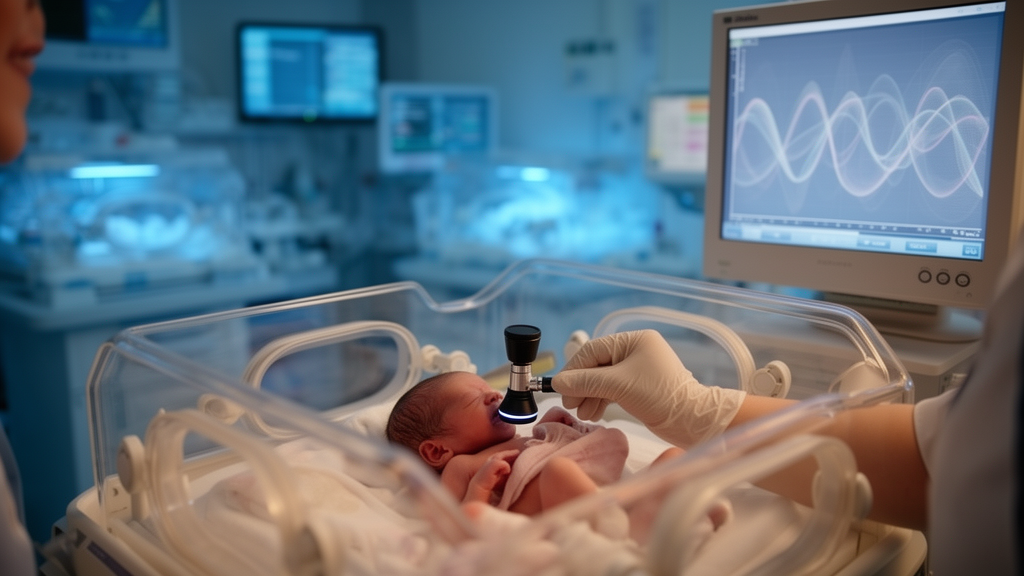
In neonatal intensive care units across the world, one of the most feared complications of premature birth is a disease of the eye that most parents have never heard of. Retinopathy of prematurity, or ROP, is a disorder in which the blood vessels of the retina fail to develop normally in babies born too early, growing abnormally and, in its severest forms, pulling the retina away from the back of the eye. It remains one of the leading causes of preventable childhood blindness, and its management depends on catching the disease at exactly the right moment. Now, a large real-world study from eastern India suggests that machine learning models trained on ordinary clinical records can help identify which newborns are most likely to develop ROP and which will go on to need treatment, offering a potential triage tool for places where specialist eye examiners are scarce.
The research, published in Pediatric Research by a team led by Tapas R. Padhi of the L.V. Prasad Eye Institute in Bhubaneswar and collaborators at CognitiveCare Inc. and Tufts University School of Medicine, set out to answer a deceptively simple question: can the data that hospitals already collect about a baby, without any retinal photographs at all, predict who will develop ROP? To find out, the team assembled a de-identified clinical dataset of remarkable scale for this setting: 23,404 medical records from 9,205 infants, abstracted and curated from 25 newborn care units across the state of Odisha, India. Rather than relying on curated research databases, the investigators worked with the messy, incomplete reality of routine clinical documentation, which is precisely the kind of data any deployed prediction system would have to handle.
Technically, the heart of the study is a sequential two-step modeling framework, and the design choice matters as much as the numbers. In the first step, the researchers trained models to predict whether a baby would develop any form of ROP using only demographic, perinatal, laboratory, and neonatal intensive care variables, the kind of information available from birth onward. In the second step, for infants who had already undergone specialist ophthalmic examinations, the models incorporated structured findings from those exams, including the disease stage, the retinal zone involved, plus or pre-plus disease status, and related severity descriptors, to identify which of the examined infants would require treatment. Crucially, the models used structured clinical variables rather than raw retinal images, distinguishing this approach from the deep-learning image-analysis systems that have dominated artificial intelligence work in ROP screening.
The team trained and tested eight different machine learning algorithms for each step, comparing their ability to separate babies who would develop disease from those who would not. In the first step, the best performer was Random Forest, an ensemble method that builds many decision trees on random subsets of the data and averages their votes, a technique known for robustness on tabular clinical data with nonlinear relationships between variables. In the second step, the top model was LightGBM, a gradient-boosting framework that builds trees sequentially, with each new tree correcting the errors of its predecessors; LightGBM is prized for its speed and accuracy on large structured datasets. The choice of two different winning algorithms across the two steps reflects the different nature of the prediction problems: a broad population-level risk question in step one, and a finer-grained severity question informed by examination findings in step two.
The most important test, however, was not how the models performed on data they had already seen. The researchers evaluated the full sequential framework prospectively in a separate validation cohort drawn from the same population, a design that gives a far more honest picture of real-world performance than retrospective splits. In that prospective cohort, the framework achieved 84.9 percent sensitivity for treatment-requiring ROP, correctly identifying 437 of the 515 infants who ultimately needed treatment. That figure, while strong, also carries a sobering corollary: 78 infants who required treatment were not flagged by the model. The authors are explicit that this level of performance supports the framework’s use as an adjunctive prioritization tool, not as a replacement for specialist examination.
That caution is woven throughout the paper and is worth taking seriously. The authors state that model outputs should not be used to defer indicated ophthalmic assessments without additional threshold optimization, calibration, external validation, and implementation testing. In other words, even a model that catches roughly 85 percent of treatment-requiring cases leaves a dangerous minority undetected, and in a disease where timely laser or anti-VEGF therapy can mean the difference between sight and lifelong blindness, missing one in six or seven severe cases is not acceptable as a standalone screening strategy. What the framework can do, the researchers argue, is help resource-constrained networks decide which babies to examine first, prioritizing referrals while preserving the safety net of routine guideline-based screening for everyone.
The context in which this tool was developed makes that prioritization argument compelling. ROP is fundamentally a disease of the interplay between premature birth and modern neonatal care, driven by factors such as low gestational age, low birth weight, oxygen exposure, and postnatal growth patterns. Earlier risk models, such as the WINROP algorithm and the CHOP and G-ROP models built on postnatal weight gain, birth weight, and gestational age, demonstrated that longitudinal clinical data could predict severe disease, and versions of these tools have been validated in populations from Sweden to Mexico, China, Taiwan, and Scotland. More recent efforts, including the DIGIROP decision-support tools and non-imaging machine learning approaches tested in multicenter studies, have pushed the field toward models that integrate nutrition duration, physiological data, and broader clinical variables. The Odisha study extends this lineage into a large, real-world, resource-constrained public health system, where the bottleneck is often not knowledge of who is at risk but the sheer scarcity of ophthalmologists trained to examine preterm retinas.
India carries a substantial share of the global ROP burden, and screening programs there have pioneered creative solutions, including telemedicine-based wide-field imaging with non-physician graders, as in the KIDROP model. National operational guidelines for ROP screening exist, but implementation varies widely across districts, and the third epidemic of ROP, driven by expanding neonatal care in middle-income countries, continues to grow. In such settings, a structured-data model that runs on information already flowing through hospital records, without requiring retinal cameras or image-reading infrastructure, has a different kind of practicality than image-based artificial intelligence systems. It can be computed at the bedside or centrally, updating a baby’s risk status as laboratory values, weight trajectories, and intensive care variables accumulate over the first weeks of life.
The study also illustrates the unglamorous engineering that determines whether clinical machine learning ever leaves the laboratory. The dataset required extensive abstraction, curation, and processing, including handling of missing data, a persistent challenge in real-world neonatal records where the authors employed modern imputation techniques. The team audited the specialist interpretation of the fundoscopic images used to establish clinical ROP diagnoses and staging, although those image files themselves were never inputs to the models. The work was approved by the institutional ethics board at the L.V. Prasad Eye Institute with a waiver of individual informed consent because the data were retrospective and fully anonymized. One disclosure deserves note: CognitiveCare Inc. holds a patent covering artificial intelligence platforms for predicting pregnancy-related adverse events, with ROP among 48 conditions incorporated, so the work has a commercial dimension alongside its public health motivation.
What happens next will determine whether this framework saves sight. The authors themselves chart the path: threshold tuning to push sensitivity higher, calibration so that predicted probabilities mean what they say, external validation in populations beyond Odisha, and careful implementation studies to see how risk scores actually change referral behavior in busy neonatal units. If those steps succeed, the vision is a staged system in which every preterm baby still receives guideline-based screening, but the model continuously sorts the queue, ensuring that the highest-risk infants reach an ophthalmologist before the disease crosses the point of no return. In a world where an estimated tens of thousands of children are blinded by ROP each year, and where the specialists who could save them are unevenly concentrated in a handful of cities, a well-calibrated early warning system built from data hospitals already possess could prove to be one of the more consequential applications of machine learning in global child health.
Subject of Research: Machine learning prediction of treatment-requiring retinopathy of prematurity in preterm infants using structured clinical data
Article Title: Prediction of retinopathy of prematurity using machine learning models
Article References: Padhi, T. R., Nelaturi, N., Teltumbade, M., Ganti, J., Peri, V. N., Rani, S. P., Vishnoi, G., Gill, S., Sutar, S. K., Bhunia, S., Misra, R., & Norwitz, E. R. (2026). Prediction of retinopathy of prematurity using machine learning models. Pediatric Research. https://doi.org/10.1038/s41390-026-05413-6
Image Credits: AI Generated
DOI: 10.1038/s41390-026-05413-6
Keywords: retinopathy of prematurity, machine learning, preterm infants, neonatal screening, Random Forest, LightGBM, predictive modeling, childhood blindness, India, neonatal intensive care, clinical decision support, prospective validation
Cite Scienmag News
Teresa Odom. (October 16, 2026). Machine Learning Models Flag Which Preterm Babies Will Need ROP Treatment. Scienmag. https://scienmag.com/machine-learning-models-flag-which-preterm-babies-will-need-rop-treatment/
Teresa Odom. "Machine Learning Models Flag Which Preterm Babies Will Need ROP Treatment." Scienmag, 16 October 2026, https://scienmag.com/machine-learning-models-flag-which-preterm-babies-will-need-rop-treatment/. Accessed 16 October 2026.
Teresa Odom. "Machine Learning Models Flag Which Preterm Babies Will Need ROP Treatment." Scienmag. October 16, 2026. https://scienmag.com/machine-learning-models-flag-which-preterm-babies-will-need-rop-treatment/


