


Electromagnetic smog has become one of the defining infrastructure challenges of the wireless age. With 5G base stations, Wi-Fi 6 routers, and dense arrays of connected devices radiating across the 900 MHz to 6 GHz spectrum, architects and engineers are increasingly looking for building materials that do more than hold up a wall—they want materials that can quietly soak up or reflect unwanted electromagnetic energy while remaining affordable and low in carbon. A new study published in Polymer Bulletin by Mahfuz Pekgöz and İlker Tekin of Karabük University in Turkey suggests that an unassuming volcanic rock may be the key to that vision.
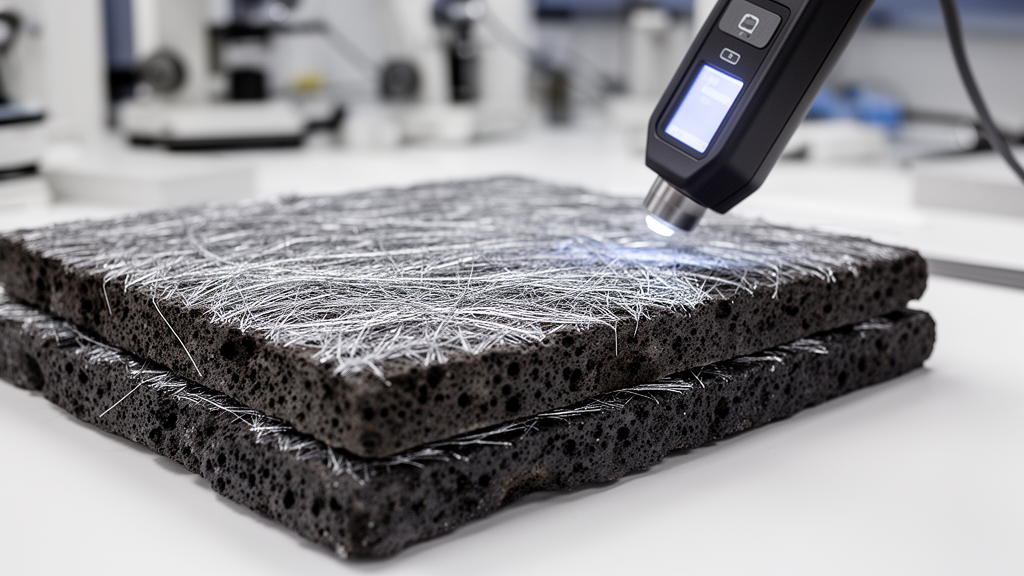
The researchers turned to rhyolitic tuff, a porous volcanic rock abundant in Anatolia, as the base material for a family of geopolymer tiles. Geopolymers are inorganic binders formed by activating aluminosilicate-rich raw materials with alkaline solutions, and unlike ordinary Portland cement, they can be produced without high-temperature clinkering, which makes them dramatically less carbon-intensive. By milling the tuff and blending it with micronized calcite, then adding variable amounts of zinc oxide powder and a small dose of conductive fibers, the team created tiles designed to serve as structural building elements and electromagnetic shields at the same time.
The experimental program was unusually thorough. The researchers measured water absorption and drying shrinkage, tested compressive and flexural strength according to standard ASTM procedures, examined the microstructure of the cured composites, and—most importantly—characterized electromagnetic shielding effectiveness across a sweep from 900 to 6000 MHz at 100 MHz intervals. They also performed life-cycle-style accounting of carbon dioxide emissions and production costs, benchmarking their best geo-tiles against conventional ceramic tiles, which are fired in energy-hungry kilns at temperatures exceeding 1000 degrees Celsius.
Zinc oxide emerged as the quiet workhorse of the mechanical side of the story. Incorporating the powder significantly enhanced the compressive and flexural performance of the tuff-based geopolymers, consistent with a growing body of literature showing that ZnO can refine pore structure and influence hydration and reaction kinetics in cementitious and alkali-activated systems. In other words, the additive did not just ride along—it actively strengthened the matrix, improving the durability characteristics that any real tile would need to survive in a building envelope.
But when it came to blocking electromagnetic waves, the type of fiber made all the difference. Each mix received the same total fiber dosage—two percent by volume—drawn from three candidate reinforcements: polypropylene fibers, brass-coated micro-steel fibers, and carbon fibers. The carbon fiber-reinforced geopolymers decisively outperformed the rest, posting total shielding values of 31.2 dB at 900 MHz, 42.8 dB at 1800 MHz, 39.16 dB at 2400 MHz, and 46.86 dB at 5000 MHz. For context, a shielding effectiveness of 40 dB means that only one ten-thousandth of the incident electromagnetic energy gets through, which is enough to meet most commercial shielding requirements for sensitive electronics.
The synergy between the functional powder and the conductive fibers proved even more striking. When the researchers combined 2.5 percent by volume of zinc oxide with 2 percent by volume of carbon fibers, the composite reached a total shielding effectiveness of 60.32 dB at 5800 MHz—a frequency band that sits squarely in the upper range used by modern 5G and Wi-Fi systems. At 60 dB, only one part in a million of the incoming radiation penetrates the tile, a level of attenuation that rivals purpose-built shielding enclosures. The mechanism is a classic one in shielding science: carbon fibers form interconnected conductive networks that reflect and dissipate incoming waves through induced currents, while the ZnO-modified matrix contributes dielectric loss and improves impedance matching so that more energy enters the material to be absorbed rather than bouncing off the surface.
The economic and environmental results may be the most viral-worthy part of the study. The lowest recorded carbon footprint among the developed geo-tiles was 2.63 kilograms of CO2 per square meter, and the lowest production cost came in at $1.30 per square meter. Compared with conventional ceramic tiles, that represents reductions of approximately 81.7 percent in CO2 emissions and 90.9 percent in cost. The savings stem from what the geopolymers avoid: no kiln firing at extreme temperatures, no energy-intensive clinker production, and a raw material—rhyolitic tuff—that is essentially a low-value volcanic byproduct of the landscape. The study was supported by the Scientific and Technological Research Council of Türkiye, and the steel fibers used in the experiments were supplied as waste material by Kardemir Steel Industry, adding a circular-economy dimension to the work.
Why does this matter beyond the laboratory? Modern buildings are being asked to serve as faraday-like refuges for a growing inventory of electromagnetic-dependent infrastructure: data centers, hospitals with sensitive imaging equipment, secure government facilities, and increasingly, ordinary homes where residents worry about interference between the dozens of wireless devices competing for spectrum. A tile that can be laid as a standard floor or wall finish—while passively attenuating signals across nearly the entire relevant frequency range—would eliminate the need for separate shielding layers, metal meshes, or costly retrofits. And because the material is a geopolymer rather than a fired ceramic, it aligns with the construction industry’s urgent push to decarbonize, given that cement and ceramic production together account for a substantial share of global industrial emissions.
Of course, translating laboratory results into building products involves hurdles. The durability of carbon fibers in the highly alkaline geopolymer environment over decades, the scaling of mixing procedures to industrial tile production, and long-term structural performance all warrant further study. The authors also note that fiber type played a pivotal role in determining shielding properties, meaning that material specification will need to balance mechanical demands, cost, and electromagnetic targets on a project-by-project basis. Steel fibers, for instance, offer magnetic loss mechanisms that carbon lacks, while polypropylene fibers contribute mainly to crack control rather than conductivity.
Still, the core finding stands as a compelling proof of concept: a humble volcanic rock, activated with alkalis, stiffened with zinc oxide, and threaded with carbon fibers, can be transformed into a multifunctional building tile that strengthens structures, shields electronics, slashes carbon emissions by more than 80 percent, and cuts costs by more than 90 percent relative to the ceramic tiles found in millions of kitchens and bathrooms. If future work confirms long-term durability, the walls and floors of tomorrow’s buildings may quietly become the electromagnetic shields that today’s infrastructure still builds as expensive afterthoughts.
Subject of Research: Electromagnetic shielding performance of fiber-reinforced rhyolitic tuff geopolymer tiles with zinc oxide
Article Title: Synergistic effects of carbon, steel, and polypropylene fibers with ZnO on the electromagnetic shielding of rhyolitic tuff geo-tile
Article References: Pekgöz, M., & Tekin, İ. (2026). Synergistic effects of carbon, steel, and polypropylene fibers with ZnO on the electromagnetic shielding of rhyolitic tuff geo-tile. Polymer Bulletin, 83(12), Article 686. https://doi.org/10.1007/s00289-026-06743-5
Image Credits: AI Generated
DOI: 10.1007/s00289-026-06743-5
Keywords: geopolymer, rhyolitic tuff, electromagnetic shielding, carbon fiber, zinc oxide, steel fiber, polypropylene fiber, CO2 emissions, ceramic tile alternative, construction materials, 5G shielding, sustainable building
Cite Scienmag News
Bethany Barker. (October 16, 2026). Volcanic rock tiles with carbon fibers and zinc oxide block over 99.999% of electromagnetic waves. Scienmag. https://scienmag.com/volcanic-rock-tiles-with-carbon-fibers-and-zinc-oxide-block-over-99-999-of-electromagnetic-waves/
Bethany Barker. "Volcanic rock tiles with carbon fibers and zinc oxide block over 99.999% of electromagnetic waves." Scienmag, 16 October 2026, https://scienmag.com/volcanic-rock-tiles-with-carbon-fibers-and-zinc-oxide-block-over-99-999-of-electromagnetic-waves/. Accessed 16 October 2026.
Bethany Barker. "Volcanic rock tiles with carbon fibers and zinc oxide block over 99.999% of electromagnetic waves." Scienmag. October 16, 2026. https://scienmag.com/volcanic-rock-tiles-with-carbon-fibers-and-zinc-oxide-block-over-99-999-of-electromagnetic-waves/


