


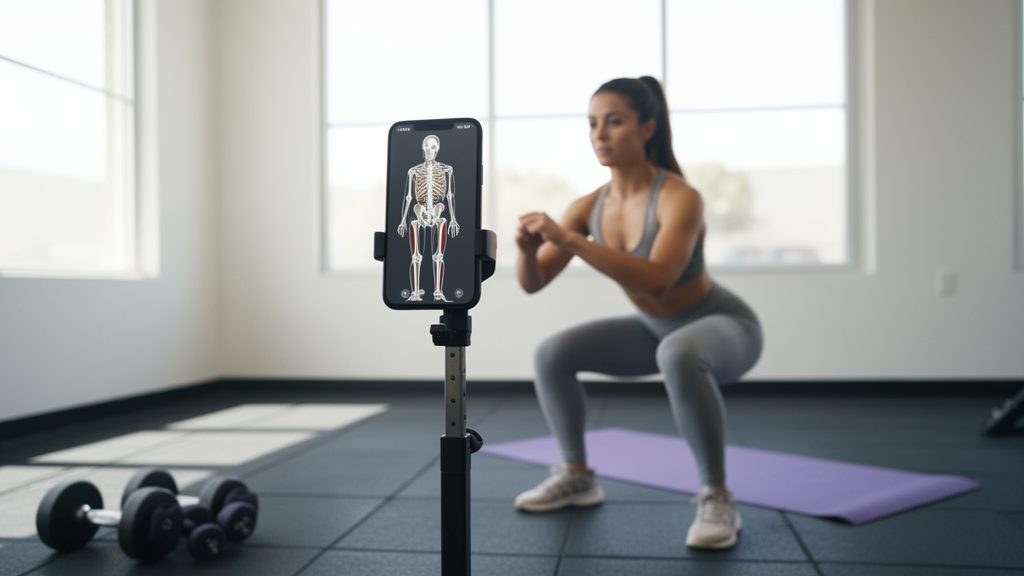
For decades, high-quality technical coaching has been a luxury. Elite athletes work with trainers who dissect every squat, shot, and lift frame by frame, while amateur athletes are left to guess at their own flaws based on brief verbal cues. A new open-access study published in Discover Artificial Intelligence by Yuan Liu of Shaanxi University of Science and Technology presents a system designed to close that gap: a deep learning platform that watches an athlete through a camera, estimates their body pose in real time, spots biomechanical errors, and delivers corrective feedback instantly—all on a small, affordable edge computer rather than a cloud server.
The core challenge the study tackles is a familiar one in applied artificial intelligence. The most accurate human pose estimation models, such as the high-resolution HRNet architecture that has set benchmarks in computer vision, are computationally enormous. They maintain rich, high-resolution feature representations throughout the network to pinpoint anatomical keypoints precisely, but their massive parameter counts and floating-point operation demands make them far too heavy to run at interactive speeds on mobile or embedded hardware. Meanwhile, the lightweight models that do fit on edge devices have traditionally sacrificed the accuracy needed for professional-grade movement analysis. The result has been a landscape dominated by offline analysis tools that process video after the fact, useful for post-game statistics but useless for correcting a flawed movement while it is actually happening.
Liu’s solution is built on knowledge distillation, a technique in which a large, high-performing teacher model transfers its learned expertise to a compact student model. In this system, a pre-trained HRNet serves as the teacher, supervising a student built on the MobileNet-V3 architecture. The training objective combines a standard mean squared error for heat-map regression with a distillation loss that penalizes divergence between the student’s intermediate feature maps and the teacher’s, aligned through one-by-one convolutions and bilinear interpolation across four of HRNet’s stage outputs. By learning to mimic not just the teacher’s final answers but its internal representations, the student captures postural nuances far beyond what a model of its size could achieve through conventional training alone.
The compression pipeline does not stop at distillation. The student model is then subjected to 8-bit integer quantization, which slashes the network’s memory footprint from 15.5 megabytes to 6.2 megabytes and accelerates inference by roughly 75 percent. Finally, the quantized model is deployed through NVIDIA’s TensorRT inference engine, which extracts further speed gains through hardware-aware optimization. The results of the ablation experiments trace each contribution in turn: distillation alone lifted accuracy from 84.2 percent to 90.1 percent mean Average Precision with negligible speed cost, quantization traded less than one percentage point of accuracy for dramatic efficiency, and TensorRT pushed the frame rate higher still. The finished system reaches 92.4 percent mAP while running at 45.8 frames per second on an NVIDIA Jetson Nano—a single-board computer typical of portable sports-analysis devices.
Those numbers represent what the author describes as the optimal precision-speed balance among mainstream edge pose estimation models. Compared head to head on the study’s self-built dataset, the system outperformed the heavyweight OpenPose reference by 3.9 percentage points of accuracy while running roughly nine times faster, beating it 45.8 FPS to 5.2 FPS. Against Google’s lightweight BlazePose and MoveNet models, it posted large accuracy advantages—14.2 and 15.9 percentage points respectively—while remaining competitive in speed. The complete model weighs in at just 12.3 megabytes, versus 209 megabytes for OpenPose, making it genuinely practical for local deployment on phones and embedded platforms.
Accurate pose estimation is only half the story; the system’s real innovation lies in what it does with the keypoints. The biomechanical correction engine treats the athlete’s limbs as a series of interconnected vectors. For any joint of interest—an elbow during a shot, a knee during a lift—the angle is calculated from the dot product of the adjacent limb vectors, taking the arccosine of the normalized result. That angle is then compared against predefined professional standard ranges for each phase of the movement. When the measured value drifts outside the threshold, the system immediately triggers a correction cue, translated by the feedback layer into intuitive visual or audio instructions. Because the logic is grounded in joint-angle thresholds rather than subjective pattern matching, the feedback is quantitative, specific, and traceable to established biomechanical principles.
Keeping that feedback truly instantaneous required serious software engineering. Traditional sequential pipelines stall because the processor waits for inference to finish before grabbing the next frame, producing lag and dropped frames. Liu’s architecture instead separates video acquisition, model inference, and user-interface rendering into independent threads that communicate through thread-safe high-speed queues. A frame-skipping mechanism prioritizes the most recent data, so the interface always reflects the athlete’s current position rather than a stale one. This asynchronous design is what allows the system to hold a frame rate above 45 FPS on the Jetson Nano while keeping the interface responsive even under heavy computational load—a requirement the author identifies as essential for interactive coaching.
The performance claims were put to a statistical test in a two-week controlled user study involving 40 athletes of mixed skill levels, randomly assigned to either an experimental group using the real-time feedback system or a control group receiving conventional coaching. The primary metric was the Posture Standard Rate, defined as the percentage of movement cycles in which joint angles stayed within professional biomechanical thresholds. At baseline the two groups were statistically indistinguishable, at roughly 62 to 63 percent. After two weeks, the experimental group reached 89.4 percent, versus 71.2 percent for the control group—a difference the author reports as highly significant, with the improvement gap of 26.9 percent versus 8.1 percent also statistically robust. Athletes using the system reported being able to adjust their center of gravity and limb extension mid-movement, preventing the reinforcement of bad habits, while control participants often struggled to visualize the specific errors their coaches described.
Validation was conducted on a dual-dataset strategy: a self-built repository of 5,000 high-definition video clips of basketball and weightlifting movements—chosen for their complex biomechanical demands—annotated by professional coaches, plus the public UCF101 dataset used solely to confirm that the distilled model’s skeletal features preserved discriminative action semantics. Training ran on an RTX 3060 workstation with PyTorch 1.12, before cross-platform optimization via OpenVINO and deployment-grade acceleration through TensorRT. The study is honest about its limits: extreme outdoor glare and dynamic backgrounds can still introduce noise into the heat-map regression, and the quantization process sacrificed some high-resolution spatial features needed to resolve self-occlusions during rapid maneuvers. The author suggests future work on multi-modal sensor fusion to compensate, and proposes integrating augmented reality glasses so corrective cues could be projected directly into an athlete’s field of view.
The broader significance of the work is its demonstration that professional-grade movement analysis no longer requires expensive hardware, cloud connectivity, or a specialist on standby. Because all processing happens locally, the system protects user privacy and works without a persistent internet connection, making it viable for gyms, schools, and home training. With a movement library currently covering basketball and weightlifting—and ambitions to expand into gymnastics and martial arts—the platform points toward a future in which the kind of instant, data-driven feedback once reserved for elite training facilities becomes a standard feature of everyday athletic practice. For amateur athletes worldwide, the pocket coach may be closer than it seems.
Subject of Research: Real-time athlete pose estimation and biomechanical error correction using knowledge distillation on edge devices
Article Title: Research on real-time athlete movement and pose estimation and error correction system based on deep learning
Article References: Liu, Y. (2026). Research on real-time athlete movement and pose estimation and error correction system based on deep learning. Discover Artificial Intelligence, 6(1), Article 1505. https://doi.org/10.1007/s44163-026-02229-5
Image Credits: AI Generated
DOI: 10.1007/s44163-026-02229-5
Keywords: pose estimation, knowledge distillation, deep learning, biomechanics, edge computing, MobileNet-V3, HRNet, TensorRT, INT8 quantization, sports technology, real-time feedback, Jetson Nano
Cite Scienmag News
Blake Davidson. (October 15, 2026). AI Coach in Your Pocket: Deep Learning System Delivers Real-Time Sports Pose Correction. Scienmag. https://scienmag.com/ai-coach-in-your-pocket-deep-learning-system-delivers-real-time-sports-pose-correction/
Blake Davidson. "AI Coach in Your Pocket: Deep Learning System Delivers Real-Time Sports Pose Correction." Scienmag, 15 October 2026, https://scienmag.com/ai-coach-in-your-pocket-deep-learning-system-delivers-real-time-sports-pose-correction/. Accessed 15 October 2026.
Blake Davidson. "AI Coach in Your Pocket: Deep Learning System Delivers Real-Time Sports Pose Correction." Scienmag. October 15, 2026. https://scienmag.com/ai-coach-in-your-pocket-deep-learning-system-delivers-real-time-sports-pose-correction/


