


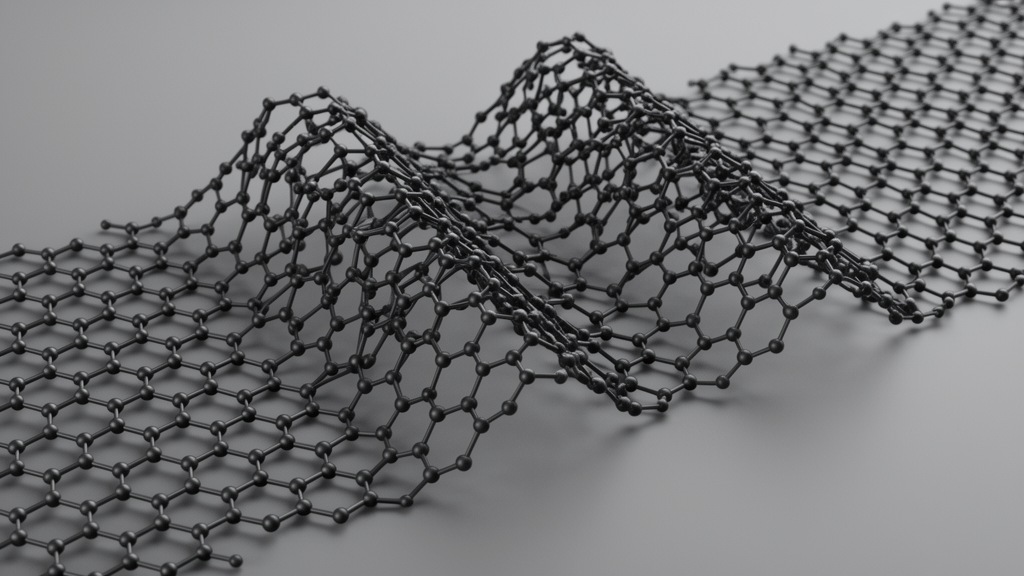
Graphene is famously strong in a single sheet, but turning that atomic strength into a usable film has long frustrated materials scientists. When individual sheets are stacked into macroscopic films, the interfaces between them become the weak link, and the material falls far short of the theoretical limits of the carbon lattice. Now a team led by researchers at Zhejiang University and Tsinghua University reports in Nature a way to overcome this bottleneck by giving each flake a folded, interlocking geometry before assembly. The resulting films combine a tensile strength of 2.9 gigapascals, a toughness of 84.5 megajoules per cubic metre and an elastic strain of 5 percent, a combination that outperforms conventional lamellar graphene films by a wide margin.
The central idea is deceptively simple. Instead of assembling flat graphene oxide sheets, the researchers first induced controlled folds on the surface of multilayer graphene oxide flakes, then stacked these folded units into a film. When the flakes are compressed during film formation, the folds on neighbouring sheets clasp onto one another, creating a lamellar architecture in which adjacent layers are mechanically engaged rather than merely stacked. The team calls this a fold-clasping lamellar structure, and it fundamentally changes how force travels through the material when it is stretched.
To make the folded flakes, the researchers modified the oxidation process used to prepare graphene oxide, carrying out reactions at reduced temperatures ranging from minus 5 to minus 25 degrees Celsius. Temperature proved to be a tuning knob for the fold geometry: colder reactions produced thicker flakes with denser and wider surface folds, which the team characterised in detail using atomic force microscopy. The folded flakes, which the researchers abbreviate SFGOs, retain the layered crystallinity of graphite while developing a heterogeneous core-shell character, with the folded surface regions differing in oxidation state from the flake interior, as revealed by Raman spectroscopy and aberration-corrected transmission electron microscopy.
Assembling these folded flakes into films was accomplished by blade coating, a scalable processing route that can produce sheets tens of centimetres across. During coating and subsequent drying, the surface folds of adjacent flakes interpenetrate and clasp, locking the lamellar stack together. Chemical reduction then removes most of the oxygen-containing groups, converting the folded graphene oxide film into a reduced graphene film with a high proportion of sp2-bonded carbon. X-ray diffraction and wide-angle X-ray scattering confirmed that the films are well aligned and densely packed, with the folded architecture preserved through processing.
The mechanical performance of the resulting films is the headline result. A tensile strength of 2.9 gigapascals places these films among the strongest macroscopic graphene assemblies reported, while the toughness of 84.5 megajoules per cubic metre indicates the material can absorb enormous amounts of energy before failing. Perhaps most striking is the elastic strain of 5 percent, meaning the film can stretch by that fraction and spring back without permanent deformation. For comparison, most lamellar graphene films fail at strains well below this level, and their stress-strain curves show early plastic yielding rather than clean elastic recovery.
The secret lies in how stress is transferred between layers. In a conventional stacked film, tension applied to one sheet is transmitted to its neighbours through shear at the interfaces, a mechanism described by the classical shear-lag model. That works well at low loads, but the interfaces eventually slip, and the film deforms permanently. In the fold-clasping architecture, the researchers identified a fundamentally different mode of force transfer. At small strains, the clasped folds are pulled against each other, but as deformation increases the force chains undergo a pull-to-push transition: the geometry of the interlocked folds converts the tensile loading into compressive contact between fold surfaces, which presses the layers together and increases frictional interlock rather than allowing slip.
The team formalised this insight as a shear-lock stress transfer strategy, supported by coarse-grained molecular dynamics simulations of a single folded sheet under tension. The simulations tracked three regimes during loading: an initial state, a maximum-stress state, and an interlock failure state. They showed that stress concentrates at the head-to-head and head-to-tail junctions of the folds, where the clasping geometry redistributes load and delays catastrophic failure. In-situ wide-angle X-ray scattering during tensile testing confirmed that the films recover their original layer orientation after unloading, direct evidence of the elastic reversibility that underpins the 5 percent elastic strain.
The concept of using topology and geometry to control mechanical behaviour draws on a growing body of work on knots, tangles and entangled structures, where the way elements wrap around each other determines how forces propagate. The Zhejiang and Tsinghua teams had previously shown that interlayer entanglement can strengthen nacre-inspired materials, and the new work extends that topological thinking to two-dimensional building blocks. Rather than changing the chemistry of the sheets or the bonding between them, the approach reshapes the building blocks themselves, treating each folded flake as a modular unit whose spatial conformation is designed before assembly.
This modular design principle is what distinguishes the work from earlier strategies that improved graphene films by refining stacking order, alignment or interfacial bonding. Those approaches, which include vacuum-assisted self-assembly, shear-flow alignment and intercalation-modulated plasticization, all operate on flat sheets and improve the interfaces between them. The fold-clasping strategy instead modifies the conformation of the individual units, adding a third design axis that had been exploited in other material classes but remained elusive for two-dimensional sheets. Because the folds are created during flake synthesis and preserved through scalable coating, the approach is compatible with large-area film production.
The practical implications reach into lightweight structural components, flexible electronics and any application where thin films must survive repeated mechanical loading. A film that is simultaneously strong, tough and elastically resilient can absorb impacts, tolerate bending cycles and carry sustained loads without accumulating damage. The researchers suggest that the fold-clasping principle should generalise to other two-dimensional materials beyond graphene, opening a route to a broader family of architectured films in which the geometry of the nanoscale building blocks is engineered as deliberately as their chemistry. As two-dimensional materials move from laboratory curiosities toward structural applications, controlling how they clasp together may prove as important as controlling how they are made.
Subject of Research: Fold-clasping lamellar architecture in graphene oxide films for superior mechanical performance
Article Title: Clasping folds enable superior elastic strength of graphene films
Article References: Wang, L., Liao, Y., Huang, J., Shen, C., Chen, L., Li, X., Ding, D., Zhang, M., Peng, L., Li, K., Li, P., Liu, Y., Xu, Z., Pang, K., Xu, Z., & Gao, C. (2026). Clasping folds enable superior elastic strength of graphene films. Nature, 658(8136), 643-649. https://doi.org/10.1038/s41586-026-11109-y
Image Credits: AI Generated
DOI: 10.1038/s41586-026-11109-y
Keywords: graphene, graphene oxide, mechanical properties, lamellar structures, toughness, elastic strain, fold-clasping, two-dimensional materials, molecular dynamics, nacre-inspired materials, stress transfer, structural films
Cite Scienmag News
Neil Sanderson. (October 15, 2026). Clasping folds give graphene films record strength and elasticity. Scienmag. https://scienmag.com/clasping-folds-give-graphene-films-record-strength-and-elasticity/
Neil Sanderson. "Clasping folds give graphene films record strength and elasticity." Scienmag, 15 October 2026, https://scienmag.com/clasping-folds-give-graphene-films-record-strength-and-elasticity/. Accessed 15 October 2026.
Neil Sanderson. "Clasping folds give graphene films record strength and elasticity." Scienmag. October 15, 2026. https://scienmag.com/clasping-folds-give-graphene-films-record-strength-and-elasticity/


